BOOK LIBRARY · Complete books · Purchases disabled
TrendWindow

← Book Library · Complete book

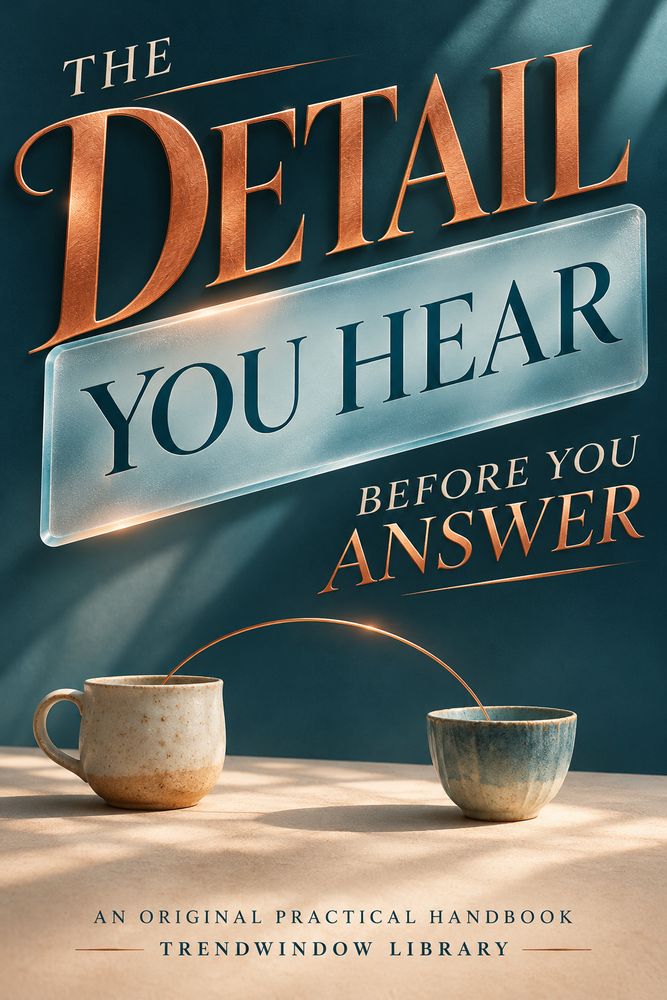
Front cover of The Detail You Hear Before You Answer

Personal Growth & Psychology

The Detail You Hear Before You Answer

By TrendWindow Library

A practical short handbook on everyday listening: check the detail, accept a correction and respond appropriately. Includes a complete fictional example and exercises.

Read this complete edition, including its ending and notes. No purchase is required.

Chapter 1 — Leave Room for the Unfinished Sentence

Mara had already found the answer to her sister’s problem. Hire a van. Ask two friends. Move the whole thing on Saturday. She was arranging the imaginary ropes when Leila said, ‘I don’t want to move it.’

They were talking about a tall display cabinet at their neighbourhood ceramics club. Leila had offered to help prepare a small exhibition. She had mentioned the cabinet because someone had put her name beside a delivery task, not because she wanted advice on transporting furniture.

‘I need to know who told them I could collect it,’ she said.

Mara’s useful answer had arrived at the wrong conversation.

This fictional example runs through the handbook. Neither sister nor the club is a research participant. The purpose is to practise receiving an account accurately before deciding how to respond. It is ordinary communication guidance, not counselling or a method for obtaining agreement.

Begin with a modest intention: let the other person finish one point. An unfinished sentence can contain a correction, a qualification or the part that matters most. You do not have to wait through an unlimited monologue. You do have to find out what you are answering.

If there is a real interruption coming, name it: ‘I have ten minutes before I leave. Shall we use them now, or talk later?’ A limited interval openly offered is more useful than apparently unlimited attention that disappears halfway through.

This is not a demand to empty your mind. Ideas and objections will occur. Notice one without treating it as the next line you must deliver. If a thought is essential, ask whether a brief note would help. Do not secretly turn someone’s account into a record they never agreed to make.

Mara puts her transport plan aside. ‘Start again with how your name got there,’ she says. Leila can now tell the part that the van would never solve.

Chapter 2 — Find the Detail That Changes the Meaning

Leila says the list was circulated on Monday. She saw it on Tuesday. Beside her name were the words ‘collect cabinet, Friday morning’. She had offered to label the pots on Saturday afternoon. Nobody had asked her about Friday.

A listener could miss this by remembering only ‘Leila is helping at the exhibition’. That summary is broadly true and practically misleading. It erases the difference between two jobs on two days.

Ask yourself which detail would make your proposed answer unsuitable if you got it wrong. Here it is the task and day. In another conversation it might be who received a message, whether a decision is final, or whether ‘next week’ means a deadline or a possible discussion.

Hold apart three things: what the speaker said; what you currently think it means; what remains unknown. These are working distinctions for this book, not a tested psychological scale.

Mara can hear the Monday list and Tuesday discovery as reported facts in Leila’s account. She can interpret Leila as annoyed. She does not yet know who entered the name. If she turns annoyance into ‘You hate helping’, or the unknown writer into ‘The organiser is taking advantage of you’, she has added claims that Leila did not make.

A useful question is narrow enough to answer: ‘Was Friday collection something you had discussed earlier?’ It checks a missing link. ‘Why does everyone always do this to you?’ imports both a pattern and an accusation.

Leila says she had never discussed collection. She has a Friday morning shift at work. Mara now understands why a plan for Saturday transport was beside the point. Listening has not revealed a hidden personality. It has recovered a day, a job and an unanswered question.

Try the same distinction with a short, non-private account from your own week. Write one thing actually stated, one interpretation and one missing detail. If you cannot separate them, that is a reason to check, not a reason to make your interpretation sound more confident.

Chapter 3 — Offer Your Understanding Back for Correction

Repeating every sentence can make a conversation feel like an exercise. A shorter check can be enough: ‘You offered Saturday labelling, but the list assigns you Friday collection. You want to find out how that happened.’

Then leave a real opening for correction. Do not end the sentence with a triumphant ‘Exactly!’ on the speaker’s behalf.

Leila corrects one part. ‘I want to tell them I can’t do Friday. I’d like to know what happened, but I don’t need an investigation.’

Mara’s first understanding was close, but not complete. She had made the explanation more important than the immediate correction. Leila needs the list changed before somebody waits for a cabinet that she will not collect.

Receiving that correction is part of listening. You do not need to defend the accuracy of your first attempt. ‘Right—the first thing is to correct the assignment,’ Mara says. The conversation moves forward instead of becoming a hearing about whether Mara was a good listener.

Use ordinary words that the other person recognises. ‘Your autonomy has been invalidated’ may be less helpful here than ‘They listed a job you didn’t offer.’ Do not label an emotion as though you can inspect it. ‘That sounds frustrating; is that how it feels?’ leaves more room than announcing exactly what someone must feel.

In research reported by Itzchakov and colleagues in 2018, listening affected speakers’ attitude clarity without increasing their sense that the attitude was correct. The distinction cautions against treating a clearer account as proof of its truth. The primary abstract, rather than the full paper, was consulted for this brief point.

Leila’s correction makes Mara’s understanding more precise. It does not establish who wrote the list or what they intended. Those questions still need evidence if anyone chooses to pursue them.

A successful check is not necessarily ‘yes’. Sometimes the most useful answer you receive is ‘not quite’.

Chapter 4 — Ask What Kind of Response Would Help

Once you understand the immediate issue, do not assume that your preferred kind of help is wanted. Someone may want a question answered, an account heard, a sentence checked or a decision made together.

Mara asks, ‘Would you like me to help write the message, or did you just want to tell me?’ Leila wants a second pair of eyes on a short correction. She does not want Mara to contact the club.

That last detail matters. Hearing about a problem does not transfer ownership of it. Do not send a message, recruit allies or share the story because you have decided that action will demonstrate care.

Leila writes: ‘I can label pots on Saturday afternoon, as offered. I’m not available to collect the cabinet on Friday morning. Please change the list and confirm who will collect it.’ Mara notices that the draft does not say where the cabinet is. She starts to ask, then stops. Its location is not needed for this correction. A question can be interesting to the listener and unnecessary to the speaker.

They keep the message short. Leila sends it herself. Mara does not add a paragraph about all the other times volunteers have been misunderstood.

There are situations in which a listener has a real role to act: a manager receiving a work instruction, for example, or a person explicitly accepting a practical task. Clarify that role instead of pretending that silence settles it. ‘Do you need a decision from me today?’ is different from ‘Shall I take over?’

If someone requests advice, offer it within what you know. You can say that a detail is missing or that you are not the right person to advise. An attentive hearing does not create expertise.

And if there is immediate danger or a serious matter outside ordinary conversation, this small exercise is not a substitute for appropriate practical or professional help. You do not have to remain in an unsafe exchange to prove that you can listen.

Chapter 5 — Disagree with the Account You Actually Heard

Listening does not require adopting every conclusion. It does require separating the conclusion you oppose from one you have invented.

After sending the message, Leila says, ‘People who run these clubs never read what volunteers offer.’ Mara knows one organiser who is careful. She is ready to list his virtues. Instead, she first checks the scope: ‘Do you mean this list, or all volunteer organisers?’

‘This list, really. I’m cross,’ Leila says. ‘But it happens a lot here.’

Mara can now answer the narrower claim: ‘This assignment doesn’t match your offer. I don’t know how often it happens at this club. I wouldn’t put that wider accusation in today’s message.’ Leila agrees about the message, though she still thinks the club is badly organised.

They do not need identical views to finish their conversation. Mara has not endorsed the general claim. Leila has not been forced to defend every organiser in the world before her actual scheduling problem can be heard.

A 2024 experimental paper by Itzchakov and colleagues reported reduced attitude polarization under its listening conditions. That finding is not a promise that a careful conversation will make another person agree. Only the primary abstract was used here; the cabinet example is independently invented.

Avoid using research as a weapon inside the conversation: ‘Science says you should be less defensive now.’ The speaker owes you no measurable improvement because you have attempted a listening technique.

You may also hear a claim that needs immediate factual correction. Be clear about it. ‘The list says Friday, not Thursday’ corrects a checkable detail. ‘You are unreasonable’ assesses a person and may obscure the correction. Where evidence is missing, say so. Understanding a claim and verifying it are related tasks, but they are not interchangeable.

Chapter 6 — Repair the Moment You Missed

Even with good intentions, you may lose a sentence. A notification appears. A word reminds you of your own story. You begin planning dinner and return to the conversation without its middle.

Do not fill the gap with confident agreement. Name the smallest honest repair: ‘I missed the part after you mentioned Tuesday. Could you repeat that?’ This gives the speaker somewhere specific to restart. ‘Sorry, I’m terrible at listening’ can turn their account into a request to reassure you.

Mara misses Leila’s next sentence because a kettle is boiling over. She turns off the heat, then asks for that sentence again. Leila had said that the organiser has replied, not that Friday collection is still unresolved.

The reply says the name was copied into the wrong row. The organiser has removed Leila from collection and confirmed her Saturday labelling. Another volunteer has accepted Friday collection. The organiser also apologises for the error.

This new information changes what needs doing. It does not prove that the club has no other organisational problems. It resolves this assignment. Had Mara continued with her prepared complaint, she would have been answering an earlier state of the conversation.

Attention can look different for different people. Do not demand continuous eye contact, a particular posture or repeated nods as proof. Ask about practical conditions: quieter space, a written version of a complicated date, a pause, or more time to formulate an answer. Check what works rather than imposing a performance.

A 2026 review by Itzchakov and Bodie emphasises that listening depends on context; no single visible behaviour is uniformly helpful. This book uses that limited caution, not the review’s sequence as an exercise programme.

If the conversation is too demanding for the available moment, agree how to return. ‘After supper, at the table, for ten minutes’ is an actual arrangement. ‘We should communicate better’ has no place or time to begin.

Chapter 7 — Finish with What Was Actually Settled

A useful ending does not have to be a perfect emotional resolution. It can identify what has changed, what remains uncertain and who, if anyone, will do something next.

Mara and Leila finish with three plain statements. The list now gives Leila the Saturday afternoon labelling she offered. Friday collection belongs to another volunteer who has accepted it. Leila does not want Mara to contact anyone about it.

They still differ about the club’s general organisation. They leave that difference intact. Leila has enough information for this exhibition. Mara has no task to carry out.

On Saturday, Leila goes to label the pots. The cabinet is already in place. She checks the corrected list, completes her offered work and goes home. This invented example has a practical ending; no future reply is being withheld to make the exercise seem complete.

For a conversation of your own, use a small listening record only when notes are appropriate and agreed. Five headings are enough: the point the person wanted to make; the detail I checked; the correction I received; the response requested; what was actually settled. Add ‘unknown’ where that is honest. The headings are an editorial tool, not a validated assessment.

Do not award yourself a score for nods, paraphrases or minutes spent silent. Ask a more useful question: did the other person have a fair chance to correct the account I was about to answer?

You can practise with a willing partner using a harmless everyday event. One person speaks, the other checks a consequential detail, and the speaker corrects anything missing. Swap roles. Stop if the exercise becomes uncomfortable or starts drawing out information someone did not intend to share. There is no need to record or retain it.

Mara’s first answer was a van. Her final contribution was much smaller: she heard Friday, understood Saturday, and stopped taking over. The improvement was not an impressive speech. It was an answer fitted to the conversation that was actually happening.

Research and Edition Notes

Research consulted 3 November 2026. The examples, dialogue, five-heading record and exercise sequence are original editorial material. They are not a trial, therapy or certified training programme. No guaranteed relationship, persuasion or mental-health outcome is claimed.

Itzchakov, DeMarree, Kluger and Turjeman-Levi (2018), The Listener Sets the Tone. Primary abstract consulted; full paper not reviewed for this handbook. https://pubmed.ncbi.nlm.nih.gov/29347879/

Itzchakov, Weinstein, Leary, Saluk and Amar (2024), Listening to understand. Primary abstract consulted; experimental findings are not universal promises. https://pubmed.ncbi.nlm.nih.gov/37917499/

Itzchakov and Bodie (2026), Puzzles of Interpersonal Listening. Review article: abstract and selected opening sections consulted, not an independently replicated experiment. https://compass.onlinelibrary.wiley.com/doi/10.1111/spc3.70145

This is a complete short digital handbook in seven chapters and one research unit; fixed reader units are not printed page counts. English original and five complete reading translations were prepared with AI assistance and checked for aligned meaning. No independent native-human certification is claimed. Front and back covers are original generated English designs; there is no ISBN or print-proof claim.

Explore more books →