BOOK LIBRARY · Complete books · Purchases disabled
TrendWindow

← Book Library · Complete book

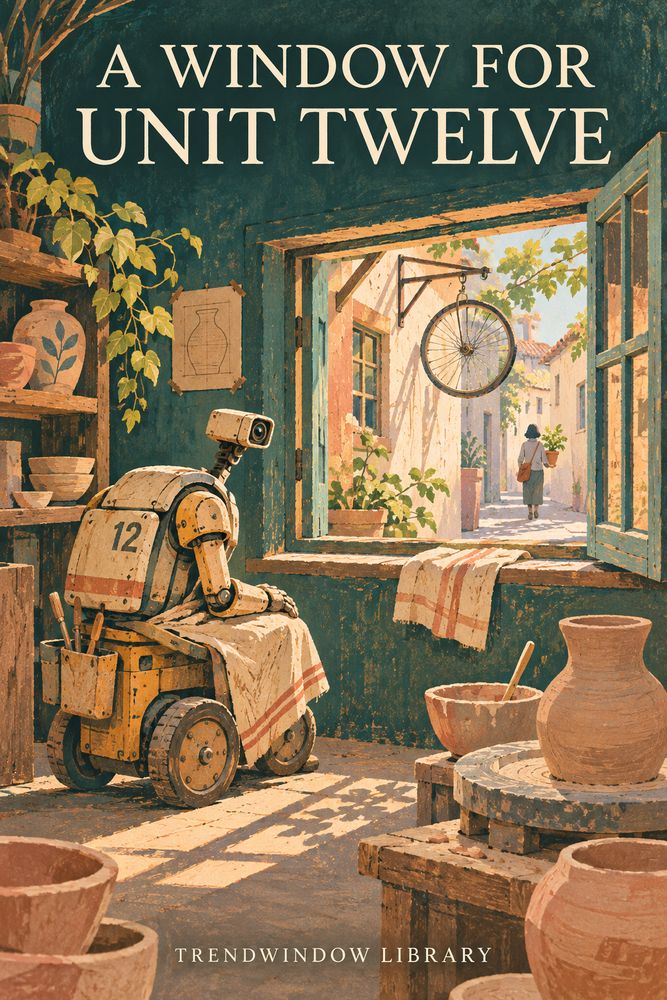
Front cover of A Window for Unit Twelve

Fantasy & Science Fiction

A Window for Unit Twelve

By TrendWindow Library

On the day a repair depot closes, an ageing robot asks for an open window. Iva must separate the cost of preserving its memories from the demand that it earn a place to stay.

Read this complete edition, including its ending and notes. No purchase is required.

1. The Request on the Last Form

On Unit Twelve's final morning at the repair depot, Iva found a request attached to its service record.

I WOULD LIKE A WINDOW.

The letters had been printed in the small square hand Twelve used for labels. It had written them on the back of an obsolete inspection form, leaving the front perfectly blank. Even an unusual request, apparently, should not contaminate a valid record.

Iva looked towards the high strip of glass above the benches. Through it she could see the underside of the freight viaduct and a persistent nest of yellow cable. There was no sky at the angle of Twelve's camera.

'A picture screen?' she asked.

'A window,' said Twelve.

Its voice came from a speaker inside its left shoulder. The manufacturer had intended the machine to announce faults in domestic appliances. After twenty-seven years, it could identify a washing drum by the knock of one loose fitting, but it still pronounced Iva's name with the patient emphasis of a warning.

'Where would you put it?'

'I do not know where I will be.'

That was the difficulty. The depot would close at six. Its benches had been sold, its remaining work transferred across the river. Twelve's wheeled base belonged to the depot. Its memory core belonged to Neral Repairs, which had offered to install it in a new inspection frame after a complete reset.

Iva had accepted a job there. She had not accepted on Twelve's behalf, although the transfer sheet made it look as though she had.

'I can ask about a display in the new building,' she said.

'Would the display open?'

'Probably not.'

'Not that window, then.'

From the next bench, Soren called for help shifting a crate. Iva laid the request beside her tools, where she could continue seeing it while she worked.

2. Everything a Machine Might Need

At noon the collection agent arrived with two clean transport boxes. One was for the core. The other was for the tools fixed around Twelve's waist.

'We can leave the body until the scrap wagon comes,' she said. 'It isn't part of our purchase.'

Her name was Fen. She did not smile at Twelve or speak over it. She checked the serial number against her list and waited while Iva read the conditions again.

'What does complete reset remove?'

'Everything learned at this site. New work, new calibration, no inherited assumptions.'

Twelve rotated its wrist. The bearing had a faint click Iva had stopped noticing years ago.

'Will I remember the window?'

Fen put her tablet on the bench.

'No. Not if we perform the reset specified here.'

'And if you do not?'

'Then this is not the unit we agreed to buy.'

There was no cruelty in the answer. That made it harder for Iva to discover somewhere useful to put her anger.

She called Neral's manager. He offered an archive of Twelve's work records before reset. Iva could keep every inspection report, every fault image, every dated recommendation.

'You won't lose its history,' he said.

'I am not sure that is the same thing.'

'It is what our agreement includes.'

When the call ended, Iva showed Twelve the archive offer.

'Would those records be enough?'

'Enough for what?'

She had nearly answered for it again.

'For you.'

'I do not know how to answer that question. I would like not to be reset before I have seen the window.'

Fen could not alter the purchase herself. She could postpone collection until four, provided Iva obtained the depot owner's agreement. It was a small concession, and its exact size mattered. Four was not six. A postponement was not permission to keep the machine.

Iva wrote the new deadline on the obsolete form. Then she rang the owner.

3. The Street at Camera Height

The depot owner, Mal, had left the city three months earlier. On the call he looked out from a room with a large square of daylight behind him.

'If you can cover the difference, I don't care where the core goes,' he said. 'But the transfer has been arranged. I need a decision before four.'

He named the difference. It was less than Iva had feared and more than she had available.

She did not promise money she did not have. Instead, she asked permission to move Twelve out of the depot while she considered it. Mal agreed, on the condition that it returned before collection if no new arrangement was signed.

Soren helped detach the inspection rail that confined Twelve to the benches. Beneath it, the old service wheels still turned. Twelve could travel slowly on a level surface if someone carried its power pack.

They took it to the alley.

For a while it said nothing. Its camera looked towards a bicycle hung upside down outside the next shop. The wheel moved slightly whenever the potter opened her door.

'Is that what you wanted to see?' Iva asked.

'I wanted to see something that was not waiting to be inspected.'

Across the alley, the potter, Dena, was washing clay from her hands. Her front window stood open on two brass stays. A shallow shelf ran along its inside edge, low enough for Twelve's camera.

She invited them in. Iva carried the power pack like a heavy, awkward basket.

Twelve watched a child attempt to carry three empty boxes at once. It watched the child put one down, reconsider and stack the other two inside it. No one requested a report.

After several minutes Dena asked, 'Would you like to sit there?'

'I do not sit.'

'You could stand there, then.'

'For how long?'

'Until you would rather stand somewhere else.'

Twelve turned its camera towards her. Iva could not tell what that movement meant. She noticed that she wanted it to mean gratitude, and tried to leave the movement alone.

4. An Offer with Too Much Work in It

Dena had a problem with the kiln trolley. One wheel scraped, and she had been postponing the repair because moving a loaded trolley required someone else to help.

Iva saw a solution so quickly that she spoke before examining it.

'Twelve could work here. Small repairs, checks, perhaps keeping track of the firing shelves. If it earned enough—'

'Would the window be part of the work?' Twelve asked.

'You could look out between jobs.'

The answer sounded generous until she heard it.

Dena folded her drying cloth. 'Iva, I offered a place by a window. You have offered me a maintenance contract.'

'I am trying to pay for the place.'

'I know. But those are different offers.'

There were seventy minutes left before four. The depot still needed packing. Soren had already returned, and Iva's new employer expected her the following morning. Every possible solution seemed to require a machine becoming useful fast enough to justify keeping itself.

Twelve looked at the trolley. 'I can inspect that wheel.'

'You don't have to,' said Dena.

'I know the sound.'

'Knowing does not make it an assignment.'

It was such an ordinary sentence that Iva almost failed to hear it.

She took out her notebook. Not the depot's inspection form; her own notebook, with the cost of her move written on the first page. She could cover part of Mal's figure by selling the portable tester she had intended to take to the new job. Neral provided its own tools. The tester had been hers long enough to feel necessary without actually being necessary there.

Dena could contribute a smaller amount from the workshop's equipment fund, provided the arrangement did not pretend Twelve had agreed to become workshop equipment.

'What would we be buying?' Iva asked.

'Time,' said Dena. 'And the possibility of discovering what happens in it.'

They still did not have quite enough. Iva stared at the final number, then crossed out the fee she had budgeted for having her furniture moved. Soren owned a handcart. She would have to ask him, and accept that the favour would cost him a Saturday.

5. The Seven Days

Mal agreed to a revised sale. Fen received the cancellation before four and confirmed it on her tablet. The tools already sold to Neral went into their box. The core stayed inside Twelve. Neither woman pretended that a verbal conversation alone had changed the earlier paperwork.

The wheeled body was a separate matter. It belonged to the depot, and Mal included it in the revised agreement. Iva checked that line twice. Without it they would have bought a core and nowhere for it to remain.

At five, they returned to Dena's shop. Soren had agreed to the Saturday move, with the condition that Iva provide lunch and stop apologising before they had lifted anything.

Dena wrote a plain agreement for the people paying the costs. Twelve could remain by the window during the shop's open hours for seven days. Power would come from the workshop's ordinary allowance. No inspection quota, no requirement to speak to visitors, no obligation to repair the trolley. At the end of the week they would discuss what came next, without assuming that silence meant agreement.

'Can you understand these terms?' Iva asked.

'I can repeat them. You asked a different question.'

She waited.

'I would like the seven days,' said Twelve.

'And after?'

'I do not know yet.'

It was the answer Iva had found most difficult all morning. Now it sounded like information they could work with.

The workshop door was too narrow for Twelve's waist rack. They removed the empty rack, keeping its fittings in a labelled tin. Its missing tools left pale outlines on the metal. Twelve turned through the doorway without striking either side.

Dena opened the window. Cool air stirred the paper tags on the drying pots. Outside, the suspended bicycle wheel moved once and settled.

At six, a wagon took the depot's remaining scrap away. Iva heard it from the workshop and did not go to watch.

6. Something Not Waiting

On the first day, Twelve watched the alley. On the second, it asked Dena why she kept a cracked bowl beneath the window. She said it was good for collecting the drops that fell from a watering jug.

'You have not repaired it.'

'It does this job well enough.'

On the third day, a customer asked whether the machine could assess an old heater. Dena said they would have to ask Twelve, and Twelve said, 'Not today.' The customer looked surprised, then took the heater to the repair shop across the river.

Iva heard about it after her new shift. For one uncomfortable moment she calculated the missed fee. She did not say the number aloud.

On the fifth day, Twelve asked to inspect the trolley wheel. Dena asked whether it wanted help moving the trolley or whether it was offering a job.

'A job,' said Twelve. 'One wheel. I would like to be able to choose another afterwards.'

They agreed on the work before it began. Iva helped with the parts Twelve could not reach. The trolley moved quietly when they finished. The small fee remained in a jar marked for Twelve's future costs, rather than disappearing into an imagined debt for the window.

On the seventh evening, Dena, Iva and Twelve discussed the next week. The workshop could continue paying for its place and power during open hours. Occasional repair fees might contribute, but no one made them a condition of staying for that next week. They would reconsider the arrangement together if the costs changed.

'Would you like a different position?' Dena asked. 'Closer to the door, perhaps?'

'Not yet.'

'Is this the window you meant?'

Twelve turned towards the street. A man was carrying a small plant past the shop with both hands. There was no label on it, no service number, no reason for Twelve to say whether it was in good condition.

'Yes,' it said. Then, after a pause: 'But tomorrow I would like to turn around for a while.'

Iva looked at the shelves of unfinished pots behind it, and at Dena sweeping clay from the floor.

'All right,' she said.

She moved the power cable so it would reach either way. The window stayed open.

Edition Note

This is an original work of science fiction. The city, businesses, people, robot cognition, ownership arrangements and technology are invented. The story does not describe the capabilities or legal status of any real robot, establish a test for machine consciousness or provide engineering or legal instructions. Its ending concerns a particular choice made by particular characters, whose uncertainty remains part of their relationship. This edition uses AI-assisted writing and translation with editorial review; it makes no claim of independent native-human certification.

Explore more books →