BOOK PREVIEWS · First five content pages · Purchases not yet available
TrendWindow

← Book Library · Five-page preview

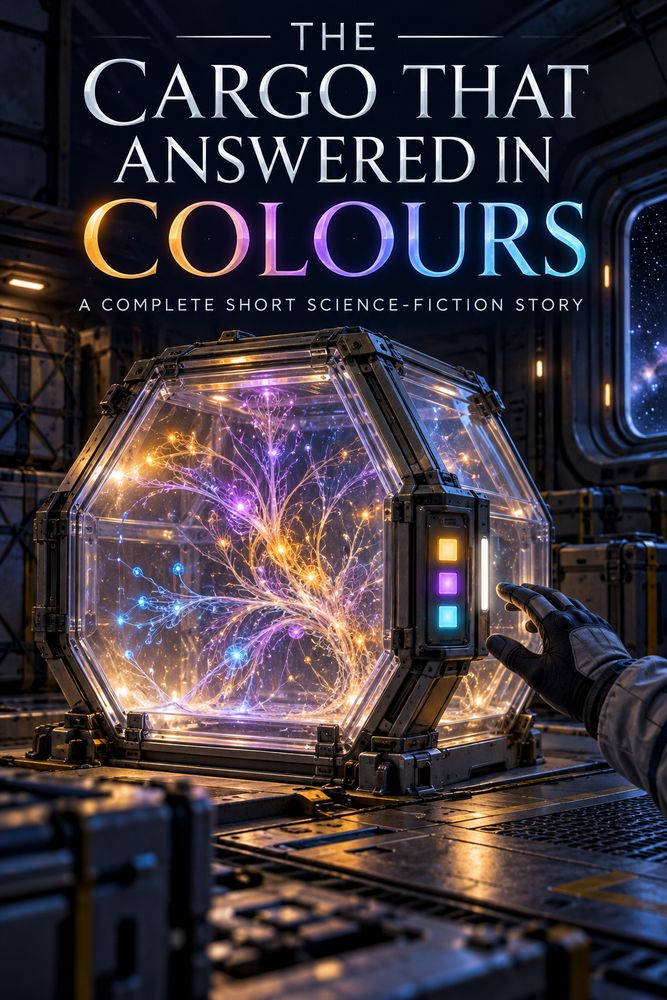
Front cover of The Cargo That Answered in Colours

Fantasy & Science Fiction

The Cargo That Answered in Colours

By TrendWindow Library

A complete short first-contact story: cargo listed as dry glass answers in colours. Sela and a small freighter crew must protect an unknown system without pretending they understand its language.

First five fixed content pages only. Full-book access and purchases are not available.

1. Item Forty-Seven

The cargo list called it dry glass. Sela found that unhelpful even before the glass began to answer her.

It occupied the last cradle in the freighter's hold: a hexagonal case taller than her waist, its clear panels crossed by fine dark threads. The retrieval drone had brought it from the wreck of an unmanned carrier. No destination survived on its outer label. Their job was to take it to Kestrel Depot, where someone would decide whether it was useful or rubbish.

Sela checked the number on her tablet. Forty-seven. Dry glass. No active contents declared.

She moved her inspection lamp. A band of amber passed through the threads.

She held the lamp still. The band stopped.

"Tern?"

The engineer answered from beneath a storage rack. "If it's the loose strap, I've heard it. I'm developing a relationship with it."

"It's the glass."

He slid out far enough to look.

A violet line travelled up the inner panel. Beside Sela's hand, three small squares on the case's control strip glowed amber, violet and pale blue. They had been dark when the drone secured it.

Tern sat up. He didn't touch the strip.

"Did you activate anything?"

"Only my lamp."

The violet line returned, followed by two shorter ones.

Sela moved back beyond the painted hold boundary. Tern closed the clear divider between the cradle and the working aisle. Neither of them opened the case.

On her tablet, the description remained dry glass, as confidently as if confidence were a sensor.

2. A Hold Is Not a Laboratory

Captain Varo arrived with his coat half-fastened. He had been trying to eat a bowl of noodles before the ship's next routing change.

"What has it done?"

"Lit up," Sela said. "Possibly in response to my lamp."

"Possibly?"

"I haven't made that a fact yet."

He looked pleased by the distinction and unhappy about everything else.

Their little ship, the Dovetail, carried no laboratory and no specialist in unfamiliar living things. It had a sealed recovery cradle, a remote handling arm and a transport rule Varo had once made Sela recite: when a description fails, stop treating it as a description.

He suspended Item Forty-Seven's ordinary unloading instruction. Tern isolated the cradle's service controls from the rest of the hold. They could still observe through the divider and operate the cradle remotely. The case itself stayed sealed.

Sela recorded the colours and times without calling them a language.

At Kestrel, intake controller Iven received their report. He had less than an hour before the Dovetail's assigned dock slot, but the unknown case could not enter the dry-material line as planned.

"Keep it out of the standard conveyor," he said. "I'm requesting a separate receiving bay. Send me the record, not just the word alive."

Sela sent the record. Then she deleted alive from the note she had begun writing and replaced it with observed activity.

The amber threads brightened when the service rail made a soft clicking sound. They faded when it stopped.

Tern watched the trace.

"That's not your lamp."

"No," she said. "That's something else I don't understand."

3. The Wrong Kind of Warmth

The ordinary cradle programme still held the case at the dry-cargo setting. Tern had stopped new instructions from reaching it, but the last instruction was already running.

The strip on the case shifted from violet to white. Inside, the threads drew tight around six small cloudy knots. One of the knots went dark.

Sela looked from the case to the display. The dry cycle had moved into its warming phase.

"Tern. That happened together."

He checked the record, then moved the cradle out of the dry cycle and into a hold state. He did not open a vent or guess at a new atmosphere. The ship's cradle could stop the cycle without opening the recovered container.

The white colour loosened into violet again. The dark knot remained dark.

Varo asked whether they had damaged it.

"I don't know," Tern said. "I know we were doing something to it because the list said it was glass."

Sela replayed the two minutes before the change. The service rail had clicked in the same rhythm as the case's outer strip. Something on the old carrier had once supplied more than warmth. The Dovetail had treated an unfamiliar service connection as a handle for its own standard routine.

"That's in the report," Varo said.

Nobody argued. There was no value in arriving with a tidy account and a dead thing nobody had admitted was there.

Sela moved her lamp away. In the quieter light, five of the six knots pulsed faintly. The sixth did not.

She could not tell whether it was injured, empty or asleep. She refused to choose the kindest word merely because she wanted it.

4. Three Squares

Kestrel's separate bay would be available after another ship finished its isolation check. Iven gave them a later slot. Varo accepted it and transmitted the delay to their contractor.

The contractor asked whether the unidentified material could be left in an outside rack. Varo answered no. He did not ask Sela to describe that answer as a mechanical fault.

Meanwhile Tern found an old service diagram etched into the case’s base. It showed three field connections feeding the case. Two were inactive. The third had been trying to answer the Dovetail's dry cycle with a resistance the ordinary programme had ignored.

These were devices Tern knew how to measure, though not devices he understood completely. He used a detached monitoring unit rather than reconnecting them to the ship's routine.

When the unit offered a brief low-power field, the amber threads gathered toward the nearest clear panel. When the offer stopped, the threads spread back.

"It may just be a mechanism," Varo said.

"It may," Sela answered.

She watched for another change. On the outer strip, the pale-blue square lit before the amber square. After a pause, violet followed.

The same sequence appeared inside the case.

Tern wrote the sequence on the board. Sela copied it without adding an arrow labelled yes.

"Could you repeat the monitoring offer?" she asked.

He repeated only the measured setting. The sequence came back.

Then the thin threads formed a loop around one cloudy knot and held it for several seconds. It was not a face. Sela was glad of that. A face would have tempted her to invent an expression.

5. A Reply Is Not a Translation

They made a record of what changed and what did not. Tern varied the timing within the monitoring unit's narrow tested range. Sometimes they offered nothing. Sometimes the unit repeated a previous interval.

The case did not simply repeat every flash. Its blue-amber-violet sequence followed one particular service offer. Another sequence appeared when the supply faded. During the gaps, the threads rearranged around the knots.

Sela could not prove intention from the pattern. She could show Iven that the activity was contingent, consistent and more complicated than a fault lamp.

Iven sent their record onward to the depot's containment staff. They asked them to preserve the case's internal conditions and avoid further improvised trials. Tern stopped varying the setting and kept the last stable one while they planned the transfer.

Varo came to the divider with fresh noodles, now cold.

"What do you think it's asking?"

"I think the change in supply matters," Sela said. "I don't know whether it has asked us anything."

"And what do you want it to be asking?"

She looked at the cloudy knots.

"For help. That's why I don't trust the first answer I think of."

He ate a mouthful without looking away from the case.

The pale-blue square glowed. Amber followed. Violet.

Sela wrote the time. Under interpretation she left a space.

Explore more book previews →