BOOK LIBRARY · Complete books · Purchases disabled
TrendWindow

← Book Library · Complete book

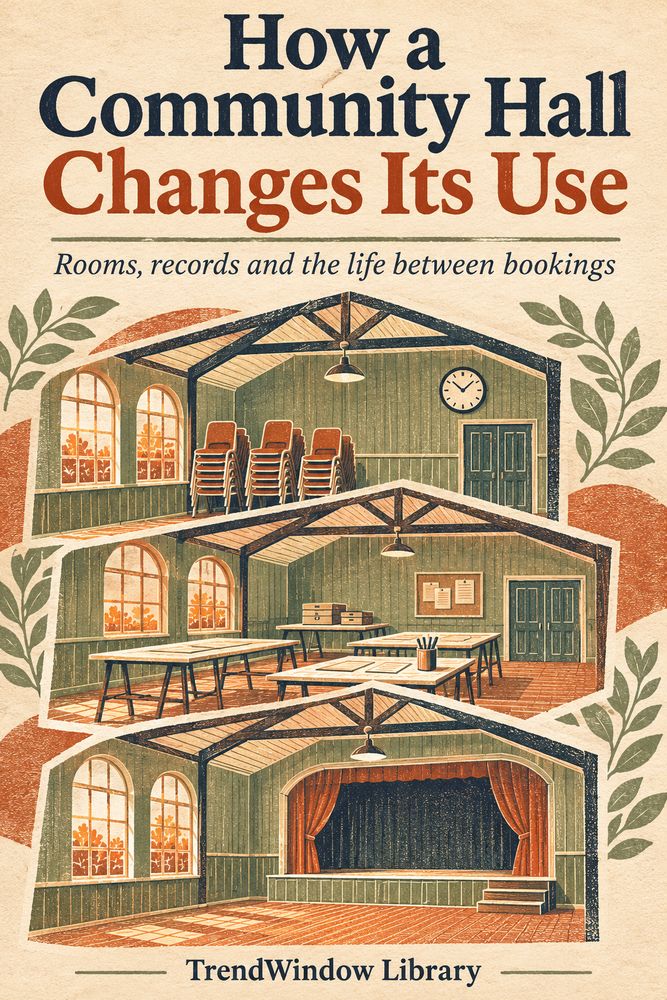
Front cover of How a Community Hall Changes Its Use

History & Culture

How a Community Hall Changes Its Use

By TrendWindow Library

A complete short cultural-history guide in eight chapters. Selective English examples and clearly invented exercises explore shared halls, changing timetables, hidden work and the limits of diaries, programmes and photographs.

Read this complete edition, including its ending and notes. No purchase is required.

About this study

A complete short cultural-history guide in eight chapters. The real examples are selective and concern England; they do not stand for every country's shared buildings. Research was checked on 16 November 2026. All references to Alder Hall, its people, dates, bookings and paperwork are invented teaching examples. They are not newly discovered archives. The distinctions and suggested questions are the author's analysis, not findings from a survey. No visit, interview, building inspection or legal assessment is claimed.

© 2026 TrendWindow Library. Original AI-assisted study and translations, reviewed by an AI assistant. No independent human-editor or native-speaker certification is claimed.

1. One hall, several kinds of change

Imagine arriving at Alder Hall on three different days. On Monday, chairs face a small stage. On Wednesday, tables divide the same floor into workspaces. On Saturday, almost everything has been pushed against the walls. A photograph of each arrangement could make the hall look like three different institutions. Yet the key holder, address and room might be unchanged. The first question is therefore not simply what the building became. It is how long a particular arrangement lasted, and what happened alongside it.

In this invented example, Monday belongs to a choir, Wednesday to a repair group and Saturday to a dance. These activities overlap in the life of the building without occupying it simultaneously. Calling the hall a former concert venue would imply a replacement that has not occurred. Calling it a dance hall would give one evening the authority to describe the entire week. A useful account names its period: a shared hall with three recurring uses during the months covered by the surviving timetable.

There are several different changes to distinguish. An activity can be added to a continuing programme. One group can replace another in the same slot. A temporary occupation can interrupt ordinary bookings. An old building can acquire an entirely different institutional purpose. Ownership, management, the name above the door and the work inside need not change together. Treating these as separate questions makes an apparently untidy history easier to follow.

Give the inquiry a manageable scale. Instead of attempting a complete history immediately, ask how Wednesday afternoons changed over a particular five-year period. You can widen the account when the records justify it. A narrow question is not a claim that other days did not matter. It is a way to keep the answer attached to evidence rather than to a fond impression of a busy room.

2. What the room was offered for

Worcestershire's archive service identifies Lindridge Parish Hall as a reading room opened in 1906. It also records Overbury's use by Bank of England staff in 1940–1942. These are specific institutional histories, not stages every hall passed through. Source: [Village Halls](https://www.explorethepast.co.uk/2019/05/village-halls/), Worcestershire Archive & Archaeology Service, 23 May 2019.

A founding purpose gives a starting point, but it does not fill every later evening. For the imaginary Alder Hall, suppose an opening leaflet advertises reading, lectures and recreation. That document shows how organisers presented the new place. It does not establish that all three activities began promptly, occurred equally often or attracted the people the organisers hoped to reach. A room can be offered for an ambitious programme while its early use remains modest.

The words deserve attention before they become labels in a history. Recreation might include several activities, or might conceal a disagreement over which activities were suitable. A historian should preserve the leaflet's wording in notes and then search for more particular evidence. The name of a group, a charge for a session or a dated programme may narrow the possibilities. Do not silently translate a broad historical term into a modern service that the document never mentions.

Now imagine that an anniversary account calls Alder Hall a place open to everyone from the beginning. Keep that claim beside the original leaflet rather than allowing the later sentence to replace it. Ask who wrote each account, who was expected to read it and what occasion prompted it. A celebratory history might accurately describe an aspiration while leaving the practical conditions of entry unexplained.

The point is not to treat celebration as deception. It is to avoid making a single document answer a question it was not designed to answer. You can write that organisers advertised a shared reading and meeting space, while adding that the surviving material has not yet established who actually used it. That sentence is less sweeping and more informative.

3. Reading a week instead of a birthday

A building's opening date is easy to place on a timeline. Its ordinary working week demands a different arrangement of evidence. For Alder Hall, draw a simple grid with days down one side and time slots across the top. Enter only the bookings the invented records support. Leave a blank where information is missing. Do not colour an empty box as unused unless a source specifically establishes that the room was available and unoccupied.

Suppose an entry made in January books twelve Wednesday repair sessions over the following quarter. A receipt records payment for ten. A committee note mentions two cancellations because the organiser was unavailable. Together these records support a better account than any one does alone. Even then, they establish scheduled sessions, a payment and reported cancellations. They do not by themselves establish how many people attended, what was repaired or whether participants found the meetings useful.

Counts should keep their units. Ten sessions are not ten people. Thirty names on a membership list are not thirty attendances at every session. One person who comes six times contributes six visits but remains one participant. If different records count different things, retain the distinction rather than adding the numbers to produce an impressive total. Where a comparison cannot be made fairly, explain why.

A week also changes with a season. The imaginary choir may rehearse more often before its annual concert; the dance may pause during a school examination period. Sampling only the busiest month could turn an exceptional schedule into a supposed norm. Compare similar periods where possible and say which weeks survive. If only a winter diary exists, write a winter history rather than guessing a summer one.

This method does not require a crowded statistical display. A paragraph can report that the available diary schedules a weekly activity, two entries were cancelled and attendance is unrecorded. The reader then knows both what changed and the limits of the count. The blank spaces remain questions for further research, rather than becoming invented facts.

4. The missing work between bookings

The timetable leaves the hall empty between Wednesday afternoon and Thursday morning. In our invented dossier, however, a caretaker's note records moving tables, drying the floor and waiting for a missing key. These tasks explain how one booking could follow another. The absence of a public event is not necessarily the absence of work.

Look for the practical joins between uses. Where did a choir store its music while another group needed the cupboards? Who returned chairs to the agreed positions? Was a booking cancelled because the room was unavailable, because equipment failed or because nobody could open it? These are research questions, not assumptions that every hall had the same difficulties. An invoice may document a purchase without identifying who carried it inside; a volunteer rota may identify an assigned role without showing whether the person could attend.

Suppose Alder Hall's committee thanked six volunteers after a large supper. The minutes provide evidence of that recorded acknowledgement. They do not prove that only six people worked, or that everyone who worked wished to be named. Conversely, the omission of a name alone cannot establish deliberate exclusion. A fair account preserves both possibilities until other evidence helps distinguish them.

Participation also includes different positions in the room. A person serving food, a person performing and a person buying a ticket may have experienced the same evening very differently. Collecting their accounts would require consent and care, but this book has not conducted such interviews. Where only committee papers survive, say that the story is largely told through the committee's records. Do not write conversations for absent participants to make the history feel complete.

A change of use can therefore be a change of labour as well as a change of activity. A new weekly booking may appear as one added line in a diary but require extra cleaning, storage or unlocking. When evidence permits, describing those arrangements makes the hall's continued operation understandable without turning its workers into anonymous background furniture.

5. When an emergency changes the timetable

The brief Overbury example in chapter two marks a dated wartime occupation. Its value here is not that it explains every wartime hall, but that it warns against treating an interrupted programme as permanent abandonment. A local account needs evidence for the start of an interruption, its practical effects and what followed. Those are three separate questions.

Return to the entirely imaginary Alder Hall. A notice in this teaching dossier suspends ordinary bookings for six weeks while a nearby building is unusable. A later letter asks to extend that arrangement. A third document records the return of the key. It would be a mistake to use the original six-week proposal as the actual duration without checking the later papers. A plan, an extension request and a completed handover belong at different points in the chronology.

The word closed also needs an object. Closed to dances may coexist with daily work inside the hall. Closed to the public may not mean empty. Conversely, a committee continuing to meet elsewhere does not prove the building itself remained open. Write the actual relationship: which activity stopped, where people went if known and which use continued. Keep the address of the institution distinct from the location of its activities.

Resumption is not always a return to the previous timetable. In the hypothetical example, the choir and the Saturday dance come back, but Wednesday repair sessions move to another room and do not return during the period documented. That is an uneven recovery, not a clean pause in an otherwise unchanged story. The event may also have generated new storage, cleaning or scheduling arrangements that outlasted the temporary occupation.

A careful account can acknowledge urgency without inventing heroism or unanimous agreement. If letters show disagreement, describe the recorded disagreement with its date and context. If they do not, resist supplying a dramatic conflict. An emergency is already consequential; it does not need imagined voices to make its effects on a shared room worth explaining.

6. A building altered, a use retained

Historic England records that Harlow's Moot House, formerly a vicarage, opened as a community centre in 1952. Source: [A Brief History of Community Centres in England](https://heritagecalling.com/2022/12/08/a-brief-history-of-community-centres-in-england/), 8 December 2022.

That short example concerns a change of institutional use. It should not be confused with every alteration made to a hall that continues its previous role. In the invented Alder dossier, a kitchen extension allows two groups to prepare refreshments without using the main room. The hall remains a shared meeting place. Yet the extension could change which combinations of activities are practical, who does preparation and how early a group needs access.

A drawing of the proposed kitchen establishes a design at a particular stage. A dated photograph may show that a structure existed later. An invoice can establish a billed item or service. None automatically supplies all the dates of approval, construction, payment and first use. Keep separate columns if necessary. Otherwise a perfectly real drawing can be made to carry an opening date that it never recorded.

Avoid diagnosing the fabric from a photograph. A dark patch is not enough to establish damp, and a new doorway is not enough to establish that everyone could enter comfortably. A history can describe a documented alteration and its stated intention without claiming a professional inspection. Current access arrangements require current information from the responsible organisation; an old plan is not a promise about a visitor's experience today.

Equally, do not assume that keeping a facade preserves every social function. If all former groups move elsewhere while the building gains a new purpose, physical continuity and continuity of use tell different stories. If a group retains its weekly slot after major rebuilding, the reverse distinction may matter. Describe the relationship you can support rather than choosing between a story of total loss and one of uninterrupted survival.

At the end of this stage, the timeline should show changes to the room alongside changes to its programme. Sometimes the two will coincide. Sometimes they will not. That difference is a finding worth keeping.

7. What a programme and a photograph leave open

Toynbee Hall's archive index lists a Bengali song-contest award photograph and an opera-club programme for Orpheus. The individual items were not accessible during this research; the index alone was read. Source: [Toynbee Hall Archive](https://explore.toynbeehall.org.uk/explore/).

The difference between finding an entry and examining an item matters. An index title can establish how a collection describes an object. It cannot justify a detailed account of the clothing, audience, performance or mood if those features have not been seen or otherwise documented. The relevant next step would be to inspect the item through the archive's available arrangements, not to fill its absence with a convincing scene.

Even an accessible programme is not a transparent account of an evening. In an invented Alder Hall programme, four performers are listed for a concert. That shows an announced arrangement. A cancellation note, recording or later report might help establish what occurred. Without such evidence, write that four performers were listed, rather than that all four performed. A programme can be valuable without proving more than it contains.

Photographs introduce different questions. If an imaginary photograph shows occupied chairs, the visible people belong to a particular frame and moment. The image does not establish everyone present in the building, the number who stayed throughout or the number unable to attend. A cropped copy may hide information available in a fuller version. Note the version examined, any caption and whether the date is recorded or merely estimated.

Nor does a change in the recorded language of publicity automatically explain a change in the audience. It may reflect organisers, translators, the intended readership or a different way of preserving materials. These are possible lines of inquiry. They should not be converted into conclusions about ethnicity, class, age or belonging from names and appearances alone.

The best account may bring several kinds of object together while allowing each to remain incomplete. A programme describes an offer; a photograph preserves a view; a personal recollection gives someone's account. Their differences are useful evidence, not defects that require a single tidy story.
8. Writing a history that can be corrected

ACRE's 2021 village-hall recording project received details of over 800 rural community buildings. Source: [Village Halls Domesday Book 2021](https://acre.org.uk/village-halls-domesday-book-2021/). A contribution to such a project should not be mistaken for a complete census of participation.

Our invented Alder Hall exercise can now be brought to an ending. We began with three arrangements of one room. We separated scheduled activity from attendance, identified work between bookings, followed a temporary interruption and distinguished a physical extension from a change of institutional purpose. We also left questions unanswered. The work has produced a bounded account of change, not a certificate that the community has been fully represented.

Write the account in an order a reader can test. Start with the period and question. Explain which records were examined and which were unavailable. Present the changes that those records establish. Then discuss interpretation using language that reveals its status: suggests, may explain or remains uncertain where appropriate. Do not weaken a well-supported date unnecessarily, but do not make a possibility definite merely because it supplies a satisfying ending.

For the hypothetical hall, a concluding paragraph might say that three recurring uses shared the room in the available winter schedule; a later temporary occupation displaced ordinary bookings; two activities are documented after reopening; and a kitchen extension changed the arrangements for refreshments. Attendance and the experiences of several working groups remain unknown. Each statement can be tied to a particular item in the invented dossier. In a real study, each would need an actual reference.

Keep a short record of corrections as the history develops. Preserve the earlier wording with a date rather than silently concealing a changed interpretation. A new diary might alter the timetable; a participant might identify an overlooked role; another version of a photograph might change a caption. Revision is part of making an account trustworthy, not an embarrassment to be avoided.

A hall changes through the uses people arrange and through the work that makes those uses possible. Its history becomes clearer when we name those arrangements precisely and leave room for evidence that has not yet been found. The next reader should be able to see where the account ends, and where another inquiry can begin.

Explore more books →