BOOK LIBRARY · Complete books · Purchases disabled
TrendWindow

← Book Library · Complete book

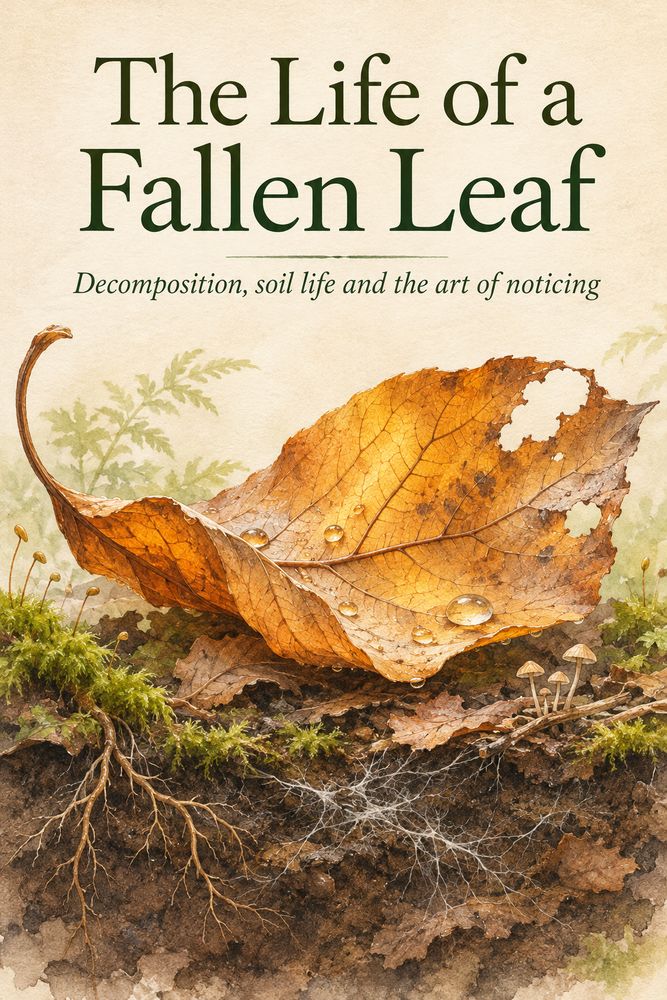
Front cover of The Life of a Fallen Leaf

Science, Technology & Nature

The Life of a Fallen Leaf

By TrendWindow Library

A folded leaf beside a garden wall opens eight chapters about decomposition, soil organisms and the limits of observation. A clearly fictional notebook connects scientific explanations with careful questions: a missing leaf is not necessarily a decomposed one, and a photograph is not a carbon measurement.

Read this complete edition, including its ending and notes. No purchase is required.

About this book

A short nature book about decomposition, soil organisms and attentive observation. The garden and notebook used throughout are invented teaching examples, not fieldwork results. Scientific explanations draw on the linked institutional sources, checked on 10 November 2026, Asia/Dhaka. “Life” in the title means the leaf's changing relationships after it falls, not consciousness or continued life as an intact green leaf. The original cover illustrations are conceptual.

Original complete short nature essay prepared with AI assistance. Garden visits and notebook entries are invented teaching examples, not fieldwork data. Scientific explanations cite institutional sources. Conceptual covers are not species identifications or microscopy. Translation meaning reviewed with AI, without independent native-language certification.

1. Before the landing

Imagine a leaf caught in the shallow corner between a garden path and a low wall. Its broad surface has folded along a vein. One edge is torn. There is enough of its shape left to recognise a leaf, but not enough information here to name its species confidently. This imagined leaf will be our starting point.

Before it reached the ground, its material was part of a growing plant. NRCS explains that plants use sunlight to make carbohydrates from carbon dioxide and water; those compounds help build leaves and other tissues. [Source: Soil Health Management](https://www.nrcs.usda.gov/conservation-basics/soil/soil-health/soil-health-management).

That fact changes the scale of the small object at our feet. We tend to think of a leaf as something a tree produced from the ground. Its story also involves the air and the energy of sunlight. The ground will matter enormously to what happens next, but it is not the only place the story comes from.

Falling itself has different contexts. In its account of autumn, the National Park Service describes a weakening connection at the leaf stem that allows wind or gravity to bring a leaf down. [Source: seasonal tree changes](https://www.nps.gov/articles/how-do-trees-change-in-the-fall.htm). That example concerns seasonal leaf fall; it does not establish why our unidentified leaf fell. We have not observed its departure.

Write the first notebook sentence accordingly: “A fallen leaf beside the wall.” Leave the cause open. A small accurate beginning gives us somewhere firm to stand before we follow the changes that are harder to see.

2. The place it comes to rest

The wall in our invented garden casts shade across one end of the path. A second leaf lies farther out, where the paving is exposed. After an imagined shower, water remains in the sheltered corner while the outer paving begins to dry. Already, “on the ground” has become two different situations.

Leaf litter is also habitat. The National Park Service describes leaves and associated plant material as shelter for overwintering insects, including some butterflies and moths. [Source: Leave the Leaves](https://www.nps.gov/articles/000/idkt_leave-the-leaves.htm). This does not mean a particular insect must be inside every leaf, or that the same seasonal pattern applies everywhere.

A leaf can therefore be both material undergoing change and part of the surroundings in which another organism lives. The two roles need not wait for each other. It need not become unrecognisable before it can contribute to a sheltered space.

Now imagine the wind moving the path leaf into the corner. Our tidy comparison has changed. If we return later and find only one visible leaf, we cannot immediately announce that the other decomposed. It may have moved, become covered or been removed. A missing object and a decomposed object are different observations.

The useful lesson is to record position as well as appearance. A quick sketch of the wall, path and leaf location can prevent later confusion. It also reminds us that the setting is active: shade shifts, water arrives, and material travels. The leaf does not sit inside a still background while its private transformation proceeds.

3. A tear is not the whole process

In our next imagined visit, the leaf has a hole near the torn edge. It is tempting to give the hole an immediate author: a beetle, a worm, a fungus. We should first ask what we actually saw. A hole establishes a missing piece. Without further evidence, it does not identify who or what removed it.

NRCS distinguishes organisms that fragment litter from microbial decomposers. Breaking material into smaller pieces increases the surface available to decomposition. [Source: Biological Underground Community](https://www.nrcs.usda.gov/state-offices/illinois/soil-tech-note-11a-biological-underground-community).

Think of the distinction as two questions. Has the material been divided? Have its compounds been transformed? The questions are connected, but they are not identical. A leaf torn into ten pieces can still contain recognisable leaf tissue. Conversely, important changes can occur without a dramatic new hole appearing in the photograph.

The word “decomposer” describes a role, not a single animal marching through every garden. Different organisms participate in different ways. Nor should every small creature seen near a leaf be assigned the same job. Presence beside food does not, by itself, show that the creature was eating that food.

For the notebook, describe the visible change before offering an explanation: “A new opening beside the earlier tear; no feeding observed.” Then add a separate question: “What might have produced it?” Keeping those lines apart preserves curiosity. We have not weakened the account by admitting uncertainty. We have made room for the evidence that would turn a possible explanation into a better one.

4. The workers outside the photograph

The most legible marks in a photograph are not necessarily the most important processes. A sharp image of a leaf cannot show every organism involved in its change. The NRCS Soil Biology Primer places bacteria, fungi and other soil organisms within a connected food web central to decomposition and nutrient cycling. [Source: Soil Biology Primer](https://www.nrcs.usda.gov/resources/education-and-teaching-materials/soil-biology-primer).

A food web asks us to look beyond a line running from leaf to soil. The organisms involved have their own requirements and interactions. Material can pass through living bodies; those bodies can in turn become food. The leaf's history intersects with other histories rather than remaining a solitary journey.

This is why a simple picture caption such as “fungus eats leaf” can be a beginning but not a complete account. It names one possible relationship. It does not identify a particular fungus, establish everything it is doing or show the wider community around it. A white thread on an unknown leaf should not become a confident species identification through enthusiasm alone.

There is no need to grow unknown organisms in a container to make this lesson interesting. We can study published explanations and observe an outdoor setting without turning a household shelf into an improvised laboratory. The limits of the photograph are part of what it teaches.

Draw the leaf in the centre of a page. Around it, leave spaces labelled “organisms”, “water”, “air” and “soil”. Add connections only when you can explain what each means. A few well-understood arrows reveal more than a dense diagram whose arrows merely suggest that everything somehow helps everything else.

5. Where the material goes

A USDA climate primer describes several routes for leaf carbon: fragments and dissolved material can enter soil, while microbial processing also returns carbon dioxide to the atmosphere. [Source: Soil Organic Carbon in Temperate Managed Ecosystems, June 2024](https://www.climatehubs.usda.gov/sites/default/files/Soils_CPrimer_05302024.pdf).

The important word is “several”. A leaf does not become one neat parcel of soil at the end of a conveyor belt. Nor does losing its outline mean that all its material has disappeared from the world. The recognisable object and the material composing it are different things to follow.

Imagine a handful of marked beads being carried away by different people. As those people separate, following one bead will no longer tell you where all the others went. The analogy helps us see why the phrase “where did the leaf go?” contains many smaller questions. It does not mean atoms behave like beads or that a backyard observer can track them by sight. It is a way to notice that a whole object can have multiple destinations.

Likewise, a dark patch beneath a leaf is not a measurement of long-term carbon storage. Such a claim would need a suitable method and evidence about the material and its persistence. A photograph can document appearance; it cannot supply those measurements just because the patch looks rich and earthy.

The satisfying conclusion is more complicated than “the leaf feeds the same tree again”. Some of its material may participate in future growth, but we cannot assign it to a particular new leaf without evidence. The cycle is a network of transformations, not a promise that every piece returns to its original owner.

6. No universal clock

How long until a fallen leaf is gone? The question sounds simple because it refers to one familiar object. Before answering, however, we must decide what “gone” means. No longer visible from the path? Broken into fragments? No longer recognisable? Those endpoints would produce different answers.

NRCS identifies moisture, temperature, habitat conditions and interactions among organisms as influences on soil biological activity. [Source: Biological Underground Community](https://www.nrcs.usda.gov/state-offices/illinois/soil-tech-note-11a-biological-underground-community). A calendar alone cannot describe those conditions.

Return to our invented corner. In one visit the leaf lies flat and dark after rain. In another it curls as the surface dries. The change in appearance is real within the example, but it is not a direct measure of how much dry leaf material has decomposed. Wetness can change what a photograph shows. It can also complicate a casual weight comparison.

Suppose someone weighs a wet leaf and later the same leaf when it is drier. A smaller number does not automatically quantify decomposition; the water content changed too. This is a lesson about measurement, not an instruction to collect or dry samples at home. For an ordinary observation notebook, describing visible changes honestly is enough.

Avoid assigning every leaf the same deadline or treating slower visible change as failure. Different settings and materials need not follow identical schedules. Instead, write the visit date, note the conditions you actually observed and describe the current state. A sequence of careful entries can be valuable without ending in a dramatic countdown to disappearance.

7. A notebook that can be trusted

Choose an accessible observation spot where you are allowed to be, and leave the material in place. For this simple exercise, observation is the task. There is no need to disturb an animal, move litter between sites or collect an unknown growth.

In our fictional notebook, the first entry contains a small location sketch, a date and a description of the folded leaf. The next entry uses a similar viewpoint. It records a new tear and says that rain fell during the visit. It does not say the corner stayed wet for the entire week, because nobody watched it continuously.

A third entry finds the leaf partly covered. The observer records that fact rather than uncovering it to make the picture match. A fourth cannot confidently identify the original leaf among the fragments. The entry says, “Individual leaf no longer distinguishable here.” It does not announce the completion of decomposition.

This sequence is invented; it is a model of language, not a report of elapsed times or measured change. Its strength lies in the separation of description, possible explanation and unanswered question. A photograph number beside each note makes the sequence easier to revisit.

If you compare two places, describe both. Do not claim that shade caused a difference merely because one leaf was in shade and another was not. Their species, starting condition, water exposure or history may also differ. A small observation can lead to a question worth investigating without pretending to be a controlled experiment that has already answered it.

8. A different kind of ending

At the end of our imagined notebook, the observer returns to the wall. There are still leaves in the corner, but the folded one can no longer be picked out with confidence. The last drawing shows the place rather than forcing a portrait of an individual that the observer can no longer recognise.

That is a real ending for the observation, even though the processes continue. A notebook can stop when its question has reached the limit of its method. It need not invent a final event to create a tidy story.

The experience may change how we view a garden edge. What looked like a layer of leftovers can also be a setting for living organisms and changing material. This does not settle every decision about a managed space. A walking route, a planted bed and a protected habitat can have different requirements. Follow the relevant local guidance and the needs of the place rather than turning one small lesson into a universal maintenance rule.

What we can carry away is a more precise attention. We can distinguish a missing leaf from a transformed one, a visible tear from an identified cause, an attractive image from a measurement, and a nutrient cycle from a guaranteed return to the same tree.

The leaf began this book as something easy to overlook. It ends as a meeting of air, plant, water, organisms and soil. Its outline may cease to be recognisable, but our questions have become sharper. That is enough reason to pause beside an ordinary fallen leaf and look again.

End.

Explore more books →