BOOK LIBRARY · Complete books · Purchases disabled
TrendWindow

← Book Library · Complete book

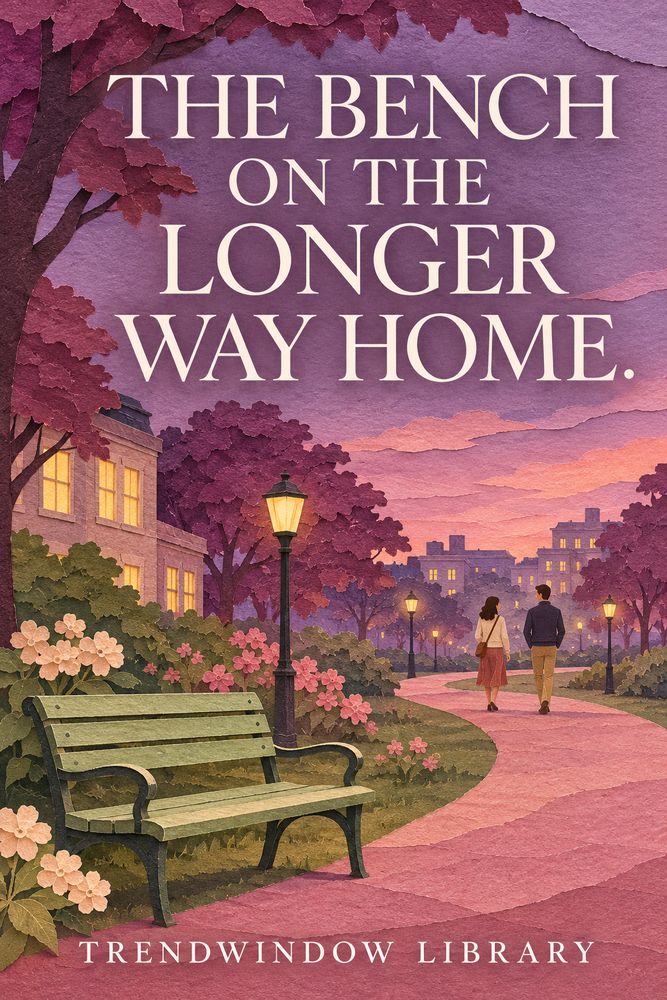
Front cover of The Bench on the Longer Way Home

Romance & Relationships

The Bench on the Longer Way Home

By TrendWindow Library

A complete original short romance. Alma likes Ben, but she cannot keep accepting evenings without thinking about the cost. A shopping bag, a green bench and an honest Thursday help two adults choose how to spend their time together.

Read this complete edition, including its ending and notes. No purchase is required.

1. The Invitation

Alma Price had enough money for the evening Ben suggested. What she did not have was enough money to say yes to evenings like it without thinking.

She stood in her kitchen with his message open beside a bag of potatoes. A small restaurant by the river. Friday, seven. He had found a table, but had not booked it yet.

The distinction should have helped. Instead she imagined the table already waiting, its two glasses making demands of her.

She was thirty-eight, paid her own rent, and had managed an ordinary life through months more difficult than this one. Her hours at the office had been reduced for the winter. She had adjusted her spending. Nothing was falling apart. But she had met Ben six weeks earlier, and had somehow begun treating the price of dinner as a test of whether she belonged across from him.

Their first restaurant had been her suggestion. She had liked the blue door. Their second had been his. At both, they had paid for their own meals. He had neither ordered for her nor watched what she spent.

Now she wrote that Friday might be difficult because of work.

It was a small lie, just large enough to hide inside.

His answer arrived while she was washing a potato.

No problem. Another day?

She left the question unanswered until the water ran cold.

Ben Sayer was forty-one. He worked in a school office, remembered the names in stories she told him, and laughed before finishing his own jokes. When they kissed outside her building the previous Sunday, he had asked whether she would like to see him again.

She had said yes without calculation. She wished she could recover that particular voice.

On Thursday, they met by chance outside the corner shop. He was carrying washing powder. She had bought bread and a tin of tomatoes.

“Work still busy?” he asked.

“Something like that.”

He nodded. It was a careful nod, giving her room she had not asked for and was suddenly afraid to lose.

“Would you walk a little?” she said. “Now, I mean.”

He shifted the box under his arm.

“Yes. Where?”

“The longer way home.”

2. An Ordinary Route

The short route went past the pharmacy and straight to Alma's street. The longer one followed the houses down to a footbridge, crossed the narrow stream, and returned through a small park. It added time rather than grandeur. You could still see the backs of the same houses from the bridge.

Ben took the heavy shopping bag when she offered him the bread instead.

“You have interpreted that generously,” she said.

“Bread is a serious responsibility.”

She kept the tomatoes. They walked slowly because neither had suggested a reason to hurry.

At the bridge, he stopped to recover a receipt that had escaped from his coat. He caught it against the railing with a rather theatrical bow. Alma laughed, and for a moment everything she had rehearsed became unnecessary.

Then he said, “If you would rather leave things here, you can tell me.”

She looked down at the stream.

“The walk?”

“Us. Whatever stage of us this is.”

He had not said it angrily. That made the question harder to dodge.

“I don't want to leave it.”

“All right.”

They reached a green bench with one pale patch where the paint had worn away. Alma sat at the end nearest the path. Ben placed the bread between them and settled his washing powder beside his shoe.

“Friday isn't work,” she said.

He waited.

“I don't want another restaurant bill this week. I could pay it. But then I'd spend the weekend wishing I hadn't. I didn't know how to say that without making everything strange.”

“You could have said that.”

“I know. That's not the same as finding it easy.”

He looked at her, then at the loaf between them.

“No,” he said. “It isn't.”

She had expected kindness. She had feared the quick kind, the kind that would make her explanation disappear beneath an offer to pay. He did not reach for his phone or suggest a cheaper restaurant. He sat long enough for her to hear the words she had finally used.

3. The Wrong Offer

“I was going to ask you about a weekend by the coast,” Ben said at last.

Alma closed her eyes.

“Excellent timing.”

“I can hear that now.”

He had not booked anything. He had looked at a place online and imagined them there. She was glad he told her before the imagined weekend could acquire tickets and a room she would have to refuse.

“It sounds lovely,” she said. “I can't plan that sort of spending now.”

“I could cover—”

He stopped. She opened her eyes.

“You can offer,” she said. “But please let no be an ordinary answer. I don't want to owe you a version of me who's pleased about every arrangement.”

His face changed, not into offence, but into the effort of listening properly.

“You wouldn't owe me that.”

“Then we need to be able to find out. With something smaller than a weekend away.”

He nodded.

“No coast,” he said. “And no surprise booking.”

She looked across the park. A boy and an older woman were trying to fold a large umbrella that had already become dry. Beyond them, the windows of the houses were turning yellow.

“This isn't an announcement that I never want to go anywhere,” Alma said. “I'd like to see a play with you sometime. I'd like to decide that in advance, when I can enjoy it. I don't want you checking every purchase I make to see whether it agrees with what I told you today.”

“I won't ask you to prove it.”

She let out a breath.

“And I shouldn't have made up work. That made you guess about something else.”

“Yes,” he said. “I thought you were trying to stop seeing me politely.”

It was the first cost of the lie she had not already counted.

“I'm sorry. I wanted you to like me. I became rather unhelpful about it.”

“I already like you.”

“I'm trying to believe that includes me holding a tin of tomatoes.”

He smiled, but he did not make a joke that would end the conversation.

“It does.”

4. What Ben Had Brought

The bread slid towards Ben as he shifted on the bench. He caught it with both hands.

“I haven't been especially helpful either,” he said.

Alma waited as he had waited for her.

“I've been divorced for five years. I've had a few dates since. Not many I wanted to turn into ordinary Thursdays.”

She looked at his washing powder.

“This is quite an ordinary Thursday.”

“Yes. I like it.” He rubbed his thumb along the folded top of the bread bag. “When I ask you out, I keep thinking I should produce something impressive. An evening with a proper shape. Otherwise you might notice that I come home, eat dinner, and sometimes spend twenty minutes looking for a screwdriver I put away too sensibly.”

“I would need to know how often.”

“The screwdriver?”

“Twenty minutes is a serious commitment.”

His laugh escaped before his answer. She had missed that laugh while he was being careful outside the shop.

“I don't have endless money either,” he said. “I have more room in my budget than you do just now, from what you've said. I shouldn't pretend that's the same thing. But I've also been spending more than I usually would.”

“Because of me?”

“Because of an idea I brought with me. You didn't ask for it.”

They sat with that distinction. Alma did not ask about his former marriage. He had offered a piece of his history, not invited her to diagnose it.

“What would you have wanted to do tomorrow,” she asked, “if you hadn't been trying to make an evening?”

He considered it.

“See you. I was less specific after that.”

She moved the bread to the bench beside her. The space it left was small and unmistakable.

“That seems like a useful beginning.”

5. Friday, Without a Booking

Their Friday plan took three messages and no reservation. Six o'clock at the park gate. A walk if it was dry. If it rained, they would decide together whether to shorten it or change the day. Neither was required to turn wet shoes into evidence of affection.

Alma finished work, went home, and ate before leaving. She put on the blue scarf Ben had once said suited her. It was not a new purchase. She liked it more for being something she had already chosen for herself.

At the gate, Ben stood with his hands empty.

“I considered bringing a very impressive box of washing powder,” he said.

“I'm glad you resisted.”

He looked at her scarf.

“You look lovely.”

She said thank you. She did not turn the compliment into a joke about its price.

They passed the bench without sitting at first. The evening was cool, and Alma wanted to walk beside him before giving the previous conversation a location too important to approach.

They talked about a cupboard in his office that refused to shut, and a colleague of hers who named every houseplant after an uncle. She told him she disliked the ending of a film he loved. He defended it so badly that he eventually agreed they would have to discuss it again, with drawings.

At the bridge, he asked whether he could hold her hand.

She put hers into it.

The pleasure was immediate and quite unhelpful to any sensible sentence she might have prepared. His hand was warm. When they resumed walking, their arms took several steps to agree on a rhythm.

“This is a date,” Alma said.

He turned towards her.

“I was hoping so.”

“I wanted to say it. So you didn't have to work it out from the route.”

“Thank you.”

They reached the green bench again and sat closer than they had on Thursday. This time there was no loaf between them.

6. The Way We Chose

A month later, they went to a play. They had chosen it together, bought their own tickets after discussing the price, and arranged to eat separately beforehand. Alma enjoyed the evening without silently subtracting the next week's groceries from every line of dialogue.

Two weeks after that, Ben paid for tea when she accepted his invitation. Another time she bought it. They had not invented a system that removed every awkward feeling. Once, she said yes too quickly and changed her mind that evening. Once, he suggested an expensive place without noticing. They corrected their plans before the corrections became a quarrel about their worth.

He still went out with his friends. She still chose some evenings alone. Her work hours had not increased. His screwdriver remained difficult to find. None of these facts prevented her from wanting to kiss him in his kitchen while the kettle was boiling.

On a cold Sunday, she met him outside the corner shop. She was carrying tomatoes again. He had a loaf under one arm.

“The short way?” he asked. “I can make tea.”

Alma looked towards the footbridge, then at the darkening sky. She liked the bench. She liked the walk that had given them room to speak. But she did not want to turn either into another test they must keep passing.

“The short way today,” she said. “I'd like to be inside with you.”

He kissed her, gently, beside a display of empty flower buckets. Nobody applauded. A person behind them asked whether they were waiting to go into the shop.

“Sorry,” Ben said, stepping aside, and Alma began to laugh.

They walked to his house with their ordinary shopping. At the door he offered his hand for her bag. She gave it to him and followed him in.

The longer way home was still there. They no longer needed to take it to prove that they wanted more time together.

Edition Note

This is a complete original short work of fiction. Alma Price, Ben Sayer, their circumstances and the unnamed neighbourhood are invented. The story depicts particular adults choosing a relationship; it offers no financial or psychological advice and no promise that affection resolves material differences. The English text, full translations and original cover artwork are AI-assisted and editorially reviewed, without independent human-authorship or native-human certification.

Explore more books →