BOOK LIBRARY · Complete books · Purchases disabled
TrendWindow

← Book Library · Complete book

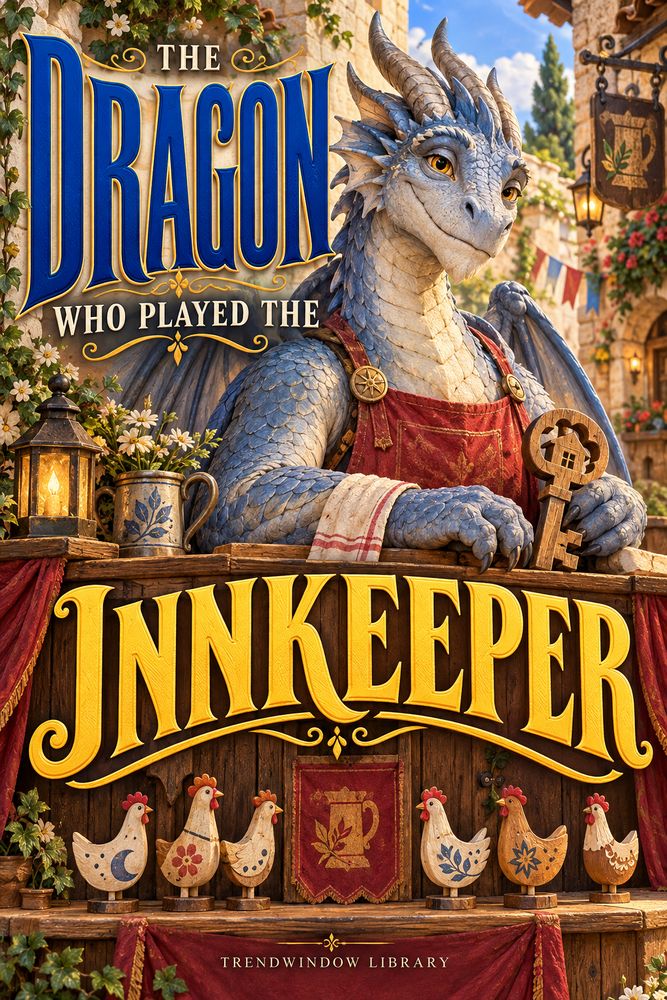
Front cover of The Dragon Who Played the Innkeeper

Fantasy & Science Fiction

The Dragon Who Played the Innkeeper

By TrendWindow Library

Varr wants the innkeeper’s part, not a roar from the wings. A complete original fantasy about a dragon, a small theatre company and their opening night.

Read this complete edition, including its ending and notes. No purchase is required.

1. The Wrong Kind of Notice

The notice asked for an innkeeper, a travelling aunt, two cousins and someone willing to fall into a basket. Varr read it twice. At one hundred and twelve, he had never fallen into a basket, but he knew something about welcoming visitors. He had kept a kettle in his cave for forty years.

He arrived at the assembly hall carrying the notice between two claws. His forefeet fitted through the door. His shoulders did not.

Mina, who directed the Salt Lane Players, came outside with a pencil behind her ear. She was forty-six and had already spent that morning persuading a retired cooper that the basket was padded.

'We haven't cast the creature in the hills,' she said, looking up.

'What does it say?'

'It roars. Then the cousins run away.'

'I came for the innkeeper.'

Behind Mina, Tomas, the stage carpenter, stopped measuring the door. He was sixty-one and knew an alteration when he heard one.

Mina asked Varr to read the innkeeper's first speech. He set the paper on the pavement. His voice moved three loose leaves and made the cooper appear at a window.

'Quieter,' Mina said.

Varr tried again. This time the voice stayed beside them. He gave the line about a room with a leaking ceiling the weary pride of someone who had once offered a guest a bucket.

Mina laughed at the right place. That made what she said next more difficult.

'You read it well. But I don't see how to put you on our stage.'

2. A Part with Words

The company's play, The Supper at the Wrong Inn, was a new comedy written by Mina. Its innkeeper had promised a private dining room to two families who would rather eat their shoes than share a table. By the last scene, neither family could remember who had started their quarrel. The innkeeper could. He had served the first unfortunate supper thirty years earlier.

Varr liked that part. The man was mistaken about several things, but he noticed when people were hungry.

Mina offered to add a friendly dragon who could announce the interval from the courtyard.

'Would the dragon be the innkeeper?'

'No. A separate part. An introduction, perhaps.'

'Then I'd rather not.'

He did not say it angrily. He folded the notice along its old crease, a delicate task for such large claws.

Mina had meant her offer kindly. She had also meant it as a solution that would leave the rest of her production untouched. Both things were true, and neither made Varr accept it.

She asked him to return on Thursday. There was no promise of a part. She wanted to hear the whole scene, and Tomas wanted to measure the courtyard.

Varr agreed. On the walk home he practised the leaking-ceiling speech. A woman carrying cabbages asked whether his roof needed mending. He explained that he was rehearsing. She wished him luck and advised him to mind the chimney when he bowed.

3. The Courtyard Drawing

On Thursday, Tomas had chalked a rectangle on the courtyard stones. Varr could stand inside it if his tail curved beside the wall. He could not turn around without passing through the place intended for the cousins.

'Then don't put the cousins there,' Varr said.

Tomas rubbed out a line. It was an encouraging beginning.

The hall had a back door opening onto the courtyard. Mina considered using it as the fictional inn's entrance. Human actors could pass through the door; Varr could wait behind a low counter outdoors. The audience could sit facing him.

They borrowed six chairs to test the view. From the last chair, the counter hid the bottom of Varr's face. From the first, everyone would see the carpentry behind it.

They lowered the counter and gave it two broad side panels. It suggested an inn without pretending to be a building that could hold a dragon.

'What about rain?' asked Mina.

'We postpone,' Tomas said. 'We don't persuade water to respect theatre.'

Varr could neither shrink himself nor make a dry roof by wishing. His heat was no solution either. Nobody intended to warm an audience beneath wet scenery with dragon breath.

Mina looked at the new drawing. It would mean fewer seats than the hall, different entrances and work they had not planned. She asked the company to try one rehearsal outside before deciding.

4. The First Missed Cue

Varr learned his speeches by arranging small stones beside his kettle. One stone for a speech, a second for its cue. When he could speak without looking down, he put both away.

At rehearsal, the stones were no use. He had learned when to speak, but not when to listen.

Lea, twenty-eight, played the travelling aunt. She changed the way she delivered her accusation about the missing supper. Varr was waiting for a particular rise in her voice. When it did not come, he stared at the panel behind her.

Mina prompted him. He answered too soon and spoke over Lea's next sentence.

They stopped. Varr felt heat collect under his tongue and shut his mouth until it passed.

'Again from my entrance,' Lea said.

'I've wasted it.'

'One entrance? I have plenty.'

She came through the back door carrying the same empty travelling case. This time Varr watched her put it down. He heard the last words rather than waiting for the sound he had imagined. His answer met hers.

Mina asked them to repeat the scene. It was better on the second attempt and worse on the third, when Varr became pleased with himself. They worked until the innkeeper seemed to be answering the aunt instead of reciting beside her.

Afterwards, Varr put away the cue stones. He kept the speech stones. He still needed to learn the words.

5. The Cloth Apron

Costume fitting happened in the courtyard on Saturday. Edrin, the costume maker, was fifty and disliked the phrase 'just something simple' when it meant an afternoon's unmentioned work.

She had brought three lengths of faded red cloth. They were remnants the company already owned, not the town's ceremonial banners, as an excited cousin suggested.

Varr stood still while she pinned an apron shape against his chest. Nothing went round his neck. Edrin made broad loops that rested comfortably behind the first plates of his shoulders, then asked him to raise and lower his forelegs.

One loop pulled. She unpinned it before continuing.

'An innkeeper needs somewhere to wipe his hands,' said Tomas.

'Not if he wishes to remain an innkeeper with clean hands,' Edrin replied.

Varr liked her immediately.

They added a large pocket with a false wooden key. The key had no working lock and weighed almost nothing. Varr practised taking it out without catching the cloth.

For the scene's last joke, he had to put the key on the counter and discover that the aunt had been holding another one all along. It was a small action that everyone needed to see. His size did not make the action clear by itself.

Edrin watched him repeat it five times. On the sixth, the pocket tore. She took the apron home and strengthened it. Varr went home knowing exactly where his free evening had gone.

6. The Question of the Roar

Mina's original script included a distant creature's roar. The cousins heard it, forgot their argument and hid together beneath a table. Tomas had planned to make the sound backstage with a wooden contrivance that behaved more like a complaining wardrobe.

Someone proposed asking Varr to roar instead.

He tried a small theatrical growl. It was surprisingly unconvincing. He was thinking about the neighbours, the chairs and whether his apron pocket would hold. His throat produced the noise of a disappointed drain.

The company laughed. Varr laughed too, then realised they were waiting for a louder attempt.

'I can play the innkeeper,' he said. 'I don't want to leave him halfway through to frighten everyone as myself.'

Mina looked at her script. In the old scene, fear had put the cousins beneath the table. What she needed was an interruption large enough to make them forget their quarrel.

They tried the aunt dropping her case. It was too small. Then Lea suggested opening it.

Tomas's basket actor, Bram, had a talent for making wooden hens. Six of them rolled out of the case on little wheels and scattered under the table. The cousins went after them to protect their good shoes from what they believed were live birds.

The innkeeper watched in silence. Then he asked whether anyone still wanted the private dining room.

Mina crossed out the roar. She kept the pause before Varr's question.

7. An Audience of Six

They invited six neighbours to watch a rehearsal on Tuesday. Nobody had bought a ticket. Mina wanted to discover what a person could hear without already knowing the play.

The woman with the cabbages came. So did two shopkeepers, a mason and an elderly couple who took the end chairs because they wanted to leave easily if they grew tired.

From the back, the aunt's quiet reply disappeared beneath a cart passing in the street. Varr's answer was clear, but hearing half a conversation did not make it funny.

They changed the actors' positions and tried again after the cart had gone. Varr stopped pointing his face down at the little key. Lea turned enough to let her words travel towards the chairs without staring past him.

The older couple asked whether they could reserve those same end places for the performance. Mina marked them on her drawing. Tomas checked that the route out stayed clear.

The cabbage woman had one criticism.

'You give the joke away before she opens the case. Your mouth starts smiling.'

Varr had not known his smile could be seen from the back.

He practised looking like an innkeeper who expected ordinary luggage. It took more work than the speech about thirty years of bad suppers.

8. The Evening without a Roof

On Friday, the company agreed that the performance could go ahead the following evening if the courtyard stayed dry. They had explained the outdoor arrangement to their small audience and would move the date if needed. They would not squeeze people into the hall and put Varr outside a window.

Saturday brought clear skies and a wind that worried one corner of the scenery. Tomas secured it, checked the other panels and moved a loose chair before anyone sat down. Varr waited in the space beside the counter while the company made its final checks.

He had asked whether he should enter with a sweep of his wings.

'Can you do it without catching the panel?' Mina asked.

'No.'

'Then you already live at the inn.'

That suited the story better. When the audience arrived, they found an innkeeper polishing a wooden key. He did not need an announcement to become part of the evening.

Bram stood near the basket, checking its padding. Lea closed the case around the six wooden hens. Edrin inspected the apron pocket and gave it one firm, satisfied pull.

Varr could see forty occupied chairs. The two end places were filled by the older couple. The cabbage woman sat near the back. He looked towards Mina. She lowered her hand.

The first cousin came through the door and demanded a room without relatives in it.

Varr knew what to say. More usefully, he wanted to answer.

9. Six Wooden Hens

The first half went well until Bram missed the basket.

Not dangerously. He landed on the padded mat beside it, plainly visible to everyone, and sat there with the expression of a man who had found an unexpected opinion on the floor.

Varr nearly called him by his real name. Then Bram looked up and said the innkeeper kept an excellent carpet.

'We charge extra for sitting on it,' Varr answered.

The audience laughed. Bram got up and continued. Mina, standing beside the hall door, made no attempt to hide her grin.

Later, Lea opened the case. One wooden hen refused to roll. She picked it up, examined its stiff wheel and handed it to a cousin as if it were the most troublesome bird in a very expensive flock.

Varr did not smile early. He watched the cousins scramble beneath the table, waited until Lea straightened, and asked his question about the private dining room.

The pause belonged to all of them. His line finished it, but it could not have worked without the case, the hens, the aunt and the cousins.

In the final scene, the families agreed to eat together. The innkeeper admitted that the original quarrel had begun when he served their puddings to the wrong table. Lea produced her key. Varr put his own beside it, exactly where the back row could see.

They finished the play. Nobody had to pretend that the person in the apron was small.

10. After the Last Chair

For the bow, the human actors formed a line beside Varr rather than in front of him. He lowered his head without opening his wings. From the back, someone called, 'Mind the chimney!'

There was no chimney in the courtyard. Varr recognised the voice and laughed.

After the audience left, he helped stack the chairs where Tomas directed. His strength made that job quick. It did not make him better at folding the apron, which Edrin finally rescued from his claws.

Mina brought him his script. The crossed-out roar was still there, along with the revised hen scene and a pencilled note beside Bram's fall.

'Keep that answer?' she asked.

'If Bram wants it.'

Bram wanted it. He also wanted a slightly wider mat before their next performance. Tomas wrote that down. They agreed on one more Saturday in the courtyard, with the same arrangement if the weather allowed.

Varr walked home after supper carrying the script in a cloth bag Edrin had made from the remaining red scraps. His cave had not turned into a theatre. The kettle still needed filling, and two speech stones remained beside it because he had never quite trusted the final scene to memory.

He placed the script next to them. On the company notice, Mina had written the cast in a narrow, busy hand. Beneath the title was a line he read twice before setting it down.

Innkeeper: Varr.

He put the kettle on. Next Saturday, the man with the leaking ceiling would have guests again.

11. About This Edition

This is a complete original short fantasy, created with AI assistance for TrendWindow Library. Varr, Salt Lane, the company and both stories are invented. The play within the story, The Supper at the Wrong Inn, is also original fiction. No existing play or dragon character is reproduced. The story is not a theatre safety manual or a historical account.

The ten narrative chapters and this edition note form eleven fixed reading units, not a claim about printed pagination. The English cover artwork and the complete reader translations were created for this digital edition. Translations receive assistant comparison against the English text; independent native-human certification, human authorship, an ISBN and print-proof approval are not claimed. The complete approved editions are publicly readable. Purchases and payment providers remain disabled.

Explore more books →