BOOK LIBRARY · Complete books · Purchases disabled
TrendWindow

← Book Library · Complete book

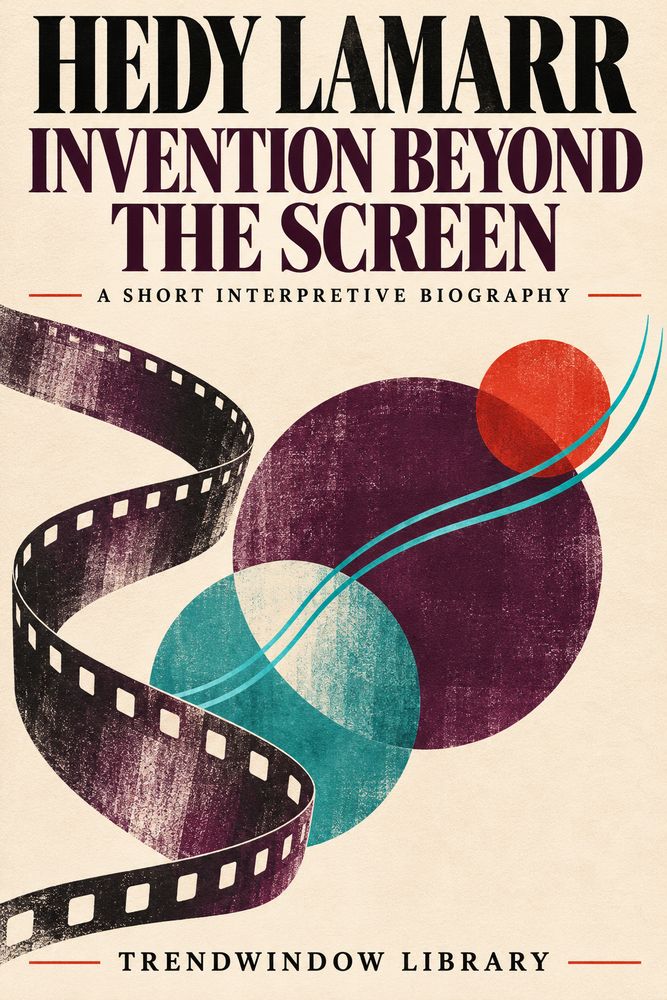
Front cover of Hedy Lamarr: Invention Beyond the Screen

Biography & Memoir

Hedy Lamarr: Invention Beyond the Screen

By TrendWindow Library

A complete original short interpretive biography of Hedy Lamarr. Follow selected records from Vienna and Hollywood to her joint patent with George Antheil, later recognition and a documented ending. Primary records and clearly bounded institutional context distinguish the work from invented private thoughts and exaggerated technological claims.

Read this complete edition, including its ending and notes. No purchase is required.

1. A Name in More Than One Record

Hedy Lamarr’s name belongs to the history of film and to a surviving record of invention. Reading those records together need not turn an actor into a secret engineer in every scene of her life. It asks a more useful question: what work can actually be connected to this person, and what kind of evidence connects it?

A patent offers a concrete starting point. The printed name Hedy Kiesler Markey appears beside George Antheil on United States Patent 2,292,387, titled Secret Communication System.[1] The screen name and the name on the patent refer to the same woman. The difference matters when a reader searches for her work rather than only her publicity image.

This short interpretive biography follows a selected documented life: Vienna, acting, a collaborative invention, formal recognition and the records that outlived her. It does not invent conversations, childhood experiments or private thoughts. Where a record describes a proposal, this book keeps it a proposal rather than supplying an imagined successful trial.

Two familiar ways of telling an inventor’s life can flatten it. One treats fame as evidence that there was no serious work. Another replaces a complicated person with a flawless genius who explains every later technology. Neither is necessary here. The two-name patent and the surviving papers are interesting enough to examine without either shortcut.

2. From Vienna to a Film Career

The Smithsonian collection guide identifies her as Hedwig Eva Maria Kiesler, born in Vienna in 1914. Its historical outline traces her acting and her move through England in 1937, after leaving her marriage to Fritz Mandl, to the Hollywood career associated with Hedy Lamarr.[2]

The guide lists Algiers in 1938, White Cargo in 1942 and Samson and Delilah in 1949 among her films.[2] These dates put the invention period inside a working screen career. They do not describe a neat exchange in which she stopped being an actor and became a completely different person.

A film title is evidence of a public work. It does not open every room of a performer’s private life. This account does not infer her feelings on a particular set, reconstruct an escape scene or turn a later anecdote into something witnessed by the writer. Those choices keep the biography narrower, but they also let its statements remain attached to identifiable sources.

There is no need to dismiss acting in order to take invention seriously. A screen performance and a patent application make different demands and leave different records. Respecting one does not require calling the other a disguise. Lamarr’s life can contain both without a competition over which was her only authentic identity.

The documented move also changes the setting of the story. The woman whose name appears on the American patent had already crossed countries and professional environments. That observation follows the chronology. It does not tell us precisely when an idea first occurred to her or supply a single cause for everything she later attempted.

3. A Collaboration Takes Documentary Form

The Smithsonian guide places Lamarr and composer George Antheil’s invention work in the early 1940s. The collection includes a notebook and correspondence associated with the project, its patent attorneys, the Patent Office and the National Inventors Council.[2] The record is therefore more than a later story that she once had a clever thought.

The collaboration should stay visible. Antheil was a composer with interests in mechanisms and synchronisation; the guide relates that background to the partnership.[2] Calling Lamarr a co-inventor does not diminish her. It identifies a form of work that involved another named person, rather than awarding one partner all the credit to correct an earlier omission.

The original patent makes the sequence unusually clear. The application date is 10 June 1941. The granted document is dated 11 August 1942.[1] Those dates are different events. An account that makes the filing date the date of the grant loses a distinction printed on the document itself.

Their proposed system concerned changing the tuning of a transmitter and receiver together for a radio-control link. The historical record connects the idea with synchronised paper records of the kind associated with player pianos.[1][2] At this level, the important point is coordination: the two ends must follow the intended changes together.

This is a historical explanation, not a construction guide. The book does not reproduce a weapon-control diagram, give operating frequencies or claim that a reader can build a secure system from the description. Its subject is the documented work and how to read it responsibly.

4. What the Patent Can Tell Us

The first drawing sheet carries the title, number and dates; the first page of the printed description names both inventors. Those parts of the facsimile were inspected for this edition.[1] Looking at them corrects a basic error that can survive even in a confident summary: an application is not the same dated event as an issued patent.

The pages also show the difference between a technical proposal and its later history. A patent sets out an invention in a particular documentary form. On its own it does not establish every test, every procurement decision or every subsequent use. This selected account has not inspected a complete set of naval adoption records and does not manufacture that missing history.

The proposal aimed to make interference with a radio-control link more difficult. That aim is not a modern guarantee that no signal could ever be intercepted or jammed. Historical intentions, the operation described in a document and independently demonstrated performance are different questions. A biography can explain the first two without pretending to have measured the third.

The same care applies to technological ancestry. This book does not make Lamarr and Antheil the sole creators of every later wireless system. Establishing the exact path from an older patent to a later device requires evidence about that later development. A moving tribute is not a substitute for tracing those connections.

The achievement retained here is specific: Lamarr participated in a joint invention that was developed into a patent application and a granted document. That is a meaningful place in a life. It does not need a claim of universal priority, a modern product logo or an invented wartime success to make it worth reading.

5. Recognition within a Life, and After It

The Electronic Frontier Foundation’s own retrospective award list names Lamarr and the late George Antheil as special honorees for 1997.[3] The page consulted for that fact is a 1999 press release recalling earlier awards; it is not evidence that Lamarr received the 1999 award.

That small distinction illustrates the work of a careful chronology. The date of an event, the date of a document describing it and the date on which a reader consults the document may all differ. Keeping them visible helps prevent a later retelling from quietly shifting the event itself.

Lamarr died on 19 January 2000. The National Inventors Hall of Fame records her induction in 2014.[4] The later honour belongs to the history of her remembrance. It should not be placed back into her lifetime or narrated as a ceremony she attended.

This biography does not invent her response to recognition, put a polished sentence into her mouth or claim to know which public identity she valued most. A record of an award supports a record of an award. Her private experience would require its own appropriate evidence.

The end of a life does not end the circulation of its work. Here, recognition and preservation extend beyond 2000. They change what later readers can find and how the name is presented. They cannot alter the dates of the earlier application or remove the collaborator printed beside her name.

6. The Papers That Remained

The Smithsonian guide records a 2023 donation by Lamarr’s daughter Denise Loder Deluca and processing by archivist Alison Oswald that year.[2] The preserved collection brings together invention material, correspondence and a notebook. The guide is a route into those records, not proof that every underlying letter has been read for this book.

This matters because a biography is shaped by what survives and what is examined. A catalogue tells us what a repository describes. A letter, a notebook and an issued patent can answer different questions. Finding one does not license a writer to pretend to have inspected all the others.

For the reader, three questions offer a useful way to continue: what does this record establish, what interpretation am I adding, and what remains unknown? They are original reading prompts for this account, not words attributed to Lamarr. A film credit, a patent header and an award list will not produce the same answers.

The selected chronology now has a documented ending. The Vienna-born performer became a Hollywood actor; the collaborative invention entered a formal patent record; recognition followed; her life ended in 2000; later institutions honoured and preserved the work. The story is complete at that scale without pretending to contain her whole inner life.

Lamarr need not be reduced to a face or enlarged into the inventor of everything wireless. The surviving record allows a more durable remembrance: an actor who also worked on invention, a named co-inventor alongside Antheil, and a person whose different forms of work deserve their own careful reading. The screen is part of that life. The papers help us see beyond it.

Sources and Edition Note

Research read 7 November 2026, Asia/Dhaka. This is a selected interpretive biography, not a complete archive survey, a filmography or a legal assessment of patent priority. No private dialogue or thoughts are invented.

[1] United States Patent 2,292,387, Secret Communication System. Record: https://patents.google.com/patent/US2292387A/en . Original facsimile: https://patentimages.storage.googleapis.com/pdfs/c2d8a2098c59bef5dc0f/US2292387.pdf . Pages 1 and 3 were actually viewed to check the header, two inventors and filing/grant dates. Only brief facts are paraphrased; no drawing is reproduced in the book.

[2] Smithsonian, Archives Center, National Museum of American History, Hedy Lamarr and George Antheil Invention Papers, NMAH.AC.1590: https://sova.si.edu/record/nmah.ac.1590 . The page makes collection descriptions and catalogue records available under CC0. That permission does not automatically cover the underlying papers or linked images. Its historical outline is institutional context, including references to a later biography; this edition does not claim to have read that biography or every original item. Catalogue facts are paraphrased in original language; third-party quotations are not copied.

[3] Electronic Frontier Foundation, 7 April 1999 press release, retrospective 1997 award list: https://w2.eff.org/awards/99pioneer.html . Used only for the brief honour fact.

[4] National Inventors Hall of Fame, Hedy Lamarr: https://www.invent.org/inductees/hedy-lamarr . Used for the brief death-date and 2014 induction facts.

This complete original short biography was written with AI assistance and editorial review. Full aligned translations and the full source note are provided in Bengali, Hindi, Spanish, French and Arabic alongside the English original. Original English front and back cover art is conceptual, not an archival photograph, technical drawing or institutional endorsement. No independent human-authorship, native-human translation, print-proof or ISBN certification is claimed.

Explore more books →