BOOK LIBRARY · Complete books · Purchases disabled
TrendWindow

← Book Library · Complete book

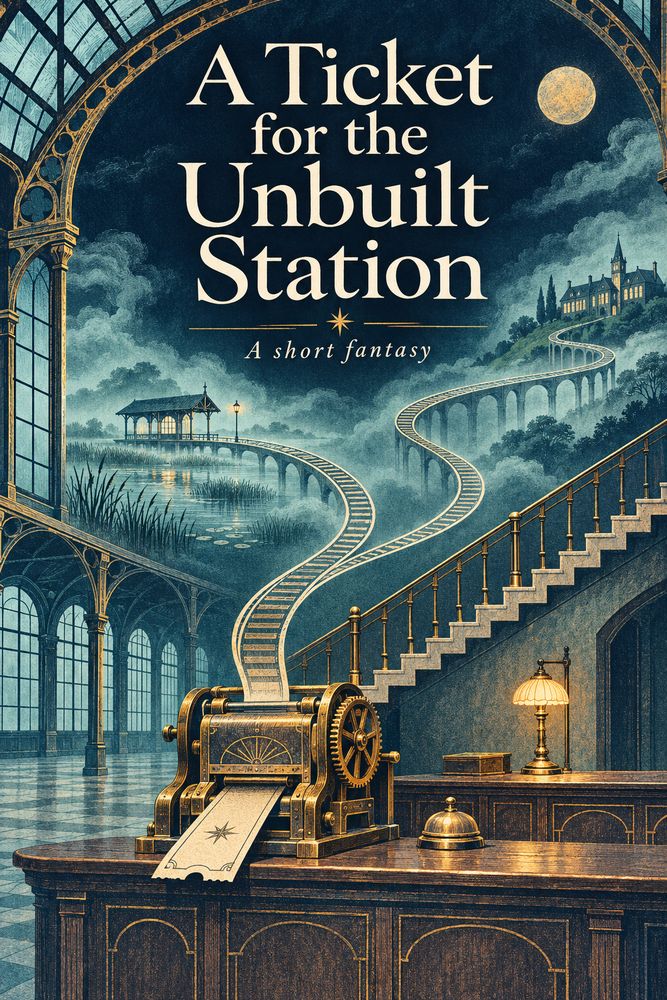
Front cover of A Ticket for the Unbuilt Station

Fantasy & Science Fiction

A Ticket for the Unbuilt Station

By TrendWindow Library

Two tickets from a forgotten machine let Enid visit stations that have not yet been built. A complete fantasy in eight chapters about choosing between possible futures, listening to ordinary lives and distinguishing a glimpse from a promise.

Read this complete edition, including its ending and notes. No purchase is required.

About this book

A complete short fantasy. All people, places, railway arrangements and supernatural rules in this story are invented. This is not a prediction or a railway-planning guide.

Original complete short fantasy prepared with AI assistance. All characters, places, railway arrangements and supernatural rules are invented. Not a prediction or railway-planning guide. Original covers are conceptual illustrations. Translation meaning reviewed with AI, without independent native-language certification.

1. The counter beneath the stairs

The ticket said LOWER MARSH, although Lower Marsh had no station. Enid held it under the records-room lamp. The destination was embossed, the fare was blank, and the date was exactly one year ahead.

She had found it inside the brass printer beneath the old terminus stairs. The machine had not appeared on the room inventory because everyone had mistaken it for part of the counter. When she pulled the stuck drawer, two tickets fell out. The other said RIDGE SCHOOL.

On Friday she had to recommend which branch the new bridge should serve. There was money and material for one branch. The bridge could not be connected to both within the agreed project. Nobody liked saying that aloud; the maps kept both lines in their optimistic blue.

Her father had surveyed the ridge before his hands began to shake. At home, his photographs showed foundation stones and men pointing into open air. He called the railway unfinished, as though finishing it were a family obligation.

The marsh branch was newer. Its proposed station occupied a strip beside the old ferry yard. Enid knew the yard's measurements better than she knew the people who used it. She had not put that admission in her report.

Behind the printer stood a bell and a small instruction plate: SET A TICKET ON ITS LINE. RING FOR AN ARRIVAL. PUNCH TO RETURN. ONE VISIT TO EACH POSSIBILITY.

Below, in a different hand: The ticket shows a world in which the line opened. It does not tell you what opening it will cost.

Enid set the marsh ticket on the map. She meant to test whether the bell still worked. The sound was small. The records-room lamp went out, and she stood beneath a station roof in rain.

2. No departure on the board

Someone caught her elbow before she stepped into a puddle deep enough to hide the edge of the platform.

“You came through the office?” a woman asked. “Then tell them the shutters are stuck again.”

The woman wore a red waterproof coat and carried a basket of wrapped cups. Her name badge said TAVI. Behind her, LOWER MARSH shone in white letters. A train stood beside the platform, its windows lit. Beyond it Enid could see the ferry yard, narrowed by a new fence.

The board listed arrivals. Where the departure time should have been, a brass hand pointed to WAIT FOR THE GATE.

Tavi followed Enid's gaze. “The yard gate, not the railway's. They put their barrier across the path to the winch. Now the gatekeeper has to go round the long way. When the water is up, the long way isn't a way.”

Enid looked towards the river. A timber gate stood across the little channel used by the ferries. The imagined railway arrangements had made two kinds of movement depend on one obstructed path. Her plans treated the yard as empty ground with a boundary.

In this design, the signal for the river bridge stayed red until the gatekeeper confirmed that the channel was clear. The railway had made his work a condition of departure, then blocked his way to do it.

A boy sitting on a case asked Tavi whether they would miss his sister's play. She gave him a cup without answering. Enid offered to ask the station office for help.

“We have asked,” Tavi said. “You may ask again. But don't come back with the name of the person who isn't here.”

In the office, beside a silent telephone, lay a ticket punch. Enid's own ticket warmed in her hand. She understood that she could leave. She was embarrassed by the relief.

Instead, she asked where the gatekeeper was waiting.
3. The price missing from the fare

The gatekeeper sat on the dry side of the fence, with the winch visible on the other side. He had a key for the yard's old gate. The railway padlock was different. In this future, two offices had given him two answers, and neither had given him access.

Enid could not undo that by knowing the shape of the original drawing. The fence had no convenient gap. She stopped looking for one when the gatekeeper told her that the ground beyond it dropped into the channel.

They went back to the office. Tavi found a number written inside the timetable cupboard. The station supervisor answered on the third attempt and said someone with the railway key was coming. No one promised a time.

While they waited, the boy introduced himself as Lio. He showed Enid the folded programme for his sister's play. The corner had become soft from opening and closing it.

“Are you the woman who chose this station?” he asked.

Enid looked at the framed opening photograph. There she was, a year older, smiling beside the mayor. Her father was not in the picture.

“Not yet,” she said.

Lio decided this was an adult answer and stopped asking. That hurt more than an accusation would have done.

Through the office window, Enid saw a person in a yellow coat arrive carrying keys. Tavi went to meet them. The boy followed, hopeful but still holding the programme tightly. Enid did not know whether they would reach the play.

She punched her ticket. The station vanished before she could see the gate open. Back beneath the stairs, the paper was cold. The hole had the shape of a small door. All she had brought back was a memory of an obstruction she had not drawn.

4. The school above the cutting

Enid ate half a sandwich at the records-room desk and studied the ridge ticket. She could leave it unused. A bad future for one branch did not make the other branch good. Yet she wanted it to. Her father's foundation stones seemed to wait beneath her hand.

She set the second ticket on the ridge line and rang.

Sunlight replaced the lamp. This platform was dry, with new benches and a clock that worked. A train departed while she watched. For a moment she felt the enormous comfort of an answer that agreed with her own preference.

Then she looked up the hill. Ridge School had lost its lower playground. The new approach road ran through it. A temporary classroom stood where the children had once planted beans. Enid knew that drawing too. The shaded block on her map had been called ancillary land.

A man wheeled a crate of stage costumes through the school gate. She recognised Lio beside him, carrying the same folded programme.

“Is the play today?” she asked.

“Last performance,” he said. “My sister's moving schools after this term.”

Enid asked whether the railway was the reason. The man, Lio's father, stopped the crate.

“Partly. The temporary room isn't temporary to a child who spends the year in it. But the headteacher left too. Don't turn our whole life into one argument.”

He invited her to help carry the lightest box. She followed them uphill, past a bright station sign that concealed nothing and explained nothing.

5. Two seats in the same row

The hall smelled of paint and coats drying near open windows. Enid put the box beside a row of cardboard trees. Lio's sister, Mara, came out wearing a paper crown. She scolded him for folding the programme across her name, then kissed the top of his head.

There were two empty seats beside their father. Enid took one. The play began with a king who had misplaced his own country. The children forgot lines, supplied each other's words and argued cheerfully with a cardboard river that refused to stand upright.

Enid laughed. In the marsh possibility, she had left Lio waiting. Here she was watching his sister finish the first scene. It would be easy to turn this afternoon into proof that one railway deserved to exist.

But the school had lost space. The marsh had gained a station and lost access. These were not totals she could add by counting smiles. Both futures contained people who did not exist merely to advise her.

At the interval she found a photograph of her father outside the hall. In the opening photograph displayed near the entrance, he stood with one hand resting on the new rail. In this future he had lived to attend the ceremony. Enid had been afraid of losing him since the first tremor; the photograph offered a comfort the ticket had never promised.

She studied his face until Mara asked whether she was looking for someone.

“Someone I know,” Enid said.

“Then ask him to come next time.”

In the station office she found another punch. She waited until the final applause reached her from the hill, then made a small door in the ticket. She did not take the programme. It belonged to Lio.

6. What her father had measured

At home, her father was trying to thread a needle through a button. Enid sat beside him, held the cloth steady and described both stations. She did not begin with the photograph of him.

He listened without asking whether the machine was real. In their city, odd things sometimes survived inside public furniture. Most people preferred not to find them during working hours.

“I measured the ridge,” he said. “I didn't measure whether it should be chosen.”

“You call it unfinished.”

“It is. That doesn't mean you owe it an ending.”

She told him about his photograph then. He took the cloth from her and laid it on his knee.

“I would like to be there,” he said. “At either opening. But a picture of me isn't a promise that the line will keep me alive.”

Enid had wanted him to say which future was true. Instead he asked what she had learned that she could examine before Friday.

The next morning she went to the ferry yard without a ticket. Tavi was there, selling tea from a cart. She had not met Enid before. The gatekeeper showed them the path to the winch. There was no new fence yet, and no key dispute. The drawings would create both unless the proposal changed.

At the school, the present headteacher showed Enid the bean beds and explained how the temporary room would be used. She did not know whether she would leave next year. Enid did not ask her to fulfil a future.

As she left, Lio and Mara came through the school gate with their father. They did not recognise her. She stepped aside to let them pass.

She returned with present-tense notes. They were less dazzling than the tickets and more useful to the meeting.

7. The line she crossed out

On Friday, Enid recommended the marsh branch, with the access route redesigned before the final layout could be agreed. She brought the yard workers' account of their movements and the school's account of its space. She did not describe a glimpse as an inspection of work that had not happened.

The marsh path could be changed within the yard; in the proposal before them, the ridge road still needed the playground.

The chair asked whether she could guarantee that the marsh station would operate without delay.

“No,” she said. “I can show you a conflict in the current proposal. We must resolve it, and still check the rest.”

Someone wanted the ridge line left blue on the public map, marked future extension. Enid said that would imply a commitment the meeting was not making. After a long argument, the committee agreed to remove it from the funded scheme. The old survey would remain in the archive. The school would keep the ground shown within the abandoned approach road.

No one clapped. One member thought they had chosen badly. Another asked how long the revised marsh layout would take. Enid said it needed work with the people who used the yard; she would not invent a completion date to make the decision sound painless.

That evening she returned to the printer. The ridge ticket was fading. For a frightened moment she thought of Lio and Mara disappearing from the hall.

Then she remembered meeting the schoolchildren outside the actual gate the previous morning. Their future had not belonged to the scene she had borrowed. She had closed a railway proposal, not a child's life.

She put both punched tickets in an envelope. On it she wrote: Two possibilities, not evidence of completed events. Beneath that she added the date on which she had chosen.

8. An arrival she had not seen

The marsh station opened later than the tickets had shown. The new drawings had taken longer, and other work had taken longer still. Enid attended on a cold morning when the sky was clear. The ferry yard had its own unobstructed route to the winch. That was something she could point to, not an assurance that nothing would ever go wrong.

Her father came with a stick. He complained about the bench, then sat on it gratefully. Enid took his photograph without trying to reproduce the one she remembered. Tavi sold tea beside the entrance and charged them both the ordinary price.

Lio and Mara arrived with their father. Mara carried a battered cardboard crown. They were going to another school's play, where she had been invited to help with costumes. Enid did not ask which parts of their lives had changed because of her decision. They had a train to catch.

After it departed, she went into the office to return a borrowed pencil. There was a new ticket punch on the desk, ordinary and heavy. She lifted it, felt its weight and put it down.

The brass printer beneath the old terminus stairs had never produced another ticket. Both used ones were now blank except for their little door-shaped holes. Enid kept them with her personal account of the visits, separate from the public planning record.

At the platform exit, her father waited for her. He asked whether she wanted to see the first train come back.

“Not today,” she said. “Let's go home.”

They walked out through the open entrance. Behind them the board turned, and a departure appeared that Enid had never seen in any future.

Explore more books →