
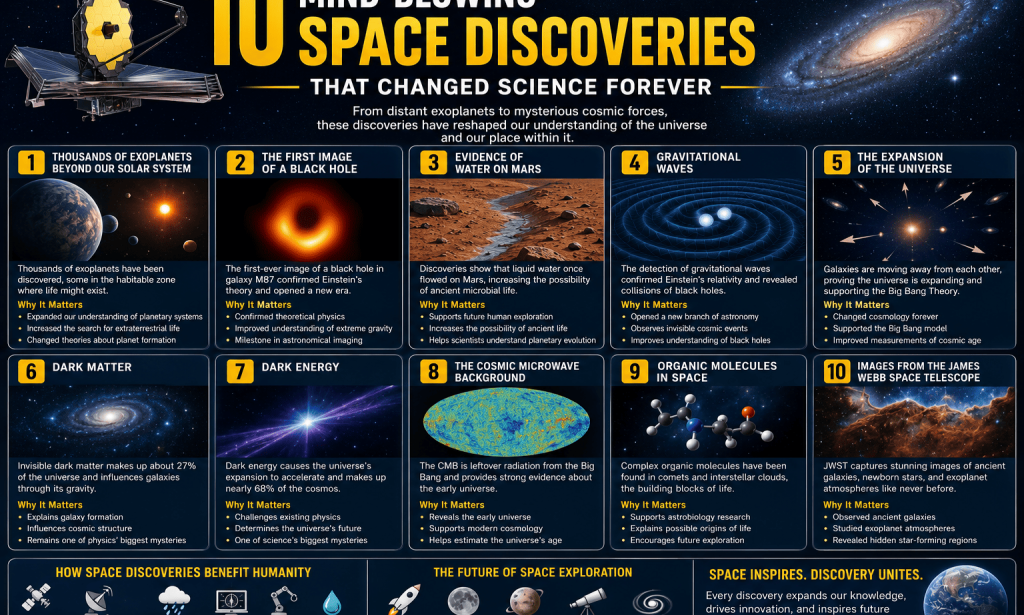
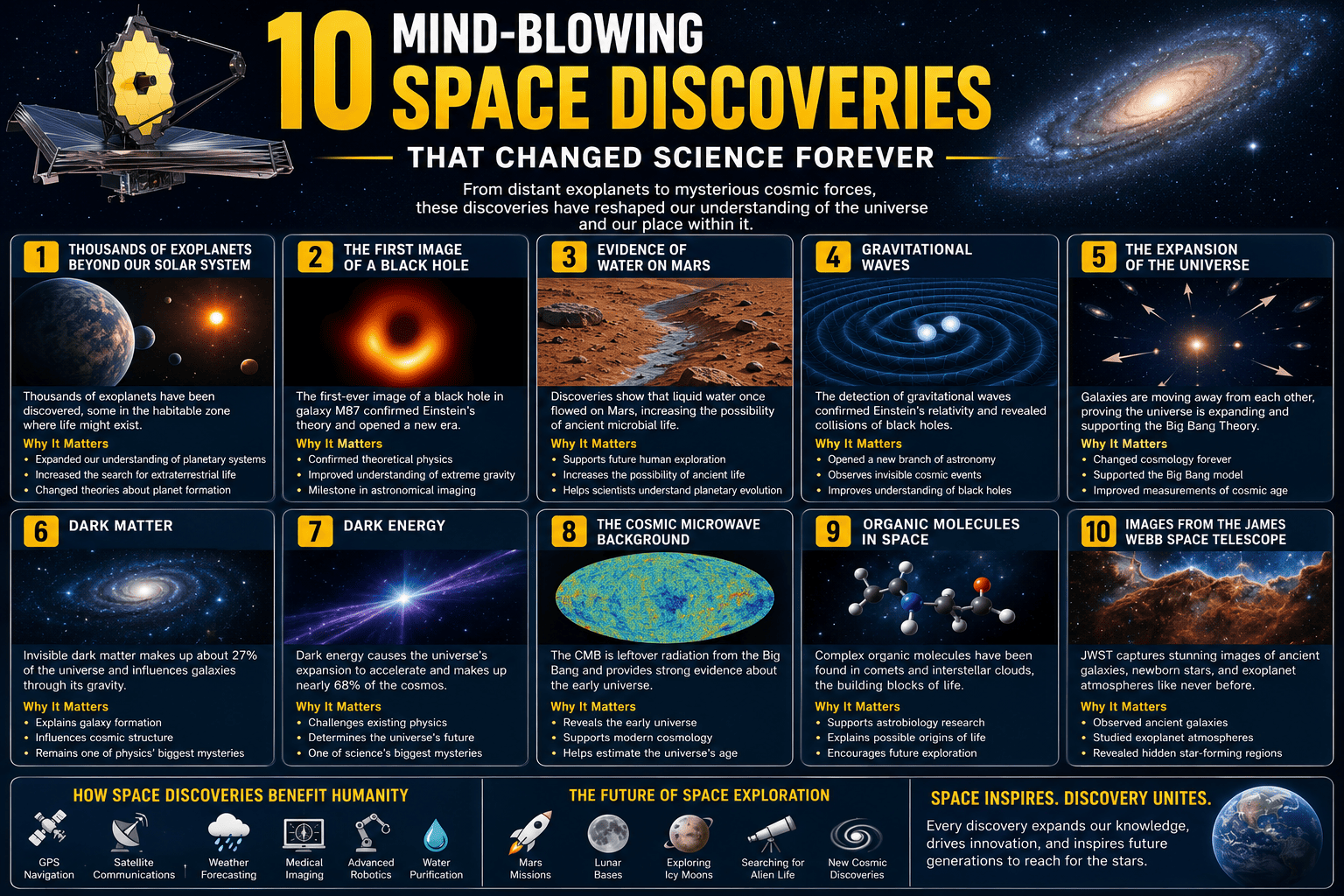
 10 Mind-Blowing Space Discoveries That Changed Science Forever
Since ancient civilizations first looked up at the night sky, humanity has been captivated by the mysteries of space. What once seemed like unreachable points of light have become worlds, galaxies, and cosmic structures thanks to centuries of scientific exploration. Today, powerful observatories, advanced satellites, and space probes allow scientists to explore regions of the universe that were unimaginable just a few decades ago.
Every major discovery in space science has expanded our knowledge of the cosmos and challenged long-held assumptions about the universe. Some discoveries have answered fundamental questions, while others have introduced even greater mysteries. Here are ten remarkable discoveries that forever changed the field of astronomy.
1. Thousands of Exoplanets Beyond Our Solar System
For much of human history, scientists believed our solar system might be unique. That changed when astronomers confirmed the existence of planets orbiting distant stars, known as exoplanets.
Today, thousands of exoplanets have been identified. Some are gas giants larger than Jupiter, while others are rocky worlds located within their stars' habitable zones, where liquid water could potentially exist.
The discovery of exoplanets has dramatically increased the possibility that life may exist elsewhere in the universe.
Why It Matters
- Expanded our understanding of planetary systems.
- Increased the search for extraterrestrial life.
- Changed theories about planet formation.
2. The First Image of a Black Hole
For decades, black holes were considered invisible because their gravity prevents even light from escaping. In 2019, scientists achieved what once seemed impossible by capturing the first image of a black hole using the Event Horizon Telescope.
The image showed the glowing ring of hot gas surrounding the supermassive black hole at the center of galaxy M87.
This historic achievement confirmed predictions made by Albert Einstein's theory of general relativity.
Scientific Impact
- Confirmed theoretical physics.
- Improved understanding of extreme gravity.
- Marked a milestone in astronomical imaging.
3. Evidence of Water on Mars
Mars has long been one of the most intriguing planets in our solar system. Multiple missions have revealed convincing evidence that liquid water once flowed across its surface.
Scientists have discovered dried river valleys, ancient lakebeds, underground ice deposits, and minerals that form in the presence of water.
These discoveries suggest Mars may once have supported conditions suitable for microbial life.
Importance
- Supports future human exploration.
- Increases the possibility of ancient life.
- Helps scientists understand planetary evolution.
4. Gravitational Waves
In 2015, researchers made history by detecting gravitational waves for the first time. These tiny ripples in space-time were caused by two black holes colliding over a billion light-years away.
The discovery confirmed another major prediction of Einstein's General Theory of Relativity.
Gravitational wave astronomy now provides an entirely new way to observe the universe.
Why It's Revolutionary
- Opened a new branch of astronomy.
- Allowed scientists to observe invisible cosmic events.
- Improved understanding of black holes and neutron stars.
5. The Expansion of the Universe
In the 1920s, astronomer Edwin Hubble discovered that distant galaxies are moving away from one another.
This observation revealed that the universe is expanding rather than remaining static.
The discovery eventually led to the development of the Big Bang Theory, which explains how the universe began approximately 13.8 billion years ago.
Scientific Significance
- Changed cosmology forever.
- Supported the Big Bang model.
- Improved measurements of cosmic age.
6. Dark Matter
When scientists studied the motion of galaxies, they noticed something unusual.
Visible matter alone could not explain the observed gravitational effects.
Researchers concluded that an invisible substance—called dark matter—must exist.
Although dark matter cannot be seen directly, it appears to make up roughly 27% of the universe.
Why It Matters
- Explains galaxy formation.
- Influences cosmic structure.
- Remains one of physics' greatest mysteries.
7. Dark Energy
Even more surprising than dark matter was the discovery that the universe's expansion is accelerating.
Scientists believe this mysterious force is caused by dark energy, which accounts for nearly 68% of the universe.
Despite decades of research, its true nature remains unknown.
Importance
- Challenges existing physics.
- Determines the universe's future.
- One of science's biggest unanswered questions.
8. The Cosmic Microwave Background
The Cosmic Microwave Background (CMB) is faint radiation left over from the Big Bang.
Discovered in 1965, it serves as one of the strongest pieces of evidence supporting the Big Bang Theory.
Detailed observations of the CMB allow scientists to study conditions that existed shortly after the universe was born.
Scientific Benefits
- Reveals the early universe.
- Supports modern cosmology.
- Helps estimate the universe's age.
9. Organic Molecules in Space
Astronomers have detected complex organic molecules inside interstellar clouds, comets, and meteorites.
Although these molecules are not proof of life, they demonstrate that the chemical building blocks of life exist throughout the universe.
This finding strengthens the possibility that life could emerge elsewhere under the right conditions.
Why It's Important
- Supports astrobiology research.
- Explains possible origins of life.
- Encourages future exploration.
10. Images from the James Webb Space Telescope
The James Webb Space Telescope has transformed astronomy by capturing incredibly detailed images of distant galaxies, newborn stars, and planetary atmospheres.
Its powerful infrared instruments allow scientists to observe objects that formed shortly after the Big Bang.
These observations continue to reshape our understanding of cosmic history.
Key Achievements
- Observed ancient galaxies.
- Studied exoplanet atmospheres.
- Revealed hidden star-forming regions.
How Space Discoveries Benefit Humanity
Although space research may seem distant from everyday life, many technologies developed for space missions have practical applications on Earth.
Examples include:
- GPS navigation systems.
- Satellite communications.
- Weather forecasting.
- Medical imaging technology.
- Advanced robotics.
- Water purification systems.
- Lightweight materials used in transportation and sports equipment.
Investing in space science often leads to innovations that improve life on Earth.
The Future of Space Exploration
The coming decades promise even more exciting discoveries. Scientists are working on missions to return samples from Mars, establish long-term lunar bases, explore Jupiter's icy moons, and search for signs of life on distant exoplanets.
Future space telescopes and observatories will also help answer major questions about dark matter, dark energy, and the origins of the universe.
As technology advances, humanity's ability to explore deeper into space will continue to grow.
Why Space Science Inspires the World
Space exploration is more than scientific research—it inspires curiosity, innovation, and international collaboration. Every mission expands our understanding of the cosmos while encouraging future generations to pursue careers in science, engineering, and technology.
Looking beyond Earth reminds us how interconnected humanity is and how much there is still to discover.

You must be logged in to post a comment.