
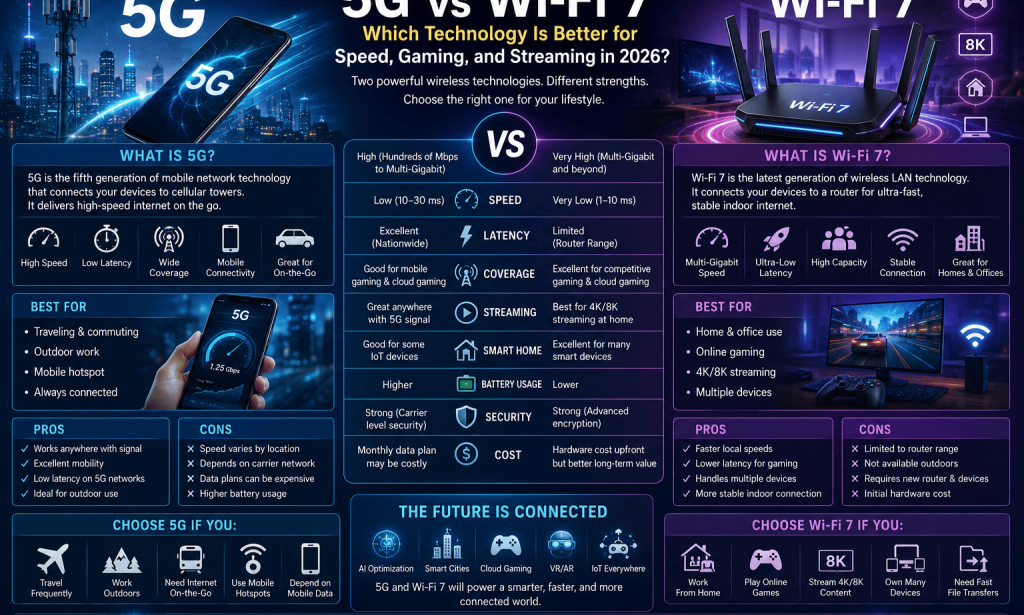
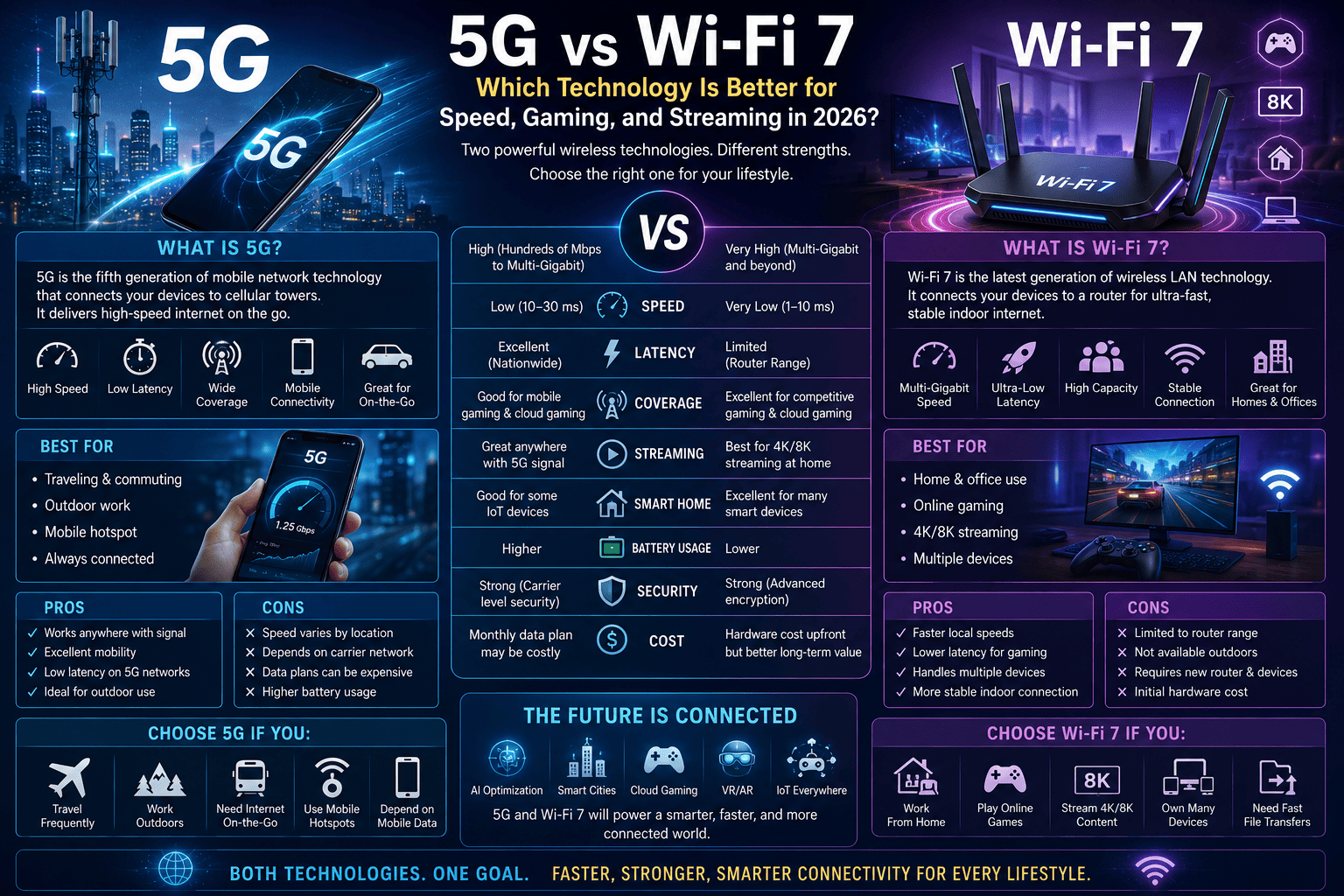
 5G vs Wi-Fi 7: Which Technology Is Better for Speed, Gaming, and Streaming in 2026?
The demand for faster and more reliable internet has never been greater. From 4K and 8K video streaming to cloud gaming, remote work, online education, and smart homes, modern lifestyles depend heavily on strong wireless connectivity.
Two technologies are leading this evolution: 5G and Wi-Fi 7.
Although many people compare them as competing technologies, the reality is that they are designed for different situations. One is built for mobile connectivity, while the other is optimized for local wireless networking.
Understanding their strengths and limitations can help users choose the right technology—or even use both together.
What Is 5G?
5G stands for the fifth generation of mobile network technology. It is the successor to 4G LTE and offers significantly higher speeds, lower latency, and improved network capacity.
Unlike Wi-Fi, which depends on a local router, 5G connects smartphones, tablets, laptops, and other devices directly to a cellular network through nearby cell towers.
Key features of 5G include:
- High-speed mobile internet
- Low latency
- Better support for connected devices
- Improved video streaming
- Enhanced online gaming
- Faster downloads
- Reliable remote communication
Because it works through mobile networks, users can stay connected while traveling, commuting, or working outdoors.
What Is Wi-Fi 7?
Wi-Fi 7 is the latest generation of wireless local area networking technology.
It is designed primarily for homes, offices, schools, airports, and other indoor environments where devices connect to a wireless router.
Compared with Wi-Fi 6 and Wi-Fi 6E, Wi-Fi 7 introduces significant improvements in speed, efficiency, and latency.
Major benefits include:
- Multi-gigabit wireless speeds
- Lower network congestion
- Better performance with many connected devices
- Improved video conferencing
- Faster file transfers
- Stable cloud gaming
- Reduced buffering
Wi-Fi 7 is especially useful for environments where dozens of devices operate simultaneously.
Speed Comparison
One of the biggest reasons people upgrade internet technology is speed.
Both 5G and Wi-Fi 7 are extremely fast, but their maximum performance differs.
5G Speed
Depending on the network and signal quality, 5G can provide:
- Hundreds of Mbps in typical conditions
- Multi-gigabit speeds in ideal environments
- Fast mobile downloads
- Smooth cloud services
However, actual performance varies depending on location, network traffic, and carrier infrastructure.
Wi-Fi 7 Speed
Wi-Fi 7 is designed for even higher local wireless speeds.
It supports:
- Multi-gigabit wireless networking
- Extremely fast local file transfers
- High-bandwidth applications
- Large media downloads
- Multiple simultaneous users
For indoor wireless networking, Wi-Fi 7 generally delivers higher peak speeds than 5G.
Winner: Wi-Fi 7 for local wireless speed.
Latency Comparison
Latency measures how quickly data travels between devices.
Lower latency means faster response times.
This is especially important for:
- Online gaming
- Video calls
- Live streaming
- Remote work
- Virtual reality
5G significantly reduces latency compared to older mobile networks.
Wi-Fi 7 also introduces extremely low latency within local networks.
For users connected to a quality router, Wi-Fi 7 often provides slightly more consistent low-latency performance indoors.
Winner: Wi-Fi 7 for indoor responsiveness.
Coverage
Coverage is where 5G has a clear advantage.
Because 5G operates through cellular networks, users remain connected while moving.
Examples include:
- Driving
- Traveling
- Public transportation
- Outdoor work
- Delivery services
- Navigation
Wi-Fi 7, on the other hand, depends on the range of a wireless router.
Once you leave the coverage area, the connection ends.
Winner: 5G.
Gaming Performance
Modern gaming requires:
- Fast download speeds
- Stable connections
- Low latency
- Minimal packet loss
5G Gaming
5G performs very well for mobile gaming and cloud gaming while traveling.
However, signal quality may fluctuate depending on:
- Tower distance
- Building interference
- Network congestion
Wi-Fi 7 Gaming
Wi-Fi 7 provides:
- Stable indoor connections
- Lower latency
- Faster game downloads
- Better multiplayer experiences
- Improved cloud gaming
Competitive gamers generally prefer Wi-Fi when available.
Winner: Wi-Fi 7.
Streaming Performance
Streaming services now support:
- 4K video
- 8K video
- HDR content
- Live streaming
Both technologies handle high-quality streaming very well.
5G allows users to stream almost anywhere.
Wi-Fi 7 delivers smoother playback inside homes because of its higher bandwidth.
Large households benefit especially from Wi-Fi 7 when multiple people stream simultaneously.
Winner: Tie, depending on location.
Smart Home Compatibility
Smart homes continue growing rapidly.
Connected devices include:
- Smart TVs
- Cameras
- Speakers
- Lights
- Thermostats
- Doorbells
- Appliances
Wi-Fi 7 is specifically designed to support many connected devices without slowing down.
Although some smart devices use 5G, most home automation systems depend on Wi-Fi.
Winner: Wi-Fi 7.
Battery Consumption
Battery life matters for smartphones and portable devices.
Modern 5G chips have become more efficient, but maintaining mobile network connections still consumes more power than using a strong local Wi-Fi connection.
Wi-Fi generally places less strain on batteries during prolonged indoor use.
Winner: Wi-Fi 7.
Security
Security is essential in today's connected world.
5G Security
5G introduces stronger encryption and more advanced authentication compared to previous mobile generations.
Carrier-managed security also reduces certain risks.
Wi-Fi 7 Security
Modern Wi-Fi 7 routers support advanced encryption protocols that improve protection for home and business networks.
Users must still configure strong passwords and update router firmware regularly.
Both technologies provide strong security when properly maintained.
Winner: Tie.
Cost Comparison
5G requires:
- A compatible smartphone or modem
- A mobile data plan
- Carrier subscription
Heavy data usage may increase monthly costs.
Wi-Fi 7 requires:
- A compatible router
- Broadband internet service
- Compatible devices
Although the initial hardware investment may be higher, unlimited home internet is often more cost-effective for heavy users.
Which One Is Better for Different Users?
Choose 5G If You:
- Travel frequently
- Work remotely outdoors
- Need internet while commuting
- Use mobile hotspots
- Depend on mobile connectivity
Choose Wi-Fi 7 If You:
- Work from home
- Play online games
- Stream 4K or 8K content
- Own many smart home devices
- Need fast file transfers
Many people will benefit from using both technologies together.
The Future of Wireless Connectivity
Rather than replacing each other, 5G and Wi-Fi 7 will continue evolving side by side.
Future developments may include:
- Smarter network management
- AI-powered traffic optimization
- Better cloud gaming
- Faster virtual reality experiences
- More connected smart cities
- Improved remote healthcare
- Autonomous transportation
- Expanded Internet of Things (IoT)
As wireless technologies advance, users will experience faster, safer, and more reliable internet almost everywhere.

You must be logged in to post a comment.