Didier Fraisse's name appears in the credits behind a kind of television that viewers often remember through its presenters. A studio conversation, a televised game and a sports programme all need someone to decide how the available pictures become the picture on screen. Looking at that work provides a useful way to approach the renewed interest in the French television director.
Stratégies reported on 30 October 2026 that Fraisse had died on Thursday, 29 October, aged sixty-five. This article attributes that news to the publication; it does not claim independent contact with his family. The focus here is his documented professional work and the choices a viewer can learn to notice: https://www.strategies.fr/actualites/medias/LQ6829560C/le-realisateur-didier-fraisse-disparait-le-monde-de-la-tele-lui-rend-hommage.html
Two France Télévisions press records offer concrete starting points. One contains Fraisse's own explanation of a virtual Olympic studio. Another identifies his studio-directing credit separately from the director of the documentary within a programme. Those records tell us more reliably what he did than an unsourced list of famous broadcasts.
Why Didier Fraisse is today's France selection
Google Trends' France Trending Now page was retrieved at 11:43 UTC on 30 October. With past twenty-four hours, all categories, all trends and search-volume descending selected, didier fraisse ranked first, displaying 200K+, an increase of 1,000 percent and Active status: https://trends.google.com/trending?geo=FR&sort=search-volume
That is the observed search position and threshold, not a count of bereaved viewers, a measure of his complete audience or a claim about advertising value. France is an owner-approved editorial market. The ranking helps explain topic selection; programme credits and other sources support the substantive account.
This profile is distinct from today's Patrick Stewart article. The subject is television direction rather than a performer's roles. It does not infer a precise reason for every search or convert a current search spike into evidence for an unverified career anecdote.
Start with a credit that says exactly what it means
France Télévisions' 16 July 2024 Affaires sensibles release names Didier Fraisse as the studio director. It separately credits Alexandra Colineau with the documentary. Fabrice Drouelle is identified as presenter. The programme draws on the France Inter format: https://www.francetvpro.fr/contenu-de-presse/67619796
The distinction matters. Saying that Fraisse directed the studio portion is supported by the record. Saying that he directed every documentary image in that edition would erase a separate named contribution. A programme title can contain several different kinds of authorship, technical responsibility and presentation.
When reading television credits, keep the role attached to the name. A researcher compiling a short biography can otherwise turn an accurate credit into an inaccurate sentence simply by dropping two words. Here the words studio director make the account more informative, not less impressive.
The same discipline applies to dates. A press release can announce a repeat, an online collection or renewed availability. Its publication date is not automatically the original broadcast date. The release itself says the documentary was initially broadcast on 24 September 2023. Those are different events in the life of the programme.
The Olympic studio as a documented example
In its Tokyo Games dossier, France Télévisions describes entrusting Fraisse with Olympic presentation images for its channels since Beijing in 2008. The dossier includes his account of developing a virtual main studio with internal teams, including the real-time graphics department. He describes a Tokyo green-screen studio whose pictures were transformed through production work in Paris: https://www.francetvpro.fr/contenu-de-presse/17310440
This is a broadcaster's contemporary presentation and an attributed first-person account. It supports discussion of the collaboration and the intended visual setting. Its promotional claims about uniqueness should not be mistaken for an independently established worldwide technology record.
The example also puts a team back into the story. A director's idea requires people who can make the images, graphics, sound and connections work together. Giving the director credit does not require describing a complicated broadcast environment as the achievement of one person alone.
The practical viewing question is what the setting helps a viewer understand. Does an opening view establish where the conversation belongs? Does a transition make a change of subject readable? A virtual background can be elaborate, but its usefulness still depends on whether people and information remain easy to follow.
What a multi-camera director contributes
ScreenSkills describes the multi-camera director as responsible for a programme's visual character and moment-to-moment direction, working with the producer and other craft teams. It distinguishes the producer's editorial responsibility from the vision mixer's execution of instructed cuts: https://www.screenskills.com/job-profiles/browse/unscripted-tv/editorial/multi-camera-director/
This is general professional context, not a transcript of Fraisse's instructions. It helps explain why a directing credit matters even when the director never appears in the finished programme. The familiar person addressing the audience is only one participant in how the broadcast reaches that audience.
Think of three separate questions: what is happening, which available view should represent it now, and how is that view put on air? These questions interact, but they are not identical jobs. A clear explanation of television should preserve that distinction rather than assigning every decision to the presenter.
For viewers, the result can be tested without specialist equipment. When a programme becomes difficult to follow, ask what information is missing. Is the speaker unidentified, is an object out of view, or is the programme moving on before a question has been understood? That describes the experience more precisely than calling every quick sequence exciting.
A fictional studio exercise: the missing envelope
Consider an invented programme in which a host asks a guest to open an envelope. Nothing in this example describes an actual Fraisse production. Its purpose is to make visible a set of viewing choices that can otherwise pass unnoticed.
An opening wide view could show both people and the table between them. A closer view could then make the envelope legible as the object of the conversation. If the guest begins to answer while still holding it, staying with the guest might preserve an important connection between action and speech.
There is no universal rule that the closer view must come after a particular number of seconds. The useful question is whether each change gives the audience something it needs. Replacing a clear view with another clear view simply because time has passed may add movement without adding understanding.
Now imagine cutting to the host just as the guest reveals what is inside. A viewer might hear the answer but miss the gesture that makes it meaningful. That is a specific observation about the sequence. It is not proof that the director made a mistake: another view, a technical limitation or an editorial reason might explain the choice.
Watch what a reaction shot can and cannot tell you
In the fictional envelope scene, a reaction shot might show the host smiling. We can describe the visible expression and the point at which the shot appears. We cannot safely turn that image alone into a detailed account of the host's private feelings or what happened outside the frame.
That distinction is particularly useful when watching an excerpt detached from its original programme. A short clip can preserve a compelling facial expression while losing the question that preceded it. Before building an interpretation, look for the longer sequence and establish whether the available context supports it.
A practical note might read: the view changes from the guest to the host after the envelope opens; the host smiles; the guest continues speaking off screen. That note keeps observation separate from interpretation. A second sentence can then explain how the change affected your ability to follow the exchange.
This is a modest exercise, but it improves discussion. Two viewers may disagree about whether the moment felt warm or awkward while still agreeing on what the picture and sound actually presented. The shared description gives their disagreement somewhere useful to begin.
The cut is a collaboration
ScreenSkills' vision-mixer checklist explains that the role involves switching among camera sources, recorded material, graphics and other feeds in real time. It also notes that responsibilities vary with a production's scale and format: https://www.screenskills.com/skills-checklists/unscripted-tv/live-studio-and-outside-broadcast-department/vision-mixer-skills/
That professional distinction prevents a common shorthand from becoming misleading. A viewer may casually credit the director for the sequence, while the practical execution involves a specialist colleague and a wider crew. The credit does not disappear when the collaboration is acknowledged; its meaning becomes clearer.
For the fictional envelope programme, imagine writing two notes after a rehearsal. One concerns whether the reveal is visible. The other concerns whether a name caption covers the envelope. They are connected presentation problems, but resolving them might involve different people and different pieces of preparation.
The useful lesson is to describe the problem before prescribing a tool. An additional camera does not automatically solve a missing explanation, and a decorative transition does not automatically clarify a change of subject. Begin with the information the viewer needs, then consider how the production can present it.
A simple way to study one minute of television
Choose a legally available programme segment and write down its title, source and the point where your minute begins. Watch once without pausing to understand the conversation or activity. Then watch again, this time noting when the view changes and what each new view adds.
Use short descriptions: both speakers, guest, object, host, inserted photograph. You do not need to guess the camera number or reconstruct the production gallery. If the source does not identify whether the programme was live, do not treat its apparent immediacy as proof of live transmission.
On a third pass, compare the sound with those changes. Can a person finish an explanation while another image supplies useful context? Does a caption introduce information at a helpful moment? Record one example that clarified the sequence and one point where you wanted more context.
Finish with a paragraph supported by those observations. For another exercise in describing screen choices, see our guide to studying a film scene: https://monetizearticle.com/article/watch-one-scene-again-a-practical-way-to-talk-about-film-867c4e
For an accessible version of the exercise, begin with a segment that supplies captions and a transcript where available. Compare the written exchange with the visible sequence. Keep a note of anything the transcript cannot convey, such as an object being shown or a change of speaker position.
A fair career account leaves room for uncertainty
A directing credit is strong evidence of a documented role. It is weaker evidence for a sweeping judgement about every programme bearing that name. Similarly, a broadcaster's interview can explain a project in the director's own words without independently verifying every claim of technical precedence.
Keep a small source record if you are exploring Fraisse's work: programme title, credited role, broadcaster page, publication date and any original broadcast date stated there. Add a separate field for what remains unknown. Leaving a gap visible is better than filling it with a plausible but unsupported story.
That approach is useful during a fast-moving news cycle, when tributes, old interviews and newly reposted clips can appear together. Their posting dates may be current while the material they describe is much older. A thoughtful profile should help readers distinguish those layers rather than flattening them into a single timeline.
Conclusion: look behind the familiar face
Fraisse's documented studio and Olympic work provides a way into television direction without relying on invented backstage memories. The precise credits show why a programme is a collaboration, while the virtual-studio account offers a concrete example of a director working with specialist teams.
The next time a presenter leads an exchange, notice what the picture lets you understand. Who is visible, what has been made clear, and what remains outside the frame? Those questions turn an often overlooked credit into a useful way of watching.
Sources and research note
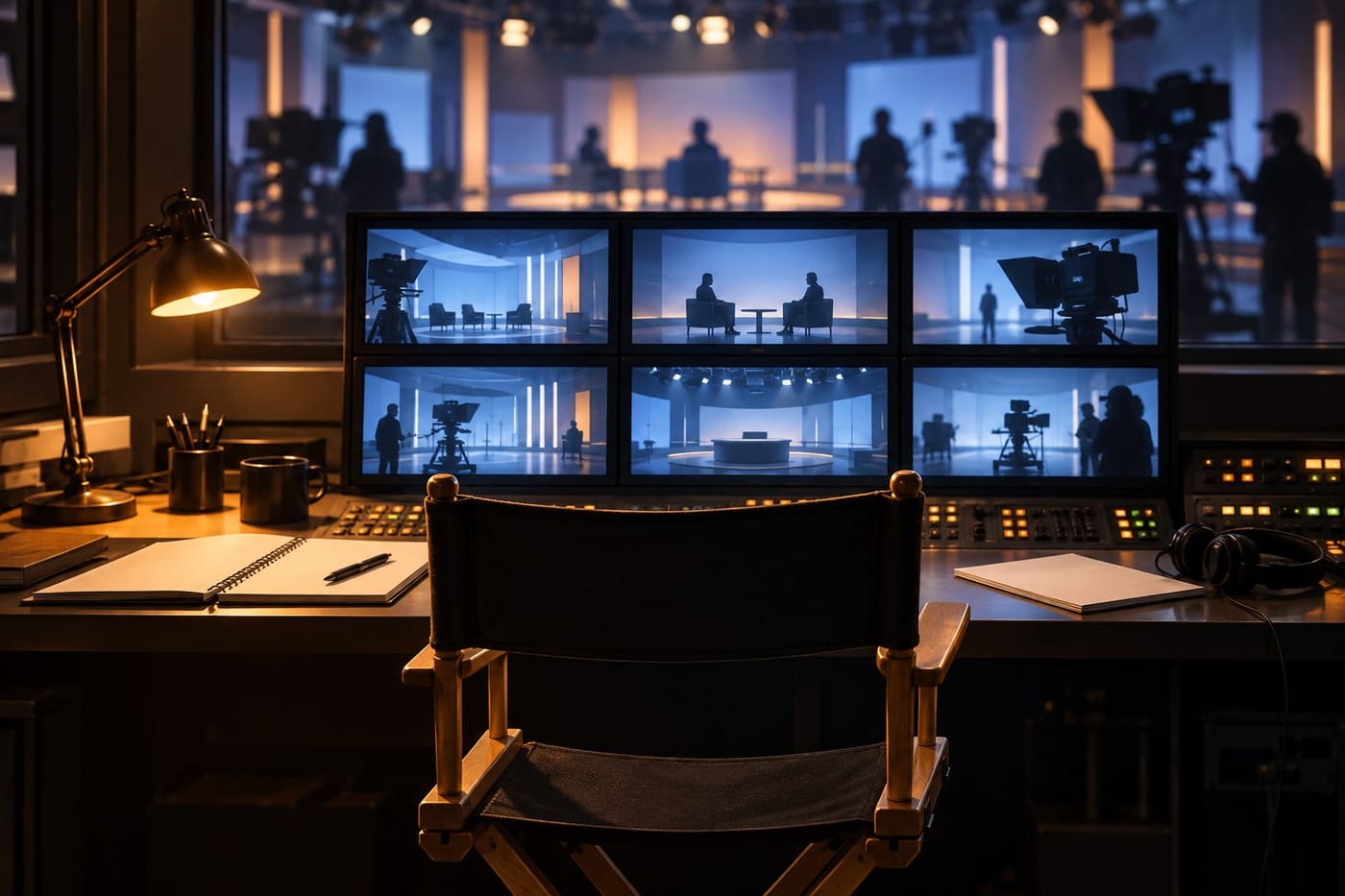
Research date: 30 October 2026. France Télévisions' Tokyo dossier and July 2024 programme release support the specific career examples. ScreenSkills supports the general role distinctions. The death report is narrowly attributed to Stratégies; no direct family contact or private medical verification is claimed. No programme or interview audio was watched or heard for this article. The envelope exercise is original fiction, not reported production experience. The accompanying original AI-generated conceptual illustration represents a generic television gallery, not Fraisse, his workplace or an actual broadcast. Search ranking describes the recorded Google Trends snapshot only.