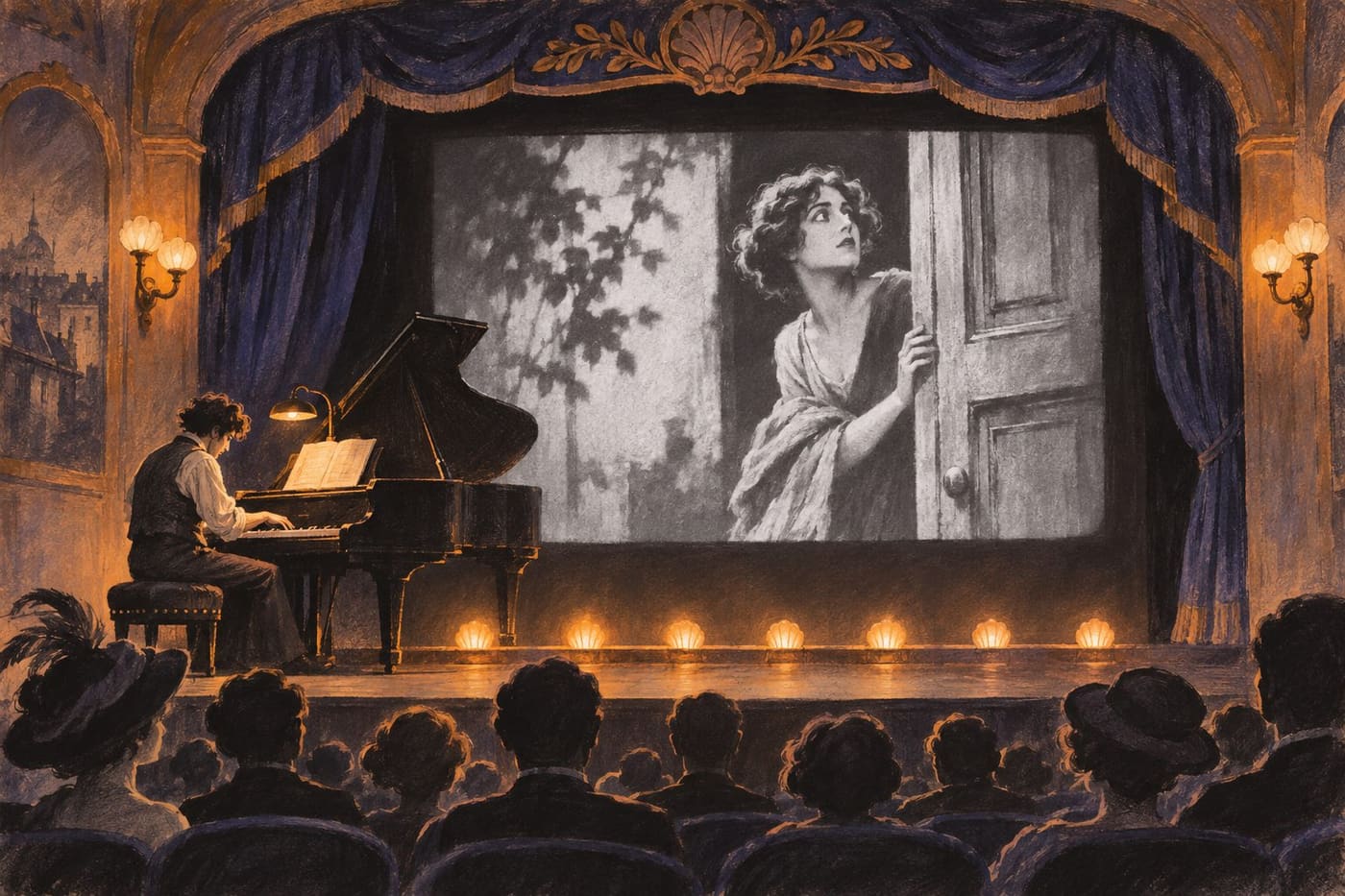
On the screen, a person waits beside a door. A pianist holds a quiet chord. The door opens, and the next note arrives a fraction later than you expected. A moment that might have seemed ordinary now feels like a decision. The picture has given you a movement, the music has given you a way to attend to it, and the timing of the two belongs to the performance you are seeing.
The doorway is fictional. It offers a simple way into a French ciné-concert, a screening presented with a musical performance. For a first visit, the useful questions start with the listing and continue once the lights go down. What is live? What is part of the film copy? How will you follow the intertitles? And what can you notice about the meeting of picture and music without spending the whole film analysing it?
Read the listing as a description of a particular performance
Start with the film title, then look for a separate accompaniment credit. A listing may name an instrument or ensemble, identify the performer, or say that the music is improvised. The Pathé description of the Fondation Jérôme Seydoux-Pathé describes screenings of silent films accompanied by pianists from Jean-François Zygel's improvisation class at the Paris conservatoire. It gives one specific example of how a venue can present silent films. Read the individual programme for the session you are considering.
Three short phrases can help when scanning a French listing. “Film muet” describes the film as silent. “Accompagnement au piano” points to piano accompaniment. “En direct” means live. Look at the phrases around those words. An online film labelled “muet avec musique” can have music in the version being played. That wording alone does not tell you that a musician is performing in the room.
The Cinémathèque française's HENRI listing for Vent debout describes the 1923 film as silent with music and French intertitles. It also identifies its restoration source. The listing is a useful contrast in what a description can tell you. The restoration information describes the film material. The music and language labels describe features of the presentation. A live session can have its own separate credits, even when the film title is the same.
Look for a programme that consists of a single feature or a sequence of shorter pieces. For a sequence, check whether the listed duration covers the whole event and whether there is an introduction or interval. A single runtime beside a film title may refer only to the film. Practical details belong to the session listing, especially if you need to plan a return journey or leave at a fixed time.
Find out how you will follow the written titles
Intertitles are written cards in the film. They can convey speech, give context or move the story from one point to another. A French intertitle can tell you that the words on the screen are French. It does not tell you whether an English translation will be displayed at the session. If the listing mentions translation, check what language it gives and how it will appear. The important information is what a viewer will actually be able to read in the room.
Imagine two fictional listings for the same film. One says French intertitles and gives no translation information. The other says French intertitles with English subtitles. In the first case a viewer who needs English should seek confirmation. In the second case, that viewer can still check whether the translation is part of the actual session and whether any other access information is available. A title's original language and the language support for a screening are separate details.
You can also prepare without reading a full plot. Read a brief synopsis to learn the setting and the main relationship, then stop before the summary reveals the ending. That gives you a way to recover if you miss a title card. In a short scene, a repeated object or a change in who occupies the frame can help you follow what is happening even when you did not catch every word.
When choosing a seat, give priority to reading the screen if that is what you need to follow the film. A clear view of the pianist can be enjoyable, but you may have to choose between seeing the keyboard and reading the titles without turning your head. Check what the venue says about the room and access arrangements before relying on any assumption based on another cinema.
Listen for three relationships between the music and the image
The first is anticipation. A sound can make you expect a change before anything on screen moves. Return to the invented doorway. If a repeated figure starts while the person is still waiting, you might begin listening for a break in it. When the door opens, the break can feel like a release. The picture gives the event and the music shapes the expectation around it.
The second is alignment. A note can coincide with a movement or a cut. At the doorway, a short accent at the moment a hand touches the handle can draw attention to the gesture. A performance does not need to accent every movement for this to matter. If only one gesture is marked, notice what makes that choice different from the surrounding music. A quieter gesture can become the thing you remember.
The third is a change that comes after the image. The screen cuts away and the pianist keeps the same figure for a moment before turning to something else. That can connect the two shots or delay your sense that the scene has moved on. In the invented example, a chord held after the door opens can leave you uncertain about whether the character's arrival has resolved anything.
None of those readings requires you to know the names of the chords. You can listen for a change in speed, loudness, register or repetition. Pick one feature for a scene and see when it changes. Then return your attention to the story. Watching closely for a short stretch can make the rest of the film easier to enjoy, because you have heard one example of how the performance is working.
Separate the characters’ world from the performance in the room
Music can suggest the weight of a footstep or the rhythm of a moving vehicle. It can also continue over a sequence without pointing to any sound a character would hear. When it seems to mimic a movement, ask whether the connection comes from the timing you hear in the room or from a cue within the film's story. That distinction can make a viewing conversation more precise.
For a related explanation, see Film Sound, which distinguishes a sound's role in a story from the way it was created. At a ciné-concert, you can make a similar distinction while hearing the accompaniment being played. A rising phrase may belong to your experience of the scene, even if nothing in the fictional room produces that phrase.
The Fondation Jérôme Seydoux-Pathé's dated sound-effects workshop listing describes a session in which participants try making effects with percussion and coordinating them with images. That was a particular workshop, with dates stated by the venue. It offers a concrete example of synchronization as a task. The musical role at the screening you attend may be broader than illustrating individual actions.
Listen to a stretch where the music and image seem to be moving differently. A fast sequence might sit over a slow phrase. A still picture might be accompanied by a restless pattern. Describe what each is doing before deciding what the combination means. A comment such as “the piano kept repeating the same figure after the image became still” gives another viewer a detail they can remember and compare with their own impression.
Leave room for variation between performances
If a programme credits improvised accompaniment, treat the musician's choices as part of the event. A performer can make different decisions about emphasis, pauses and transitions. A version with a recorded track gives you a repeatable combination of picture and music in that particular release. When you compare two experiences, note the performer or track and the presentation you saw.
Suppose one fictional pianist follows the doorway gesture closely with several accents. Another plays a slow pattern that continues across the opening and the cut. The same image sequence can support both approaches. You might prefer one in the moment and notice a detail in the other that you missed before. To make the comparison useful, identify which gesture or transition you are describing instead of judging the entire screening from one impression.
Check whether the film copy is actually the same before assigning all differences to the music. The HENRI listing for Vent debout identifies the source used for that restoration, which illustrates the kind of information an archive can provide. Another session's description may give less detail. If you cannot tell which copy was used, keep that uncertainty when describing what changed.
For a short observation after the screening, write down one change in the picture and one musical event nearby. A few concrete words are enough. “Door opens, long chord continues through the cut” gives you more to discuss than “the music was dramatic.” If you went with someone else, ask which moment they noticed. They may have been watching the actor while you were listening for the next note.
Try the same listening exercise with a sequence of shorts
A programme of short films gives you several openings to compare. In a fictional programme, the first film starts with a busy street and the second with a person waiting in an empty room. Listen to how the performance handles the first seconds of each film. A burst of sound at the start may set a pace you expect the images to follow. A delayed entrance can give the first images room to establish a place before the piano joins them.
Between the films, notice whether there is a full break or a continuous musical transition. If the programme introduces each short separately, the break may help you reset your expectations. If the music carries through, it may make the first and second films feel related even when their stories have little in common. The programme order is part of what you are hearing that evening.
You can discuss one opening with a companion afterwards without spoiling the rest of either film. Name the first change you recall and say whether it was on the screen or at the piano. Compare those two memories before looking up a synopsis. The aim is to recover an observation from the performance, even if neither of you knows how the accompaniment was planned.
Make a small plan for the visit
Before you leave, check the exact venue, session time and any admission instructions on the organiser's page. Check the programme length and intertitle language. If a practical detail matters, such as whether an interval is scheduled, confirm it for that event. A series description can explain the theme while a session listing carries details that apply to a single performance.
During the screening, choose one scene to listen to actively and give the rest of the film your ordinary attention. If you miss a card, let the following image supply whatever context it can. If the music surprises you, remember the moment and return to it afterwards. There is no need to take notes in the dark for the exercise to work.
After the film, keep the title and musician's credit together if the programme supplies both. That small record lets you distinguish what you saw from another screening or a version you find online. The next time a programme lists a ciné-concert, you can read it with a concrete question in mind. What changes in this performance when a musician makes choices alongside the moving picture?
Sources consulted 7 November 2026. Pathé, La Cinémathèque française and the Fondation Jérôme Seydoux-Pathé provide the presentation examples. The doorway scene, sample listings and listening comparisons are original hypothetical examples.