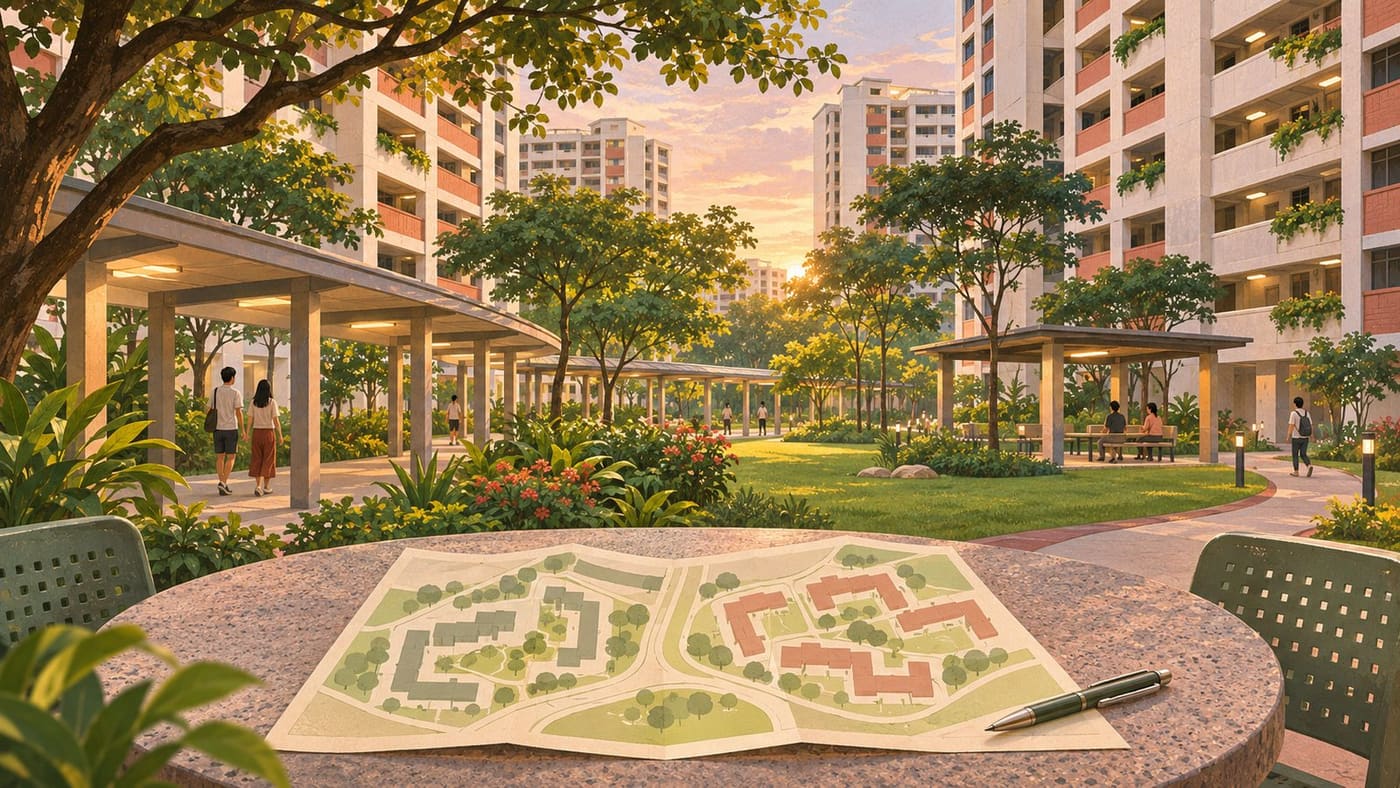
Singapore’s Housing & Development Board launched 7,964 Build-To-Order flats across seven projects on 4 November 2026. The projects span six towns because Bedok has two developments in this exercise. Applications close at 11:59 p.m. on 11 November, according to the official sales launch page. HDB says successful applicants are determined by a computer ballot. An application made earlier in the window does not move ahead merely because it arrived first.
The dated launch announcement provides the project classifications and identifies the development with the shortest published waiting time. The sales page is the starting point for the application window. Use both when comparing projects. A headline about the total supply describes the whole exercise. The project information helps answer whether a particular development, flat type and timeline fit a household.
Find the project before comparing the category
HDB lists three Standard projects. They are Sembawang Anchor in Sembawang, Plantation Dew in Tengah and Chencharu Acres in Yishun. The three Plus projects are Bayshore Sails and Bayshore Oasis in Bedok and Merpati Meadow in Geylang. Toa Payoh Hillside is the sole Prime project in the exercise. Those are classifications of the named projects in this launch. Do not infer the classification of a different development solely from the town name.
The Bedok pair is a useful example of why it helps to write down the full project name. A comparison based on the word Bayshore alone can accidentally join two sets of details. Record the exact development on one line, with the town and classification next to it. Then open the matching project information before comparing flat types, estimates or conditions. A line in your notes that says only “Bedok Plus” still leaves two possibilities in this launch.
Compare the waiting-time figures on the same basis
HDB singles out Sembawang Anchor for its shorter waiting time. The prelaunch announcement identifies 1,310 flats there and says the wait is less than three years. The November launch announcement says the other six projects have waiting times of less than four years. The overall statement that the projects have waits under four years is compatible with Sembawang Anchor having a shorter estimate.
Use the published estimate to compare plans rather than pencilling in a guaranteed moving day. If your current arrangement ends at a fixed point, the practical question is how much flexibility you would need before the keys become available. A shorter published wait is relevant to that question, but it cannot decide whether a location works for the household in the meantime. Similarly, a preferred location does not shorten the wait for that development.
For example, consider two people who need to remain close to a regular caregiving commitment for another year. They can compare travel from the prospective address, then make a separate note about how long they would need their current arrangement. If they start by treating the project with the shortest estimate as the automatic choice, they may overlook the practical importance of the trip they expect to make several days a week. Keeping the location and timeline on separate lines makes that trade-off visible.
The launch total of 7,964 also does not tell you how many flats match your comparison. It includes a range of flat types. Begin with the relevant project, look for the type that fits the household, then check the published information for that combination. Comparing one project's total with another project's supply of a particular type would mix two different measures.
Check income ceilings against the applicable scheme
HDB calls this the first sales exercise since the monthly household income ceilings were raised to S$16,000 for families and S$8,000 for singles. Its earlier policy announcement explains the changes and specifies that the revised ceiling for singles discussed there applies to eligible singles aged 35 and above buying a subsidised flat or obtaining an HDB housing loan under the applicable rules. Read that qualification alongside the number.
A ceiling tells you about an upper income limit within a stated scheme. It does not resolve every condition that may apply to a particular applicant or flat. A household can use the announcement to see what changed and then consult HDB's own application guidance to establish which terms apply. This distinction is particularly important when people share a screenshot containing only the two numbers, since the missing heading may be the part that tells you who the provision covers.
If a household already started looking at the process under the earlier rules, it is worth checking which version its own documents refer to. The policy announcement explicitly discusses the revised ceilings and the move of the exercise to November. The launch page then identifies the actual application window. Keep the earlier policy explanation and the live application instructions in separate tabs. They answer related questions at different levels of detail.
Likewise, a family comparing two projects should avoid using the income ceiling as a proxy for the monthly cost of either one. The launch figure concerns eligibility under the scheme described. The relevant project and flat information is where the household can begin a separate comparison of costs and commitments. An example based on a different unit, grant assumption or loan arrangement cannot settle the household's own figures.
Read the Toa Payoh Community Care Apartment detail separately
Toa Payoh Hillside has a second distinction besides being the launch's sole Prime project. The launch notice identifies it as the sixth Community Care Apartment project and says the eligibility age for that offering was lowered from 65 to 55. This is a specific detail about Community Care Apartments. It should not be read as a new general age threshold for every flat in the exercise.
If someone in a family has shared the age change, the next useful step is to check whether the discussion is about a Community Care Apartment or a different flat type. Ask which project the person is looking at and what type of unit is under consideration. That avoids assuming an age rule from one offering applies to a separate choice. The launch announcement's project description is a better reference than a broad summary of the exercise.
The same care applies to a flat type mentioned elsewhere in the announcement. HDB describes a range that includes 2-room Flexi and 3Gen flats as well as Community Care Apartments. A range across the exercise does not mean that every type is offered in every development. Confirm the combination in the project information. Where a requirement depends on the type of flat, keep the name of that type attached to the requirement when you share it.
Use the application window without mistaking it for a queue
The sales exercise page gives the closing time and says the computer ballot determines successful applicants. It explicitly says the exercise is not first come, first served. This means the published closing time is the deadline to work from. It does not create a reason to choose a project before you have understood what you are comparing.
Still, submitting near the deadline can leave little time to deal with questions or correct an incomplete application. A useful planning sequence is to check which project you want to examine, consult the relevant official information, then set aside time to review the application instructions before the window closes. The time you allow for preparing documents is a matter of practical planning. It is separate from how the ballot itself works.
Think of three milestones. The opening announcement describes what is offered. The closing time tells you when the window ends. The ballot is the selection process described by HDB. These milestones do different jobs. An application window does not promise a successful ballot outcome, and the fact that a project appears in the launch does not reserve a unit for any individual applicant.
When sharing the deadline, include the full date and time and link to the official page. A screenshot with the number 11 can be ambiguous once it has been detached from the month or exercise. If you open the sales page later, confirm that it still displays November 2026 before passing along a detail from it. A standing sales-launch address can serve future exercises as well, which makes the dated launch announcement useful for identifying the original release.
Build a comparison that can survive a change of preference
A simple working comparison can have one row for each project you are considering. Give the full project name, town, classification and the particular flat type you are checking. Put the published waiting estimate beside those fields. In a separate column, write one reason the location might work and one question that remains open. This keeps the information HDB supplies separate from the household's own assessment.
For a concrete example, imagine that a family first shortlists one of the Bedok Plus projects because a familiar name caught its eye. When another family member suggests Sembawang Anchor, the comparison should change in two visible ways. The location and project classification are different, and the new entry has the shorter waiting-time designation identified by HDB. The comparison does not require the family to settle those factors in a single step. It helps them see which part of the decision changed.
A second household might start with Toa Payoh Hillside because it heard about the lower age threshold for Community Care Apartments. Its next check should identify the offering it actually wants. If it is interested in another flat type, the age detail that prompted the search might no longer be the relevant starting point. Keeping the row tied to a specific offering protects against importing conditions from the part of the announcement that originally caught the reader's attention.
When the household reaches a decision, note the exact official project page used and when it was checked. If someone later sends a new screenshot, compare the project name and the exercise date first. An earlier HDB announcement may still explain why the household began looking at a particular place, while the current exercise materials contain the details it needs to verify before applying.
Keep the November figures separate from the annual totals
The launch notice also reports that HDB launched 23,928 new flats in 2026 through this exercise, counting 19,608 BTO flats and 4,320 Sale of Balance Flats. The figures describe supply announced during the year through the date of the release. They do not describe the number of homes in the November ballot. The November total is the figure attached to this specific BTO exercise. Keep the two figures on separate lines if you are using the announcement to compare the scale of different launches.
The annual figure combines two kinds of sales exercise. A comparison across months should therefore use the same kind of count in each entry. If a friend sends the annual total as evidence that a particular November project offers more choices than expected, return to the project information. Only that information identifies the choices within the named development. The year-to-date release figure answers a broader question about how much new supply HDB announced across the exercises it counted.
Conclusion
HDB's November exercise offers 7,964 flats across seven projects and six towns. Sembawang Anchor has the shorter waiting-time designation, while Toa Payoh Hillside is the sole Prime project and includes the Community Care Apartment offering described in the launch. Applications close on 11 November at 11:59 p.m., with selection by ballot. Start with the named project and flat type, then check the timeline and applicable conditions against HDB's own records.
The Singapore Google Trends capture on 4 November showed “hdb bto nov 2026” seventh by search volume over the past 24 hours, with 5K+ searches and an Active label. Higher-ranked rows overlapped existing coverage or lacked direct evidence for the proposed current treatment. The figures and dates in this guide come from HDB, while the Trends capture records search interest.
For another example of reading dated information alongside older records, see how to distinguish a dated resort notice from older listings.
Sources consulted 4 November 2026 include HDB's dated launch announcement, sales exercise page, revised income-ceiling notice and shorter-waiting-time announcement.