A shopping receipt is only the beginning of a Swiss customs check. A traveller also needs to know what the goods are for, whether their value crosses the VAT limit, whether a quantity allowance applies and whether the goods are permitted to enter at all. Answering only one of those questions can leave an important part of the journey unresolved.
For ordinary personal purchases carried into Switzerland, the Federal Office for Customs and Border Security provides a useful starting point: the CHF 150 VAT-free limit. But that number is not a universal permission to bring anything across the border. Nor is it a deduction that can always be subtracted from a larger purchase. This guide explains a practical preparation method, using the official information checked on 1 November 2026.
The focus is goods a person brings with them for private use or as gifts. Postal deliveries, business imports, vehicles and restricted goods can follow different procedures. Where the category or treatment is uncertain, use the customs authority's specific guidance and staffed declaration route rather than making an assumption from the price alone.
Start with the purpose of the goods
Before adding receipts, ask who will use each item and why it is being imported. A gift for a relative and stock intended for resale are different purposes, even if the physical items look alike. The private-traveller procedure should not be used simply because a business purchase fits into a suitcase.
The authority's travel and purchases guidance explains the importance of keeping valid travel documents ready and declaring carried goods and animals. It identifies QuickZoll as an option for most goods in tourist traffic, while distinguishing online shopping delivered across the border. Its recommendation when a traveller is unsure about declaring goods is to use the red channel.
For preparation, make a short list with a plain description beside each purchase: jacket for personal use, book as a gift, equipment for the company. The descriptions are working notes, not a substitute for a declaration. Their purpose is to reveal a mixed load before the border, when it is easier to find the correct instructions for the business item rather than treating the whole bag as personal shopping.
Understand the CHF 150 limit before doing arithmetic
The official VAT-limit page says qualifying goods up to a total value of CHF 150 can be brought in VAT-free, once per person per day, including children. If the total exceeds CHF 150, VAT applies to the total value rather than only the amount above the limit. An individual item worth more than CHF 150 remains subject to VAT regardless of how many people are travelling.
The distinction between a limit and a deduction is the key. A deduction would remove an amount from a larger taxable base. This rule instead determines whether the relevant value qualifies for the exemption. Crossing the limit changes the treatment of the total. Merely remembering the number, without remembering that structure, can lead to the wrong budget.
A receipt bundle is therefore more useful than an estimate based on the most expensive item. Smaller purchases can change a total. Write them down as they happen rather than relying on memory at the end of a busy shopping day. Keep the documents available so the value can be explained from actual evidence rather than a hurried approximation.
A worked example with deliberately simple assumptions
Suppose one adult traveller carries two ordinary personal items with established relevant values of CHF 95 and CHF 75. Assume both qualify for the standard 8.1 percent VAT rate, neither has a separate duty or restriction, and all valuation and currency questions have already been resolved. Their combined value is CHF 170, which exceeds the CHF 150 limit.
Under those assumptions, the illustrative VAT calculation is 170 multiplied by 0.081, or CHF 13.77. Calculating 8.1 percent of only CHF 20 would give CHF 1.62 and would use the wrong base. The point is not to provide a personalised assessment for an actual traveller. It is to show which number belongs in the multiplication once the applicable value and rate have been confirmed.
Now imagine the traveller finds a third receipt after calculating the total. The sensible response is to update the inventory and recalculate using the corrected information. It is not to treat the earlier estimate as a fixed entitlement. Good preparation keeps the evidence and the calculation together, so a change in one can be reflected in the other.
Value, quantity and permission are three checks
The FOCBS guidance on duty-free allowances distinguishes sensitive goods whose excess quantities can attract customs duty. It also points to additional restrictions for some animal and plant products. Staying within a value limit does not settle those separate questions.
A practical worksheet can therefore have three columns after the item description. The first records the relevant value. The second asks whether a quantity allowance needs checking. The third asks whether there is a restriction, certificate or authorisation requirement. A tick in one column should not automatically fill the others.
Consider an entirely hypothetical bag containing an ordinary scarf and a plant. Knowing their combined price does not identify the plant or determine its import conditions. The useful next step is to identify the species and origin and consult the relevant official plant guidance. A general shopping calculation cannot replace that category-specific check. The same principle applies whenever a product's treatment depends on more than its price.
This guide does not reproduce the allowance table or attempt to classify every food, medicine or other controlled product. Use the current official entry for the exact goods and origin. That is more reliable than treating a broad word such as food or gift as if it settled all possible cases within that category.
QuickZoll now distinguishes the two VAT rates
A FOCBS announcement published on 2 June 2026 explains that QuickZoll now allows goods values to be entered separately at the standard 8.1 percent rate and reduced 2.6 percent rate. The total VAT is calculated by the app. The announcement also explains that the simpler option of declaring everything at the standard rate remains available.
That change matters when reading older advice. A description of an app's earlier behaviour may have been accurate at the time and still be unsuitable for the current version. Check the publication date and the present official instructions before deciding that a feature is unavailable. This is especially useful when an old forum answer appears beside a current government result in a search.
The numerical difference can be illustrated without deciding the classification of a real product. On a hypothetical taxable value of CHF 100, 8.1 percent is CHF 8.10 and 2.6 percent is CHF 2.60. The difference is CHF 5.50. Those figures demonstrate why the correct rate matters; they do not establish that an unidentified item belongs in the reduced-rate category.
Use the app only for goods it can handle
The official QuickZoll page describes an app for private-use goods and gifts, available without prior registration. During payment, a traveller chooses a two-hour border-crossing window. It also identifies goods that cannot be cleared this way, including examples such as vehicles, weapons and live animals, for which a staffed crossing is required.
An app can simplify a suitable declaration without becoming a universal import permit. The first question is whether the goods are eligible for that route, not whether the interface accepts a number. If a product needs a different procedure, entering a value into a convenient tool does not remove that requirement.
Prepare the item information before the final travel stage. Keep the descriptions close enough to the receipts that you can tell which value belongs to which item. If travelling with others, confirm the number of people and the actual goods being declared rather than using a group size as a shortcut around the treatment of a single expensive item. This article does not attempt to resolve every multi-person allocation case; the authority provides specific examples for those situations.
Timing and proof deserve their own preparation
The QuickZoll questions and answers says purchases can be entered before crossing, with payment possible at most 48 hours before entry. The payment stage needs an internet connection. It also warns that receipts are lost if the app is deleted and recommends sending the receipt to yourself by email. These are official instructions, not a claim that this article tested the app or completed a transaction.
For a traveller, the practical lesson is to plan access to the proof as carefully as access to the calculation. A payment screen seen briefly is less useful than a retained receipt that can be produced when required. Keep it associated with the shopping documents and the journey for which it was generated.
If a payment appears interrupted or duplicated, do not invent a successful result from an uncertain screen. The official questions and answers provides a route for reporting payment problems and the evidence required. Preserve what happened and use that guidance. A customs payment problem should not be treated as resolved merely because a second attempt seemed easier than investigating the first.
The green channel is a declaration
The official air-travel guidance explains that choosing the green channel is a binding customs declaration. It is available for goods within the relevant allowances and value limit, or goods already cleared with QuickZoll, provided they are not restricted, prohibited or subject to a certificate or authorisation requirement. If uncertain, the guidance says to use the red channel, where staff can answer questions.
This makes the choice more than a decision about which queue looks shorter. A traveller should decide from the goods and their declaration status. The colour of the channel does not change what is in the bag, and following another passenger does not establish that the same declaration is appropriate.
A useful final pause before the channel is to check four things: the inventory is complete, the values are supported, any separate goods restrictions have been addressed, and the chosen clearance route matches the load. If one of those remains unresolved, identify it clearly when asking staff. A specific question about an actual item is easier to answer than an assumption that everything is ordinary shopping.
A foreign VAT refund is a separate process
The FOCBS explanation of foreign VAT refunds states that Swiss customs does not refund foreign VAT. Such refunds may be handled by the foreign seller or a tax-refund company under the relevant country's rules. Swiss VAT obligations do not disappear merely because the foreign VAT has not been refunded.
For budgeting, keep the two sides in separate records. One records any refund being sought from the foreign purchase. The other records the Swiss import calculation. Do not mark an expected refund as money already received, and do not treat it as proof that the Swiss declaration has been completed.
The distinction also helps when asking for assistance. A question about the foreign seller's refund paperwork belongs with that procedure. A question about declaring the goods on entry into Switzerland belongs with the Swiss customs guidance. Keeping the documents together while keeping the processes distinct reduces confusion without requiring a complicated accounting system. Our Finance coverage offers related practical approaches to keeping financial decisions clear.
Sources and research note
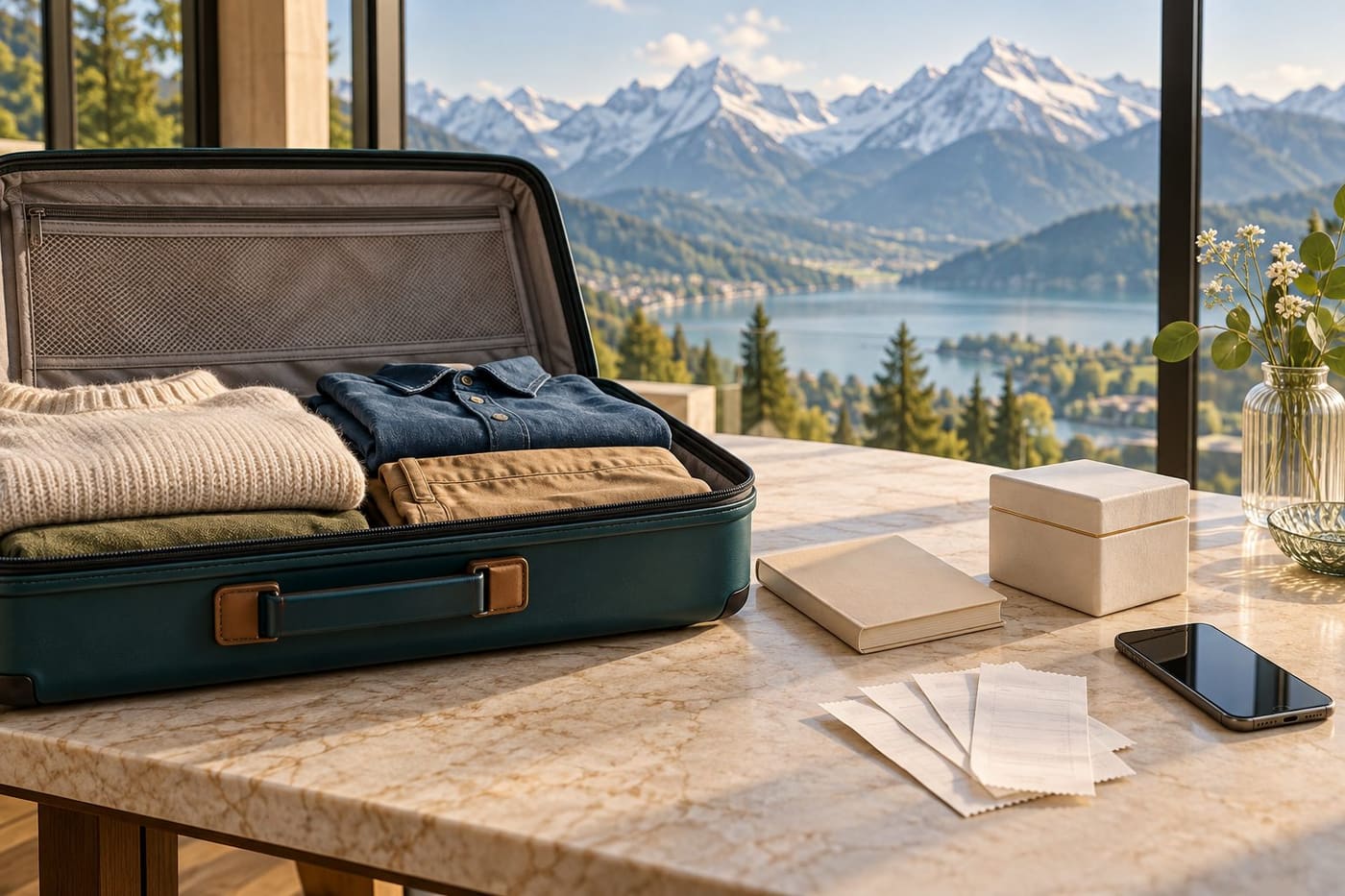
The official FOCBS pages linked above and its June 2026 QuickZoll announcement were checked on 1 November 2026. This is a general preparation guide, not an individual customs ruling or a completed app test. No goods were declared, no payment was made and no live transaction was used as a demonstration. The accompanying original conceptual luggage illustration is not an official customs document or application screen.
The Swiss Google Trends snapshot retrieved around 06:28 UTC on 1 November showed zoll first, with 10K+ searches and Active status, using the past 24 hours, all categories, all trends and descending search volume. That broad query does not establish why any individual searched. This article addresses the traveller-customs meaning; it does not claim a new rule was announced today or that search volume proves a particular news event.
Conclusion
Prepare a Swiss customs crossing by separating the questions: purpose, value, quantity and permission. Use the right declaration route for the actual goods, retain the supporting documents and keep any foreign VAT refund separate from Swiss import obligations. A complete inventory and the current official instructions are more useful than a single remembered allowance or an old screenshot of an app.