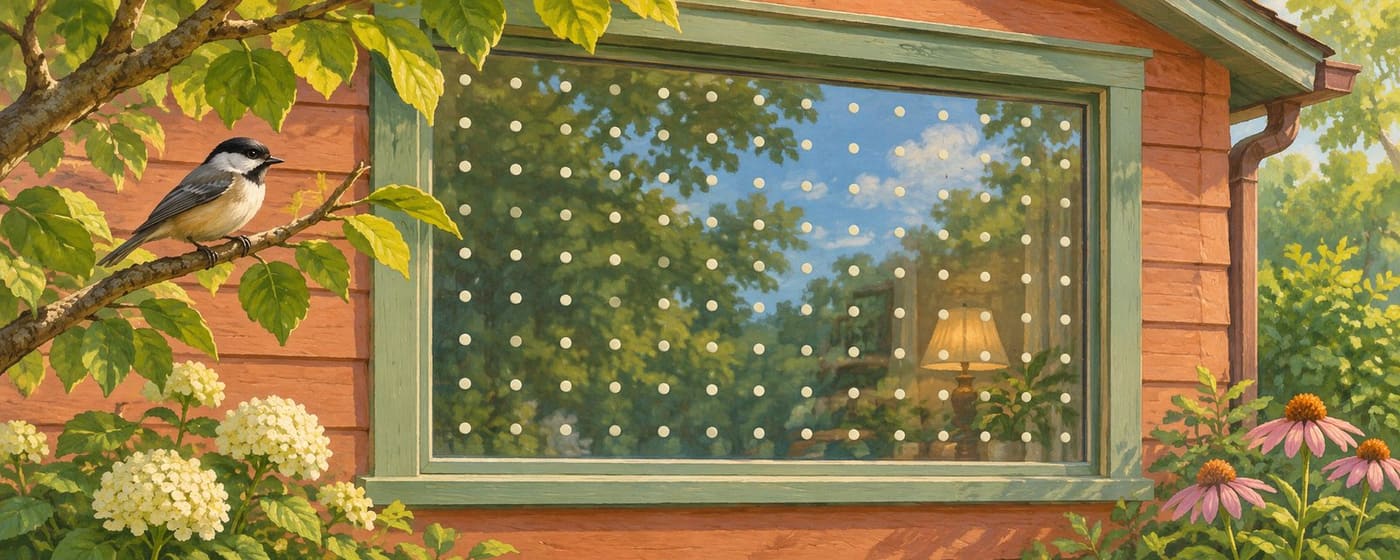
From inside a room, a picture window may look like a clear boundary. Step outdoors and the same window can look like a continuation of the tree beside it. Walk farther along the wall and the tree fades from view. Now you can see through the room to a second window, with another patch of garden beyond it. The glass has not moved. What it shows has changed with the angle and the light. Both views help explain why an untreated window can be a collision hazard for birds.
The US Fish and Wildlife Service’s guidance on bird-window collisions recommends identifying problem windows and making their outside surfaces more visible. Start with what the pane looks like from outdoors, then consider how a treatment would interrupt the apparent path across the whole glass. A separate look after dark can reveal another issue, light spilling from the building. The two observations point to different changes.
Look for reflections and apparent routes through the glass
A reflected tree can appear to occupy the space behind a pane. A bird approaching the window can encounter an image of branches or sky where there is actually a solid surface. A transparent passage presents a different visual problem. Two windows aligned across a room, or clear panels meeting at a corner, can offer a view of plants or open air on the far side. In both cases, an observer standing inside the room may miss the feature that makes the pane hazardous from outside.
Walk along the outside at ground level where you can do so safely. Look across the glass from several angles. Record which parts of the pane reflect vegetation and which offer a view through the building. A photo from one position can help document a strong reflection. Take another from a different position if the first one fails to show a clear passage you saw while walking. A human eye at ground level cannot recreate every approach a bird might take. The exercise helps identify visible clues you can act on.
Repeat the walk when the light changes. Imagine a west-facing window that reflects a hedge clearly in the afternoon but looks relatively transparent in the morning. A check at breakfast may miss the afternoon image. Curtains can interrupt a view through a room, but a curtain behind the window does not necessarily remove the reflection on its exterior. Treat a change you can see in one condition as evidence about that condition. Look again when the reflection is strongest.
Think about the whole visible opening. A door may have several glass panels, with narrow frames between them. A bird does not have to fly towards the centre of the largest pane to hit glass. Inspect the sidelight and any adjacent panel that extends the same apparent route. If the reflection is clear across several windows, marking one small patch will leave much of the visual problem intact.
Start with the window you have the most reason to suspect
The Fish and Wildlife Service suggests looking for previous strikes and features such as nearby trees or places that attract birds. A sudden thud or an imprint can tell you where to inspect. You may see neither even if the window is hazardous. A resident is unlikely to be watching every pane all day, and evidence can disappear before someone notices it. Give weight to a known strike while keeping other obvious hazards on the list.
For an imaginary house, start with the patio door. From the garden path you can see a bright rear window through the living room. Two metres to the left, a fixed panel reflects leaves. The upstairs window catches some sky, but you cannot inspect it from outdoors without access equipment. A practical first step is to document the lower door and fixed panel and choose a treatment you can safely apply from ground level. Make a separate plan for assessing the upper pane rather than treating it as safe because it is harder to reach.
Make a brief record before changing anything. Write down the room, the pane, what you saw and roughly when you saw it. If there was a suspected strike, record what you actually observed. “Heard a thud at the patio door” and “saw a bird hit the fixed panel” describe different evidence. This can help another person in the household compare observations and decide whether a nearby pane needs attention.
Prioritisation is a way to choose where to start. It cannot establish that other windows are harmless. Revisit the walk after planting a tree, replacing a window or rearranging a room so two panes have an unobstructed view through them. Changes inside and outside can alter what the glass presents.
Use a visible pattern over the outside surface
For the marking approach described in the Fish and Wildlife Service guidance, place deterrents at least a quarter inch in diameter on the outside, spaced about two inches apart horizontally and vertically. A regular pattern makes the clear spaces small across the pane. If you place a single prominent decoration at the centre, the surrounding glass can still appear to offer a large open route. Think about the repeated intervals between markers and the coverage near the edges.
Before installing, measure the glass you plan to treat and read the instructions for the material. If you are setting out rows of individual dots, draw the intended grid on paper or use a removable guide compatible with the surface. For example, on an imaginary 24-inch-wide panel, markers centred one inch from each edge and spaced two inches apart would make twelve columns. This is a layout example, not a specification for every pane or product. Check the vertical spacing too, and verify the edge coverage once the pattern is in place.
Step outside after application. Look at the markers against bright sky, a dark interior and reflected leaves, where those conditions occur. A mark that stands out against the living room wall from indoors may blend into a reflection from outdoors. If a pane has a frame dividing it, check the clear spaces in each section rather than assuming that the frame solves everything. Over time, notice where a decal has peeled or where cleaning has removed part of a temporary pattern. An interrupted pattern can leave a larger gap than you intended.
External screens can be another option where appropriate. Assess whether the screen covers the relevant opening and whether the installation is suitable for the window. A screen fitted to an opening section leaves a neighbouring fixed pane untreated. If an upper-storey window needs attention, the method of access is a separate decision. A treatment designed for the outside does not make an unsafe reach from indoors worthwhile.
If the glass is shared with other residents, make the plan legible before anybody begins installing a treatment. A sketch can show which pane is fixed, which swings open and which part offers the view through the room. Mark the surface that will receive the pattern. Include a note about how the material is cleaned or replaced. Someone washing the windows later can then distinguish an intentional set of markers from tape left over from a repair, and a replacement pane can be assessed using the same observations.
Read the film study within its limits
In a 2023 PeerJ experiment on window films, researchers observed zebra finches in controlled aviary flight trials. They compared two commercial window films applied to interior and exterior glass surfaces. The trials assessed avoidance behaviour. They found improved avoidance with exterior application in their experiments, while the interior applications did not show the same benefit. The placement difference matters because a window’s exterior reflection can affect what is visible behind it.
The design helps isolate an issue a household cannot easily test. If you place something behind a pane and still see reflected sky from outdoors, its visibility can differ from a treatment on the exterior. The experiment gives evidence about those two films and the conditions the researchers tested. It does not establish a universal ranking of products, a collision rate for any house or a guarantee that every bird will avoid treated glass.
Notice the difference between an experimental outcome and what you can observe at home. In a controlled trial, researchers can compare flights under defined treatments. A homeowner may only have occasional observations before and after installation. Weather, season and the amount of time someone is watching can all differ between those periods. A household record is useful for spotting a window that still needs work. It cannot by itself yield an exact percentage reduction.
When you compare products, look for details about how they were tested and which side of the glass they were designed to go on. Check whether the test concerns daytime avoidance, a measure of visual contrast or a different outcome. A product label may describe the surface it sticks to while saying little about how visible it is in a particular reflection. Use the published guidance and what you can observe outside the treated window to inform the decision.
Check night lighting separately
The Fish and Wildlife Service also describes how artificial light can draw or disorient birds during nocturnal migration. This adds a reason to inspect a building after dark. An illuminated room visible through a large pane can contribute light even if the outside fixture is switched off. A decorative lamp or floodlight can send light upward or outward beyond the place where it is useful. The night walk is an opportunity to see those sources individually.
Start with lights you can control. Switch off an unneeded fixture, then look at what changes. Close blinds or shades in a room where lights still need to be on, and check what is visible from the garden. For a necessary entrance light, consider whether it can be directed towards the surface people need to see. Keep essential lighting needs in view when choosing what to change. The useful distinction is between light serving a purpose and light spilling beyond it.
A night lighting change addresses light exposure. It does not make an afternoon reflection of leaves go away. A daytime exterior pattern makes a pane more visible in the conditions it was designed for. It does not switch off an illuminated room. Record the two changes separately so another person knows whether to check the pattern, the lighting schedule or both.
Revisit the result from the same places
After treating a pane, return to the places where you noticed a reflection or a view through the room. Compare what you see with the earlier record. From the garden path, is there now a repeated pattern across the area that looked like open space? Does a strip at the edge still look clear? At the corner, does the next pane retain the same uninterrupted view? These observations can guide a modest correction without pretending to measure what every approaching bird sees.
Make the review manageable. Check the most obvious window after cleaning, after a change in the room layout and when surrounding vegetation changes. Record new suspected strikes with enough detail to locate the pane. If you hear a collision near two adjacent windows, treat the exact location as uncertain and inspect both. An honest note makes it easier to investigate than a confident label assigned without seeing what happened.
The patio door in the example began with two visual problems, the view through the living room and the leaf reflection in its neighbouring panel. Looking from outside made each visible. A full exterior pattern can interrupt the apparent paths, while a separate lighting check addresses what the building sends into the night. Once you know what to look for, you can review one window at a time and make each change where it has a clear purpose.
For another example of observing a local environmental problem, see the guide to observing a stream.
Sources consulted 4 November 2026. The household, window layout and observations in the examples are illustrative.