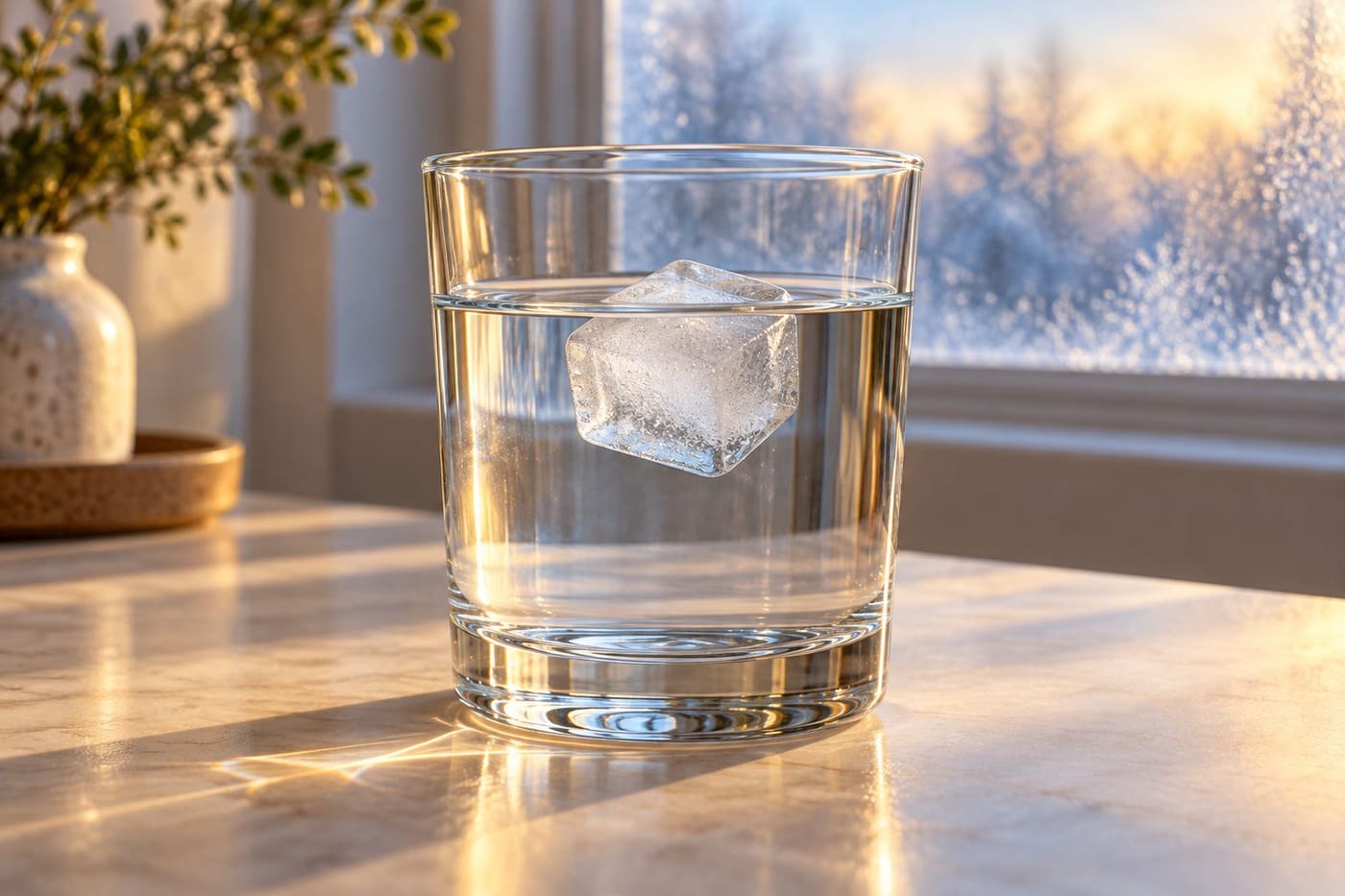
An ice cube can be large enough to feel heavy in your hand and still float in a glass. A much smaller metal object can sink. Those observations seem contradictory only if you treat total weight as the whole explanation. Floating depends on the relationship between an object's weight and the support provided by the surrounding liquid. Density helps explain why ordinary ice finds that balance before disappearing below the surface.
The familiar glass of water also raises a second question: why does freezing make water less dense in the first place? To answer it, separate three ideas that everyday language often mixes together: how much material an object contains, how much space it occupies and how much liquid it pushes aside. You can understand the main result without a laboratory or a long calculation.
Density compares mass with volume
Density is mass divided by volume. Mass tells you how much matter is present; volume tells you how much space it occupies. Two objects can have the same mass and different densities if one occupies more space. They can also have the same volume and different masses.
Imagine two fictional blocks, each occupying 100 cubic centimetres. One has a mass of 80 grams and the other 120 grams. Their average densities are 0.8 and 1.2 grams per cubic centimetre. These numbers are teaching values, not measurements of ice or metal. They show why saying that an object is heavy is incomplete: you need to know whether you mean heavy in total or heavy for its size. The latter idea is much closer to what density describes.
Freezing changes how water molecules are arranged
The International Association for the Properties of Water and Steam explains in its water-property questions and answers that ordinary ice has an open structure associated with hydrogen bonding. Freezing does not remove water molecules to make empty space. The molecules arrange themselves differently, so the same mass occupies a larger volume.
A useful reading distinction is between a molecule and an arrangement of molecules. The water does not need to become a new chemical substance to form ordinary ice. Nor does each molecule inflate like a balloon. The spacing and organization of the collection change. A simple illustration of neatly separated dots can help explain the idea, but it is not a literal photograph of a crystal or a complete molecular model. Keep the explanation at the level the illustration can honestly support.
Cooling and freezing are not the same change
For ordinary fresh water near atmospheric pressure, density reaches a maximum at approximately 4 degrees Celsius. Further cooling toward freezing does not keep increasing density in the same way. IAPWS discusses this unusual behavior separately from the larger expansion when ice forms. Conditions matter, so this is not a claim about every possible pressure or every phase of ice.
When reading an explanation, look for which part of the process it describes. “The water became colder” and “the water froze” are not interchangeable observations. A temperature change in a liquid and a change from liquid to solid can both affect volume, but you should not assume they follow one simple rule for every substance. Our earlier explanation of temperature, touch and heat flow explores another situation where familiar temperature language can conceal different physical questions.
Expansion does not mean gaining mass
Consider a fictional sealed amount of material with a mass of 100 grams. If it initially occupies 100 millilitres and later occupies 110 millilitres without gaining or losing material, its density changes from 1 to about 0.91 grams per millilitre. The larger volume makes the density smaller even though the mass remains the same.
Those deliberately rounded teaching numbers illustrate the division; they are not an exact ice-density table. This distinction also explains a common language trap. “Ice weighs less than water” can be sensible when comparing equal volumes, but misleading when discussing the same collected water before and after freezing. Specify what stays equal in a comparison. Same volume, same mass and same number of molecules are different starting conditions, and each leads to a different sentence about what changed.
Water provides an upward force
A floating cube is still pulled down by gravity. It does not stop having weight because it reaches the surface. OpenStax's explanation of Archimedes' principle describes buoyant support in terms of displaced fluid: the upward buoyant force equals the weight of the fluid displaced.
For a freely floating object at rest, that support balances its weight. Pushing the object farther into the liquid makes it displace more liquid, until the conditions change or it is fully submerged. This is the link between density and the visible waterline. An ice cube does not need to be weightless to float. It needs sufficient support from the volume of water it displaces. The same principle also applies to submerged objects that sink; having some upward support does not necessarily mean that support is enough.
Why most of the cube sits below the surface
Ice is less dense than liquid water, but the two densities are not radically different. Consequently, a substantial fraction of a floating piece lies below the waterline. For an ideal freely floating object of uniform density, the submerged-volume fraction is the object's density divided by the liquid's density. OpenStax derives that relationship from the balance of forces.
Use a separate fictional example to see what the ratio means. If an object has an average density of 0.8 and the liquid has a density of 1 in matching units, the expected submerged fraction is 0.8, or 80 percent of its volume. This does not say that 80 percent of its visible height is always underwater. A broad lower section and narrow upper section can make height a poor guide to volume. Shape affects what the waterline looks like even when the volume relationship is unchanged.
A bigger piece does not automatically sink
Imagine enlarging a solid piece of the same material while keeping its composition and structure comparable. Both its mass and its volume increase. Its density does not increase merely because the piece is larger. In the simple floating model, it needs to displace a correspondingly larger amount of liquid to balance its increased weight.
That is why comparing a tiny dense object with a large piece of ice by total mass misses the main relationship. A large floating piece can weigh much more than a small sinking one. Avoid turning this into a claim about every object with a similar appearance. Trapped materials, attached loads, cavities and other changes affect average density and the practical situation. The useful general question is what the complete object consists of, how much volume it occupies and what liquid surrounds it.
Salt changes the liquid you are comparing against
A cube floating in fresh water and a cube floating in salty water are not in identical surroundings. NOAA's Sea Water explanation discusses how salinity affects water's density and freezing behavior. A comparison needs the density of the actual liquid, not a universal number attached to the word water.
For a simple home observation, state what liquid you used rather than claiming to recreate an ocean. A kitchen mixture is not a complete model of seawater, and adding an unspecified spoonful of salt does not establish a precisely known salinity. You can use such an observation to raise a question about the surrounding liquid, but do not infer an exact density change without an appropriate measurement. Also distinguish freezing salt water from placing already-made fresh-water ice into a salt solution: those are different processes.
Observe one cube without turning it into a precision test
Place a small ordinary ice cube in a clear, unbreakable container of room-temperature drinking water on a tray. Leave enough space to avoid spills. Let the cube move freely, away from the sides if possible, and look at the waterline from the side. Keep the activity small and ordinary; no flame, pressure vessel or sealed freezing container is needed.
Write down what you actually see. Is the cube floating freely, touching a wall or resting against another piece? Can you distinguish its upper and lower surfaces? Does the waterline appear different when you move your eye? An ordinary observation can illustrate flotation without providing a reliable numerical measurement of density. The aim is to connect the explanation with a visible situation, not to obtain an impressive-looking percentage from a ruler held against a distorted image.
Notice the limits of a photograph
A photograph can show the waterline, but it can also hide the far side of the cube or distort its apparent outline through the container. Lighting, reflections and viewing angle can make it difficult to tell exactly where ice ends and water begins. A single image should not be treated as a complete volume measurement.
For a useful observation record, note the container, liquid and whether the piece was free to float. Take a side view if that makes the relationship clearer, while recognizing that perspective still matters. If you draw a diagram, mark it as a simplified sketch. The conceptual illustration accompanying this article serves that explanatory purpose; it is not a measured experiment, a real iceberg survey or evidence that a particular submerged-volume fraction was obtained under controlled conditions.
Keep a prediction separate from the result
Before a simple observation, write a prediction in words: “The ice will float with part above the surface.” Then record the result separately. If the result seems different, check the setup before replacing the explanation. A piece held below the surface by a spoon is not freely floating. A piece stuck to a container is not showing the same balance as one moving without contact.
This habit is useful beyond an ice demonstration. A prediction describes what an explanation leads you to expect under stated conditions. An observation describes what occurred in your actual setup. If the conditions differ, that difference belongs in the record. Avoid rewriting a prediction afterwards to make it appear that every detail was expected. A modest, accurate account of the setup is more useful for learning than an overconfident result without context.
Do not use flotation as an ice-safety assessment
The fact that ice floats does not tell you whether a frozen surface can support a person, vehicle or other load. Those are different questions involving conditions and structural behavior that a glass demonstration does not establish. A visible floating layer should not be turned into a general claim about safe access to a lake or river.
Likewise, a clear cube in a photograph does not establish drinking-water quality. This article concerns density and buoyancy, not a method for assessing environmental ice or water safety. When an explanation moves from a household observation to an outdoor decision, ask what additional evidence that decision requires. Staying clear about scope prevents a correct basic principle from being used as a shortcut for a much more consequential judgment.
Explain the result in three connected sentences
A concise explanation can still preserve the important relationships. Ordinary ice occupies more volume for the same mass than liquid water under the relevant everyday conditions. That makes the ice less dense than the surrounding water. It can displace enough water to balance its weight while some of its volume remains above the surface.
You can then add detail to answer a particular follow-up question. Molecular arrangement explains the density difference. Archimedes' principle explains the support. A density ratio explains the ideal submerged fraction. Keeping those jobs distinct makes the explanation easier to extend without mixing them together. It also helps you recognize when a new question, such as the behavior of saline water or an attached load, requires a different comparison rather than simply repeating that ice is lighter.
Conclusion: ask what is being compared
Ice floating in water is familiar, but understanding it requires more precise language than heavy and light. Mass, volume and density describe different properties, while buoyancy describes the liquid's upward support. The visible waterline connects those ideas in an ordinary glass.
When comparing ice and water, state whether you mean equal volumes or the same collected mass. When predicting flotation, identify the whole object and its surrounding liquid. Those two habits remove much of the apparent mystery without pretending that a kitchen observation is a precision experiment. A small everyday phenomenon becomes more understandable when each part of the explanation answers the right question.
Sources and research note
Research checked on 2 November 2026 using IAPWS water structure, density maximum and freezing explanations, OpenStax Archimedes' principle and submerged-volume relationship, and NOAA sea-water density and salinity context. The numerical blocks and expansion example are deliberately rounded fictional teaching values. No original laboratory measurements, environmental safety assessment or precision ice-property table is claimed. The image is an original conceptual illustration of floating ice, not documentary evidence or a measured diagram.