
 Can Humans Live on Mars? The Science Behind Space Colonization
Introduction
For centuries, humans have looked toward the stars and wondered whether life could exist beyond Earth. Among all the planets in our solar system, Mars has attracted the most attention as a potential second home for humanity. Its rocky surface, seasonal weather, frozen water reserves, and day length make it one of the most Earth-like planets known.
In recent years, rapid advances in space technology have transformed the idea of living on Mars from science fiction into a serious scientific goal. Space agencies and private aerospace companies are investing billions of dollars into developing spacecraft, habitats, and life-support systems that could one day make a permanent Martian settlement possible.
But an important question remains:
Can humans actually live on Mars?
The answer is both exciting and complicated.
Why Mars?
Mars is the fourth planet from the Sun and is located about 225 million kilometers (140 million miles) from Earth on average. Although it is much smaller than Earth, it shares several characteristics that make it the best candidate for human exploration.
Some reasons scientists focus on Mars include:
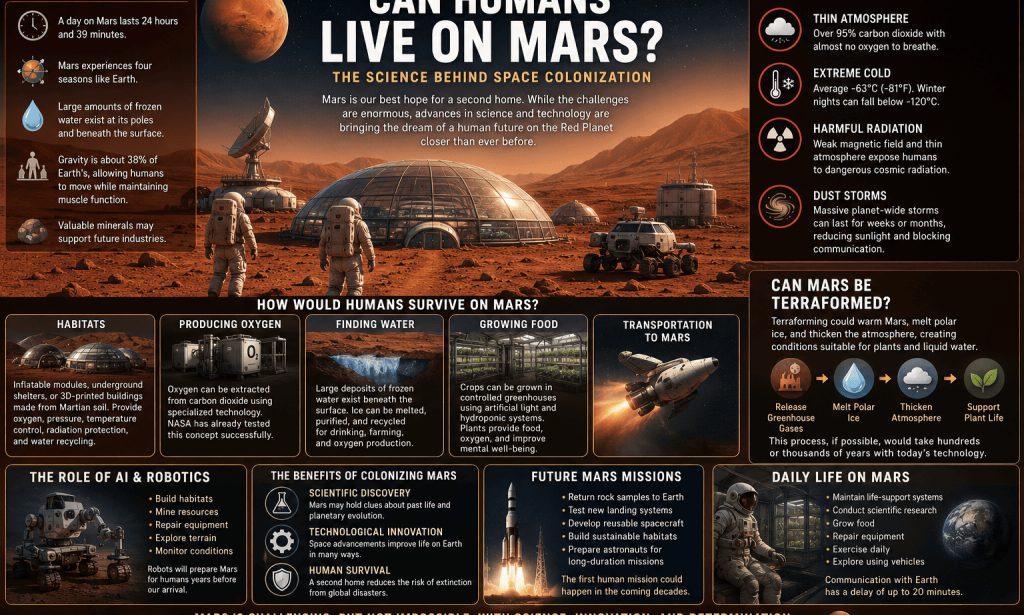
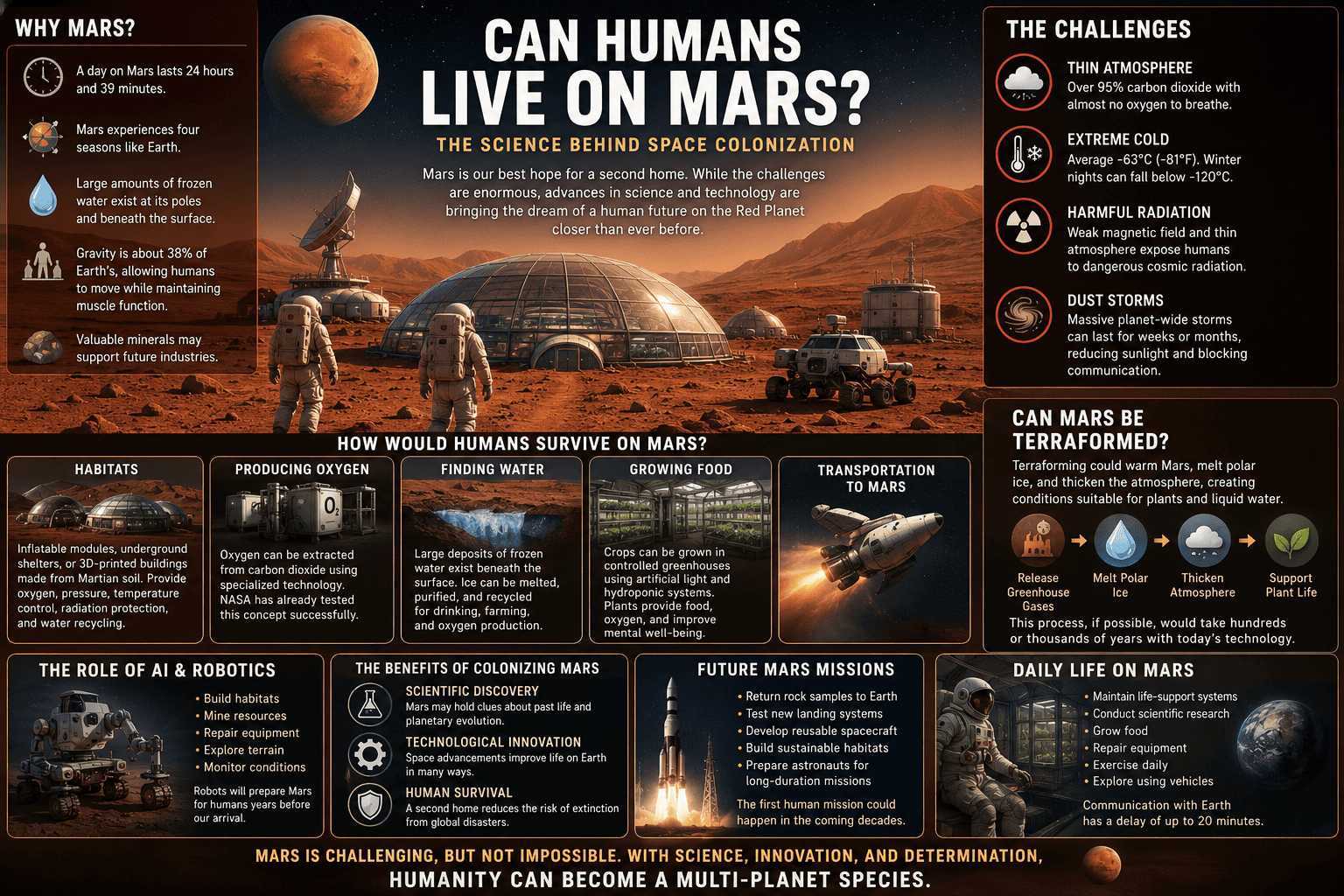
- A day on Mars lasts 24 hours and 39 minutes, very similar to Earth's 24-hour day.
- Mars experiences four seasons because of its tilted axis.
- Large amounts of frozen water exist at its poles and beneath the surface.
- Gravity is about 38% of Earth's, allowing humans to move while still maintaining some muscle function.
- Valuable minerals may support future industries.
These similarities make Mars much more suitable for colonization than planets like Venus or Mercury.
The Challenges of Living on Mars
Despite its similarities to Earth, Mars is an extremely hostile environment.
1. Thin Atmosphere
Mars has an atmosphere, but it is over 95% carbon dioxide and contains almost no oxygen for humans to breathe.
Astronauts would need fully sealed habitats and oxygen-generation systems.
2. Extreme Cold
Average temperatures on Mars are around -63°C (-81°F).
During winter nights, temperatures can fall below -120°C (-184°F).
Special insulation and heating systems would be essential for survival.
3. Harmful Radiation
Unlike Earth, Mars lacks a strong magnetic field and thick atmosphere.
As a result, astronauts would be exposed to dangerous cosmic radiation that increases the risk of cancer and other health problems.
Future habitats may need to be built underground or covered with Martian soil for protection.
4. Dust Storms
Mars experiences massive dust storms that can cover the entire planet for weeks or even months.
These storms reduce sunlight, making solar power less effective and creating challenges for communication and transportation.
How Would Humans Survive on Mars?
Living on Mars would require advanced technology and careful planning.
Habitats
Astronauts could live inside inflatable modules, underground shelters, or 3D-printed buildings made from Martian soil.
These habitats would provide:
- Oxygen
- Stable air pressure
- Comfortable temperatures
- Radiation protection
- Water recycling
Scientists are already testing habitat designs that could one day be used on Mars.
Producing Oxygen
Since Mars has almost no breathable oxygen, future colonies must generate their own.
One promising method involves separating oxygen from carbon dioxide using specialized equipment.
NASA has already tested this concept successfully through experimental technology aboard Mars missions.
Finding Water
Water is essential for drinking, farming, hygiene, and producing oxygen.
Fortunately, spacecraft have discovered large deposits of frozen water beneath the Martian surface.
Future astronauts could melt this ice and purify it for daily use.
Water could also be recycled, just as it is aboard the International Space Station.
Growing Food on Mars
Transporting food from Earth would be extremely expensive.
Scientists believe future Martian colonies must grow their own crops.
Possible foods include:
- Potatoes
- Lettuce
- Tomatoes
- Wheat
- Beans
- Herbs
Plants would likely grow inside climate-controlled greenhouses using artificial lighting and hydroponic farming systems.
Besides providing food, plants would also produce oxygen and improve astronauts' mental well-being.
Transportation to Mars
Traveling to Mars remains one of humanity's greatest engineering challenges.
Current spacecraft would take approximately six to nine months to reach the Red Planet.
Future missions aim to reduce travel time through more powerful propulsion technologies.
During the journey, astronauts must deal with:
- Weightlessness
- Radiation exposure
- Limited living space
- Psychological isolation
Long-duration space travel remains an active area of research.
Can Mars Be Terraformed?
Terraforming means transforming another planet into an Earth-like environment.
Some scientists have suggested warming Mars by releasing greenhouse gases, melting polar ice, and thickening the atmosphere.
If successful, this could eventually create:
- Higher temperatures
- More liquid water
- A denser atmosphere
- Conditions suitable for plants
However, current technology is nowhere near capable of terraforming an entire planet.
Most experts believe this process, if possible, would take hundreds or even thousands of years.
The Role of Artificial Intelligence and Robotics
Before humans establish permanent settlements, robots will play a crucial role.
AI-powered machines could:
- Build habitats
- Mine resources
- Repair equipment
- Explore dangerous terrain
- Monitor environmental conditions
Autonomous robots may prepare Mars for human arrival years before astronauts land.
Artificial Intelligence will likely become one of the most important technologies supporting future colonies.
The Benefits of Colonizing Mars
Although incredibly expensive, colonizing Mars offers significant long-term benefits.
Scientific Discovery
Mars may contain clues about whether life once existed elsewhere in the solar system.
Studying its geology could reveal the history of planetary evolution.
Technological Innovation
Developing Mars missions pushes advancements in robotics, medicine, renewable energy, recycling, and materials science.
Many technologies created for space eventually improve life on Earth.
Human Survival
Some scientists argue humanity should become a multi-planet species to reduce the risk of extinction from global disasters such as asteroid impacts or climate-related catastrophes.
Having settlements beyond Earth could ensure the long-term survival of civilization.
Future Mars Missions
Several space agencies and private companies are actively planning future missions.
Upcoming projects focus on:
- Returning Martian rock samples to Earth
- Testing new landing systems
- Developing reusable spacecraft
- Building sustainable habitats
- Preparing astronauts for long-duration missions
The first human mission to Mars could occur within the coming decades if technological progress continues.
While establishing a permanent colony will take much longer, each mission brings scientists closer to achieving that goal.
What Would Daily Life on Mars Look Like?
Life on Mars would be very different from life on Earth.
Astronauts would spend much of their time:
- Maintaining life-support systems
- Conducting scientific research
- Growing food
- Repairing equipment
- Exercising daily to prevent muscle and bone loss
- Exploring nearby regions using specialized vehicles
Communication with Earth would also involve delays of up to 20 minutes because of the vast distance between the two planets.
Despite these challenges, many scientists believe future Martian communities could eventually become largely self-sufficient.

You must be logged in to post a comment.