
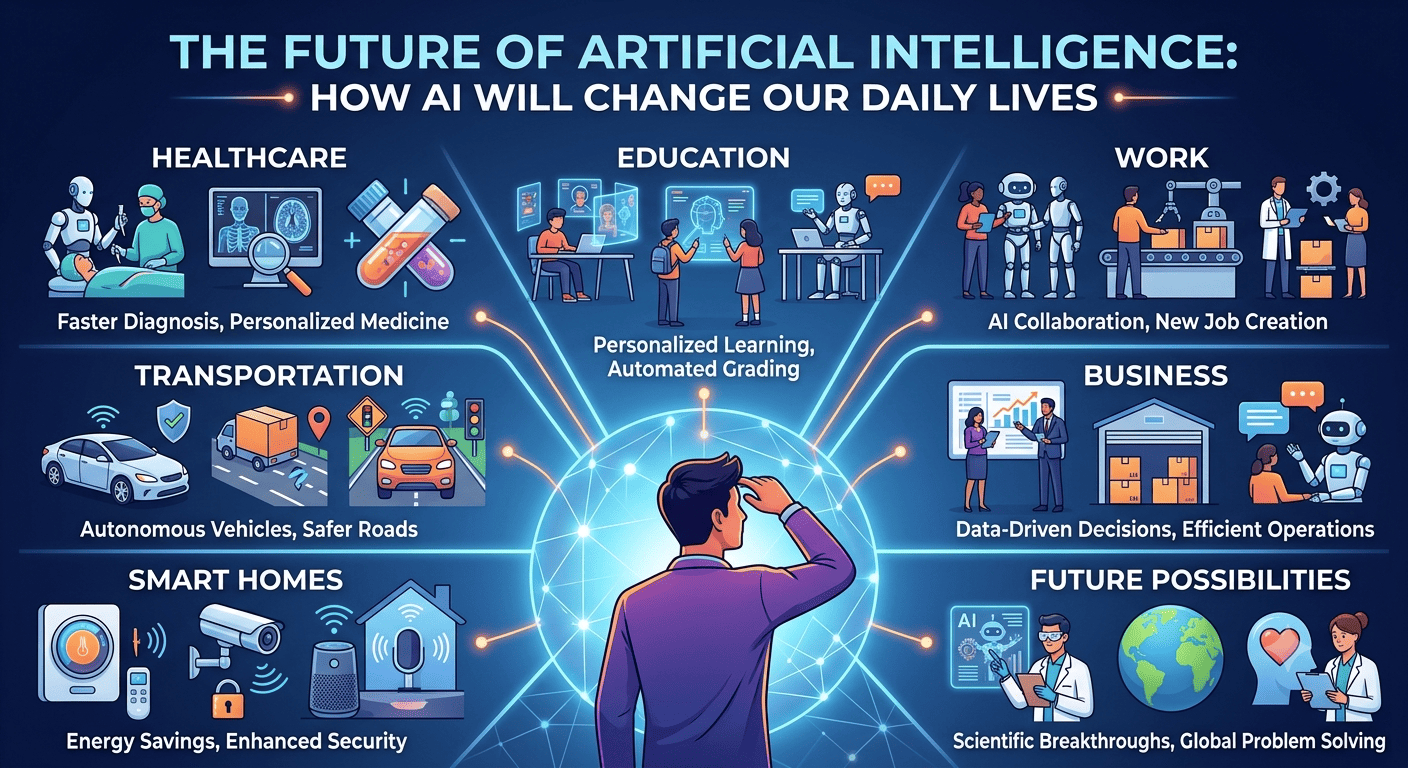
 The Future of Artificial Intelligence: How AI Will Change Our Daily Lives
Artificial Intelligence, commonly known as AI, has rapidly become one of the most influential technologies of the 21st century. What once seemed like science fiction is now a reality. AI powers smartphones, recommends movies, translates languages, assists doctors, and even helps businesses make smarter decisions.
The future of AI promises even more exciting developments. Experts believe AI will continue to improve efficiency, solve complex global challenges, and transform nearly every aspect of human life. While concerns about privacy and employment remain, there is no doubt that AI is shaping the future.
What is Artificial Intelligence?
Artificial Intelligence refers to computer systems that can perform tasks requiring human intelligence. These tasks include learning, reasoning, problem-solving, understanding language, recognizing images, and making decisions.
Unlike traditional software that follows fixed instructions, AI systems learn from data and improve their performance over time using technologies such as Machine Learning and Deep Learning.
Today, AI is used in thousands of applications across healthcare, education, transportation, finance, entertainment, and manufacturing.
AI in Everyday Life
Many people use AI every day without realizing it.
When you unlock your smartphone using facial recognition, AI identifies your face in seconds. When Netflix recommends your next favorite movie or Spotify creates a personalized playlist, AI analyzes your preferences.
Voice assistants like Siri, Google Assistant, and Alexa understand spoken language and respond instantly. Navigation apps predict traffic conditions and recommend the fastest route.
Even email services use AI to detect spam and organize messages automatically.
These everyday examples demonstrate that AI is already deeply integrated into modern life.
AI in Healthcare
Healthcare is one of the industries benefiting the most from AI.
Doctors now use AI-powered software to detect diseases earlier and with greater accuracy. AI can analyze medical images such as X-rays, CT scans, and MRIs to identify abnormalities that might be difficult for humans to notice.
AI also helps researchers discover new medicines more quickly by analyzing millions of scientific records in a short period.
Wearable devices like smartwatches monitor heart rate, sleep patterns, and physical activity. These devices use AI to provide personalized health recommendations and alert users to potential health risks.
In the future, AI may assist doctors in creating highly personalized treatment plans based on an individual's genetics and medical history.
AI in Education
Education is becoming more personalized thanks to AI.
AI-powered learning platforms can identify a student's strengths and weaknesses, then adjust lessons accordingly.
Students receive personalized recommendations, instant feedback, and interactive learning experiences.
Teachers benefit as well. AI helps automate grading, prepare lesson plans, and analyze student performance, allowing educators to spend more time teaching rather than handling repetitive administrative tasks.
Virtual tutors available 24/7 may become common, helping students learn at their own pace.
AI in Business
Businesses around the world are investing heavily in AI.
Companies use AI to predict customer behavior, improve marketing strategies, automate customer support, and optimize supply chains.
AI-powered chatbots answer customer questions instantly, reducing waiting times while improving customer satisfaction.
Financial institutions use AI to detect fraudulent transactions within seconds.
Retail companies analyze purchasing behavior to recommend products customers are likely to buy.
Manufacturing industries use AI-powered robots that work with precision, improving productivity while reducing operational costs.
AI and Transportation
Transportation is experiencing major changes because of AI.
Self-driving vehicles are one of the most exciting developments.
These vehicles use cameras, sensors, GPS, and AI algorithms to understand road conditions and make driving decisions.
Although fully autonomous vehicles are still being developed and tested in many regions, AI is already improving road safety through features like automatic emergency braking, lane-keeping assistance, and adaptive cruise control.
AI also helps airlines optimize flight schedules and assists logistics companies in planning faster delivery routes.
AI in Smart Homes
Modern homes are becoming smarter every year.
Smart thermostats automatically adjust room temperature based on user preferences.
AI-powered security cameras recognize familiar faces and detect unusual activity.
Smart speakers control lighting, entertainment systems, and household appliances through voice commands.
As AI technology advances, smart homes will become more energy-efficient, secure, and convenient.
AI and the Future of Work
One of the biggest discussions surrounding AI is its impact on employment.
Some repetitive jobs may become automated, especially in manufacturing, data processing, and customer service.
However, AI is also expected to create millions of new jobs in software development, robotics, cybersecurity, AI engineering, healthcare technology, and digital innovation.
Rather than replacing humans entirely, AI will increasingly work alongside people, handling repetitive tasks while allowing employees to focus on creativity, critical thinking, and complex decision-making.
Continuous learning and digital skills will become more valuable than ever.
Challenges of Artificial Intelligence
Despite its many advantages, AI also presents important challenges.
Privacy remains a major concern because AI systems often rely on large amounts of personal data.
Cybersecurity threats may become more sophisticated as hackers use AI for advanced attacks.
Bias in AI systems is another challenge. If training data contains bias, AI may produce unfair or inaccurate decisions.
Governments, researchers, and technology companies are working together to establish ethical guidelines that promote responsible AI development.
Ensuring transparency, fairness, and accountability will be essential as AI becomes more powerful.
What Will AI Look Like in the Future?
The future of AI is incredibly promising.
Scientists are developing AI systems capable of understanding human emotions more accurately.
Robots may assist elderly people in daily life, helping with healthcare and companionship.
AI could significantly accelerate scientific discoveries by solving complex research problems much faster than humans alone.
Climate scientists may use AI to predict natural disasters more accurately and develop better environmental solutions.
Education, healthcare, agriculture, transportation, entertainment, and business will continue evolving with intelligent technologies.
The next decade will likely witness AI becoming even more integrated into everyday routines, making life more connected, efficient, and personalized.

You must be logged in to post a comment.