
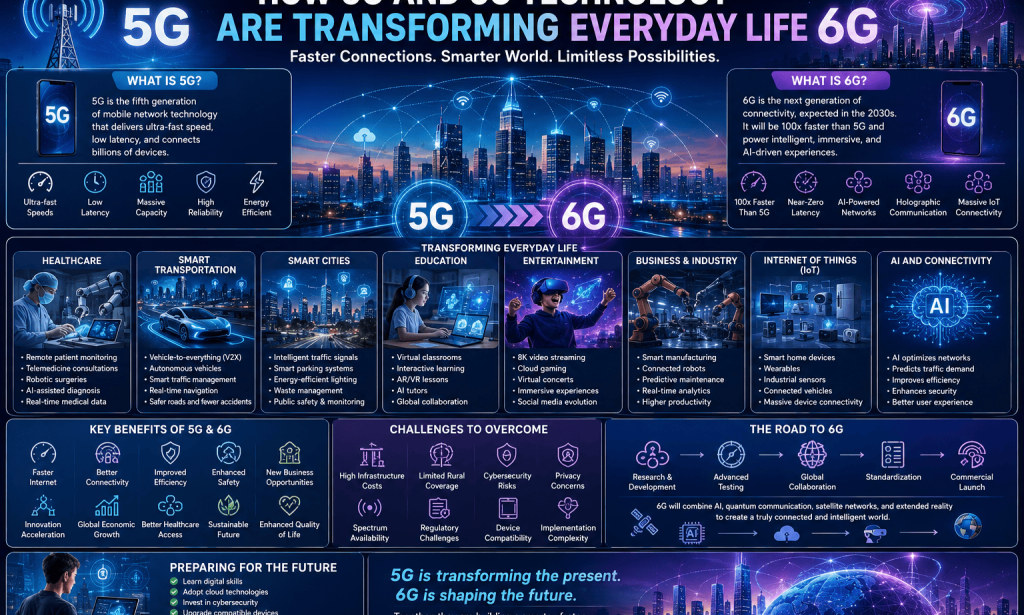
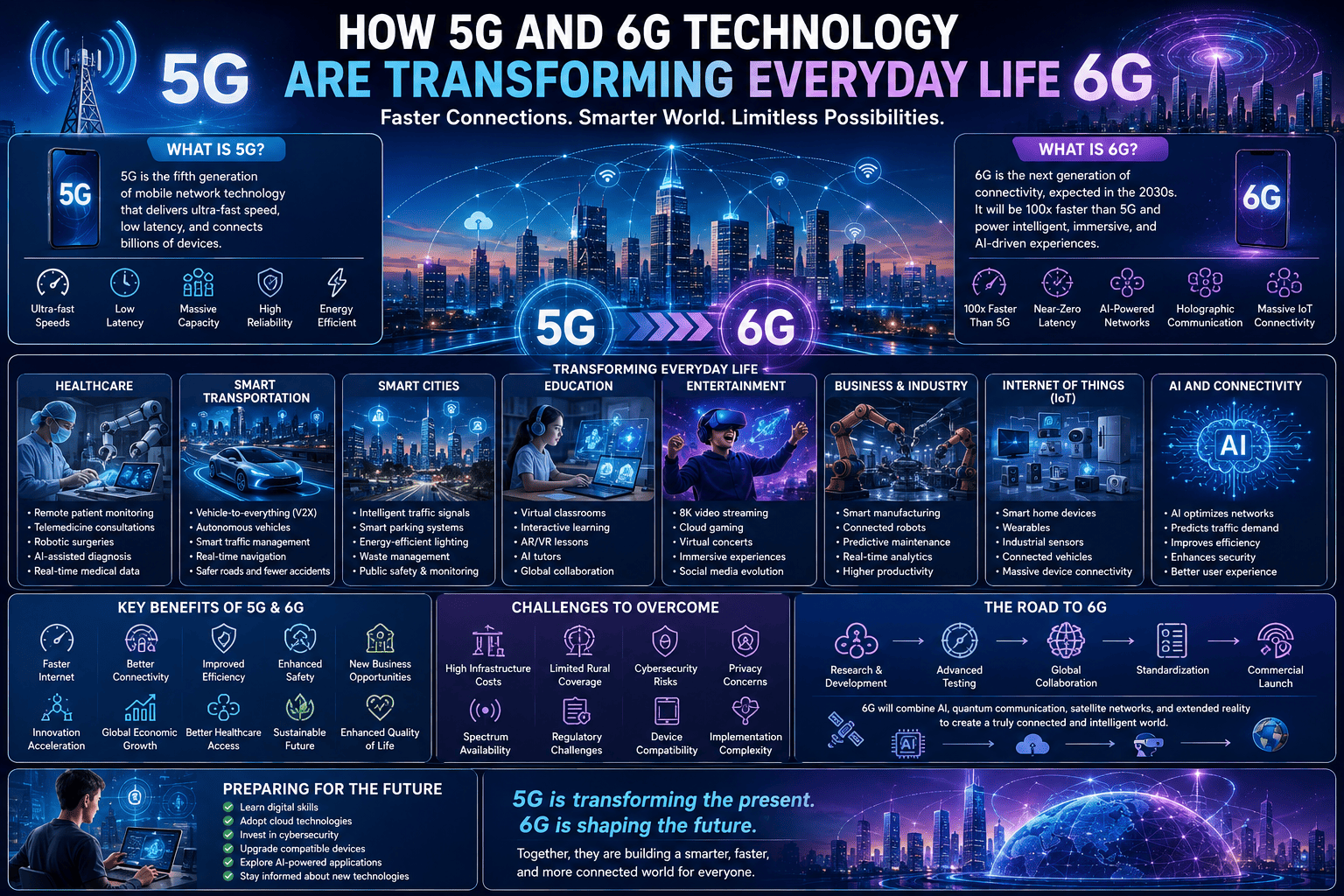
 How 5G and 6G Technology Are Transforming Everyday Life
The way people communicate has changed dramatically over the last few decades. From the early days of mobile phones to today's high-speed internet, each generation of wireless technology has introduced new possibilities. In 2026, 5G has become widely available in many countries, delivering faster connections and supporting advanced digital services. At the same time, researchers are making significant progress toward 6G, which is expected to redefine global connectivity even further.
These technologies are more than just upgrades in internet speed. They are enabling innovations in healthcare, education, transportation, entertainment, manufacturing, and smart cities. As billions of connected devices become part of everyday life, reliable and intelligent wireless communication is becoming increasingly important.
This article explores how 5G and 6G technology are transforming everyday life and what the future may hold.
Understanding 5G Technology
5G stands for the fifth generation of mobile network technology. It was designed to improve speed, reduce latency, and connect many more devices than previous generations.
Compared with 4G, 5G offers significant improvements in network performance. It allows users to download large files in seconds, stream ultra-high-definition videos, participate in real-time online gaming, and connect smart devices without noticeable delays.
The main characteristics of 5G include:
- Ultra-fast internet speeds
- Low latency
- Greater network capacity
- Improved reliability
- Better energy efficiency
- Support for billions of connected devices
These improvements make 5G an essential technology for the digital economy.
What Is 6G?
Although 5G is still expanding worldwide, researchers have already begun developing 6G.
6G is expected to become commercially available during the 2030s and will build upon the strengths of 5G while introducing entirely new capabilities.
Expected features of 6G include:
- Data speeds up to 100 times faster than 5G
- Near-zero latency
- AI-powered network optimization
- Holographic communication
- Extended reality integration
- Massive Internet of Things (IoT) connectivity
- Advanced satellite communication
Rather than simply making the internet faster, 6G aims to create intelligent networks capable of adapting automatically to user needs.
Faster Internet for Everyone
One of the most noticeable benefits of 5G is significantly faster internet access.
Users can:
- Download movies in seconds
- Upload videos more quickly
- Enjoy smoother video conferencing
- Stream 4K and 8K content
- Experience faster cloud gaming
Businesses also benefit from improved productivity through quicker data transfers and better collaboration tools.
As 6G develops, these capabilities will become even more powerful, supporting entirely new digital experiences.
Revolutionizing Healthcare
Healthcare is experiencing one of the biggest transformations through advanced wireless networks.
With reliable, high-speed connectivity, hospitals and healthcare providers can deliver better patient care.
Examples include:
- Remote patient monitoring
- Telemedicine consultations
- AI-assisted diagnosis
- Robotic surgery support
- Real-time medical imaging
- Wearable health monitoring devices
Future 6G networks could enable real-time holographic consultations and even more accurate remote medical procedures.
Smarter Transportation
Transportation systems are becoming increasingly connected.
5G enables vehicles to communicate with each other and surrounding infrastructure almost instantly.
Benefits include:
- Improved road safety
- Smarter traffic management
- Faster emergency response
- Connected public transportation
- Autonomous vehicle communication
- Efficient logistics operations
6G is expected to make autonomous transportation even safer by providing faster and more intelligent communication between vehicles and infrastructure.
Smart Cities
Cities around the world are investing in smart infrastructure powered by advanced wireless networks.
Smart cities use connected sensors and AI systems to improve urban living.
Applications include:
- Intelligent traffic signals
- Smart parking systems
- Energy-efficient street lighting
- Waste management optimization
- Environmental monitoring
- Public safety improvements
5G provides the connectivity needed for these systems, while 6G may enable even more advanced urban automation.
Transforming Education
Education has become more flexible thanks to digital technology.
High-speed wireless networks allow students and teachers to connect from anywhere.
Benefits include:
- Virtual classrooms
- Interactive online learning
- AI tutors
- Augmented reality lessons
- Virtual laboratories
- Instant collaboration
6G could make immersive educational experiences even more realistic through holographic learning environments.
Entertainment Without Limits
Entertainment has always benefited from faster internet.
5G improves:
- Video streaming
- Live sports broadcasting
- Cloud gaming
- Virtual concerts
- Online multiplayer gaming
- Social media experiences
Future 6G technology may enable fully immersive virtual worlds where users interact naturally in digital environments.
Business and Industry
Modern businesses increasingly rely on reliable connectivity.
5G helps companies automate operations and improve productivity.
Industries using 5G include:
- Manufacturing
- Agriculture
- Construction
- Retail
- Banking
- Logistics
Factories use connected robots, warehouses automate inventory management, and retailers improve customer experiences using real-time analytics.
6G is expected to accelerate digital transformation even further.
Internet of Things (IoT)
The Internet of Things refers to everyday devices connected to the internet.
Examples include:
- Smart home appliances
- Security cameras
- Smart watches
- Industrial sensors
- Connected vehicles
- Agricultural equipment
5G allows millions of devices to communicate efficiently.
6G will support even larger connected ecosystems while improving energy efficiency and intelligence.
Artificial Intelligence and Connectivity
AI and advanced wireless networks complement each other perfectly.
AI helps optimize networks by:
- Predicting traffic demand
- Reducing congestion
- Detecting security threats
- Improving energy efficiency
- Enhancing customer experiences
Future 6G networks are expected to use AI as a core technology rather than an optional feature.
Economic Growth
5G is creating new business opportunities worldwide.
It supports innovation in:
- E-commerce
- FinTech
- Healthcare
- Education
- Manufacturing
- Tourism
- Media
New startups are building services that depend on reliable high-speed connectivity, contributing to job creation and economic development.
Environmental Benefits
Advanced wireless technologies can also support sustainability.
Examples include:
- Smart energy management
- Precision agriculture
- Reduced fuel consumption
- Intelligent transportation systems
- Environmental monitoring
- Efficient resource management
These innovations can help reduce waste and lower carbon emissions.
Challenges of 5G and 6G
Despite their enormous potential, several challenges remain.
These include:
- High infrastructure costs
- Limited coverage in rural areas
- Cybersecurity concerns
- Privacy issues
- Spectrum availability
- Regulatory challenges
- Device compatibility
Governments, businesses, and technology providers must work together to overcome these obstacles.
Preparing for the Future
Individuals and organizations should begin preparing for next-generation connectivity.
Recommended steps include:
- Learning digital skills
- Adopting cloud technologies
- Investing in cybersecurity
- Upgrading compatible devices
- Exploring AI-powered applications
- Understanding emerging technologies
Businesses that prepare early will be better positioned to take advantage of future innovations.
The Road to 6G
Although commercial 6G networks are still under development, research is progressing rapidly.
Experts predict that future communication systems will combine:
- Artificial Intelligence
- Edge computing
- Quantum communication
- Satellite networks
- Extended reality
- Digital twins
- Intelligent automation
These technologies will work together to create a truly connected digital ecosystem.

You must be logged in to post a comment.