
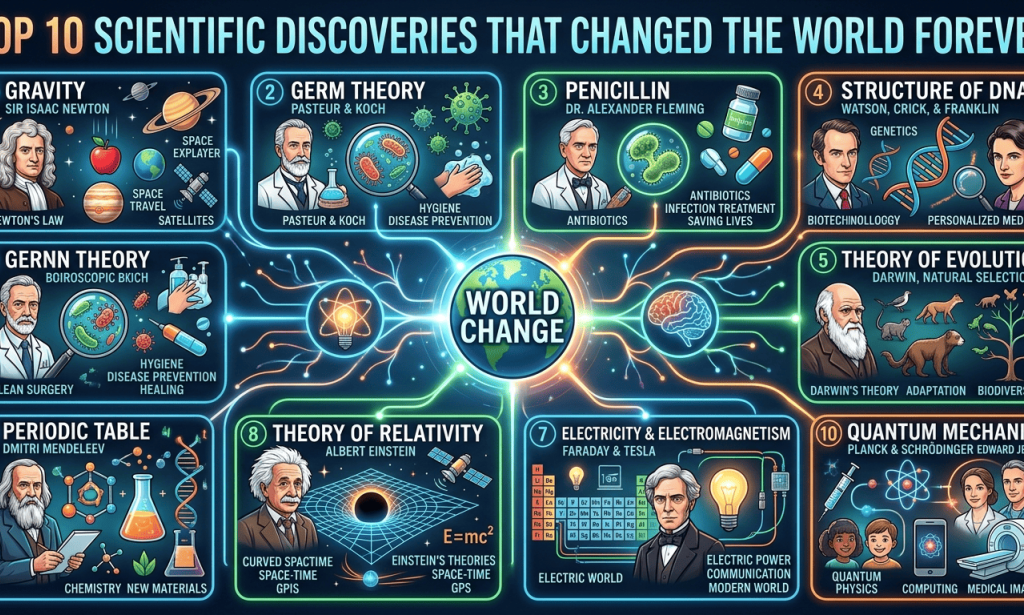
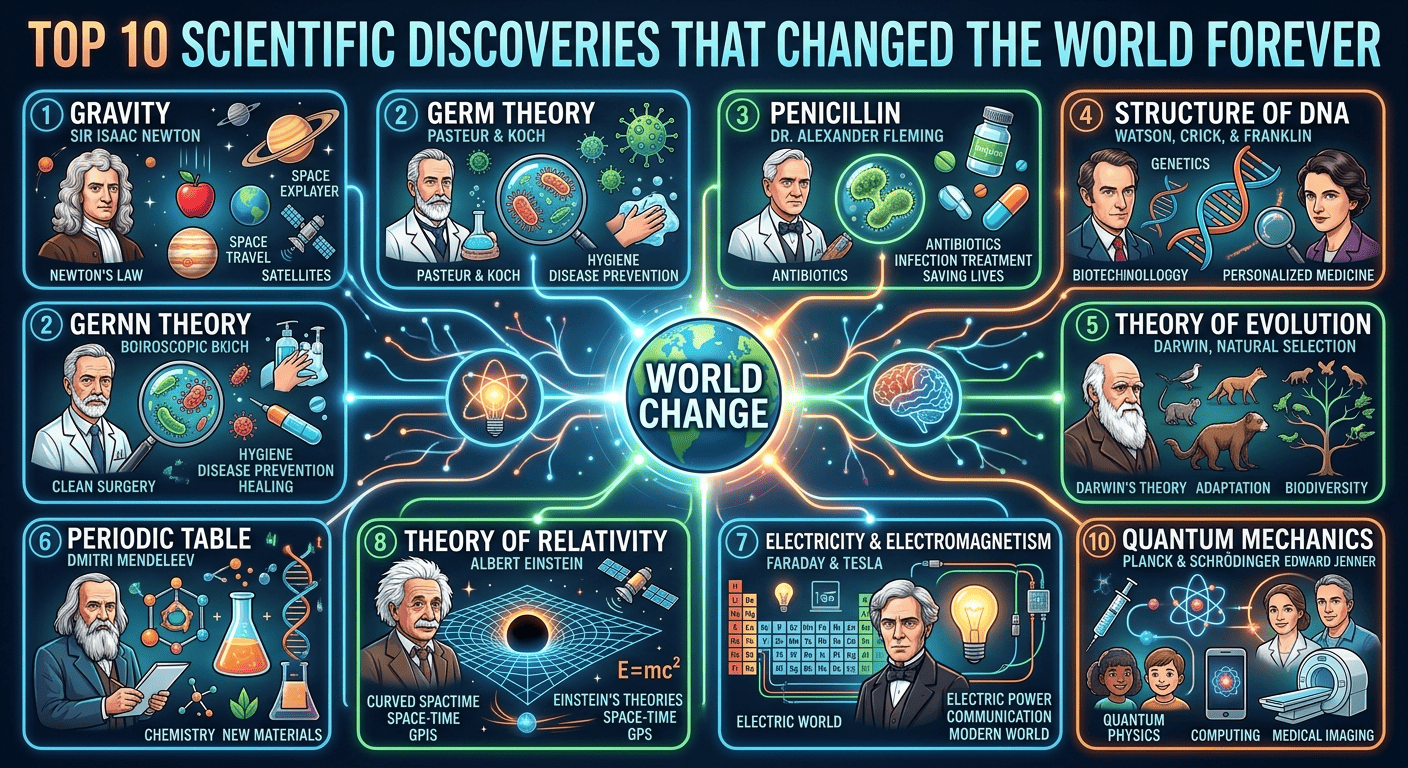
 Top 10 Scientific Discoveries That Changed the World Forever
Introduction
Human civilization has progressed through curiosity, observation, and experimentation. Every major leap in technology and medicine has been built upon scientific discoveries that expanded our understanding of nature. These discoveries have saved millions of lives, powered industries, enabled space exploration, and connected the world in ways unimaginable just a few centuries ago.
Some discoveries solved mysteries that puzzled humanity for generations, while others completely transformed how we think about life, the Earth, and the universe. Although science continues to advance every year, certain discoveries stand out because of their extraordinary impact on history.
Here are ten scientific discoveries that changed the world forever.
1. The Law of Gravity
One of the most influential scientific discoveries was the understanding of gravity.
In the 17th century, Sir Isaac Newton explained that every object with mass attracts every other object. According to the famous story, Newton began thinking deeply about gravity after observing an apple fall from a tree.
His Law of Universal Gravitation explained why planets orbit the Sun, why objects fall to Earth, and how celestial bodies move through space.
Gravity remains one of the foundations of modern physics and engineering.
Impact
- Space exploration
- Satellite technology
- Engineering
- Astronomy
- Modern physics
2. Germ Theory of Disease
For centuries, people believed diseases were caused by bad air or supernatural forces.
In the 19th century, scientists such as Louis Pasteur and Robert Koch proved that microscopic organisms called bacteria and viruses cause many diseases.
This discovery revolutionized medicine.
Doctors began sterilizing surgical equipment, washing hands before operations, and improving sanitation.
Millions of lives have been saved because of Germ Theory.
Impact
- Modern hospitals
- Hygiene practices
- Safe surgery
- Disease prevention
- Public health
3. The Discovery of Penicillin
In 1928, Alexander Fleming accidentally discovered penicillin when he noticed mold preventing bacterial growth in his laboratory.
This became the world's first widely used antibiotic.
Before antibiotics, simple infections could easily become fatal.
Penicillin has since saved hundreds of millions of lives and opened the door to modern antibiotic medicine.
Impact
- Infection treatment
- Modern antibiotics
- Longer life expectancy
- Medical breakthroughs
4. The Structure of DNA
DNA carries the genetic instructions for every living organism.
In 1953, James Watson and Francis Crick described the famous double-helix structure of DNA using research contributed by Rosalind Franklin.
Understanding DNA completely transformed biology.
Scientists can now identify inherited diseases, develop genetic therapies, solve criminal investigations using DNA evidence, and study human evolution.
Impact
- Genetics
- Personalized medicine
- Forensic science
- Biotechnology
- Disease research
5. The Theory of Evolution
Charles Darwin introduced the Theory of Evolution by Natural Selection in 1859.
His work explained how species gradually change over generations as organisms adapt to their environments.
Evolution remains one of the central ideas in modern biology.
It helps scientists understand biodiversity, animal behavior, genetics, and extinct species.
Impact
- Biology
- Ecology
- Paleontology
- Genetics
- Conservation science
6. The Periodic Table of Elements
In 1869, Dmitri Mendeleev organized known chemical elements into the Periodic Table.
Remarkably, he even predicted elements that had not yet been discovered.
Today, the Periodic Table is one of the most important tools in chemistry.
It helps scientists understand chemical reactions, develop new materials, and manufacture medicines.
Impact
- Chemistry
- Material science
- Pharmaceuticals
- Industrial manufacturing
- Scientific education
7. Electricity and Electromagnetism
Scientists including Michael Faraday, James Clerk Maxwell, and Nikola Tesla transformed our understanding of electricity.
Their discoveries eventually made electric power generation possible.
Modern civilization depends on electricity.
Homes, hospitals, computers, transportation, communication systems, and factories all rely on electrical technology.
Without these discoveries, today's digital world would not exist.
Impact
- Electric power
- Internet infrastructure
- Telecommunications
- Household appliances
- Transportation
8. The Theory of Relativity
Albert Einstein introduced the Special Theory of Relativity in 1905 and the General Theory of Relativity in 1915.
These theories completely changed how scientists understand space, time, gravity, and the universe.
Einstein showed that gravity bends space-time rather than acting as an invisible force alone.
His theories are essential for technologies like GPS satellites.
Impact
- Space science
- GPS technology
- Cosmology
- Black hole research
- Modern physics
9. Vaccination
Vaccination is one of humanity's greatest medical achievements.
Edward Jenner developed the first successful vaccine against smallpox in 1796.
Since then, vaccines have prevented deadly diseases including polio, measles, tetanus, and hepatitis.
According to global health organizations, vaccines save millions of lives every year.
Vaccination remains one of the most effective methods of disease prevention.
Impact
- Disease prevention
- Public health
- Longer life expectancy
- Global healthcare
10. Quantum Mechanics
Quantum mechanics studies the behavior of matter and energy at the smallest scales.
Scientists such as Max Planck, Niels Bohr, Werner Heisenberg, and Erwin Schrödinger helped develop this revolutionary field.
Although quantum physics seems strange, it powers many modern technologies.
Computers, lasers, MRI scanners, semiconductors, and smartphones all rely on quantum principles.
Researchers are now developing quantum computers that may solve problems impossible for today's computers.
Impact
- Computing
- Electronics
- Medical imaging
- Artificial Intelligence
- Future technology
How Scientific Discoveries Continue to Shape Our Future
Scientific progress never stops. Every breakthrough builds upon previous discoveries, creating new opportunities for innovation. Artificial Intelligence, renewable energy, gene editing, nanotechnology, robotics, and space exploration are all advancing because of the scientific foundations established by earlier generations.
Today, scientists collaborate across countries using advanced laboratories, satellites, supercomputers, and international research networks. Their work addresses some of the world's biggest challenges, including climate change, food security, disease outbreaks, clean energy, and sustainable development.
The next groundbreaking discovery may transform life just as dramatically as the discoveries listed above.
The Importance of Scientific Research
Scientific research improves everyday life in countless ways. It leads to safer medicines, cleaner energy, faster communication, better transportation, and more efficient agriculture. It also helps governments make informed decisions based on evidence rather than assumptions.
Encouraging scientific education and investing in research ensures future generations can continue solving global problems. Curiosity, experimentation, and innovation remain the driving forces behind human progress.

You must be logged in to post a comment.