
 Script
[Opening Hook]
Have you ever stopped for a moment, looked up at the sky, and asked yourself, "Why is the sky blue?" It's one of the most common questions people ask, yet the answer is surprisingly fascinating. You might think the sky reflects the color of the ocean, or maybe space itself is blue. But the real reason is far more interesting—and it all comes down to the science of light.
Welcome back to the channel! Today, we're diving into one of nature's most beautiful mysteries. By the end of this video, you'll not only know why the sky is blue but also why sunsets are red, why clouds are white, and even why the sky on other planets looks completely different.
So, let's get started!
What Is Sunlight?
Before we can understand why the sky is blue, we first need to understand sunlight.
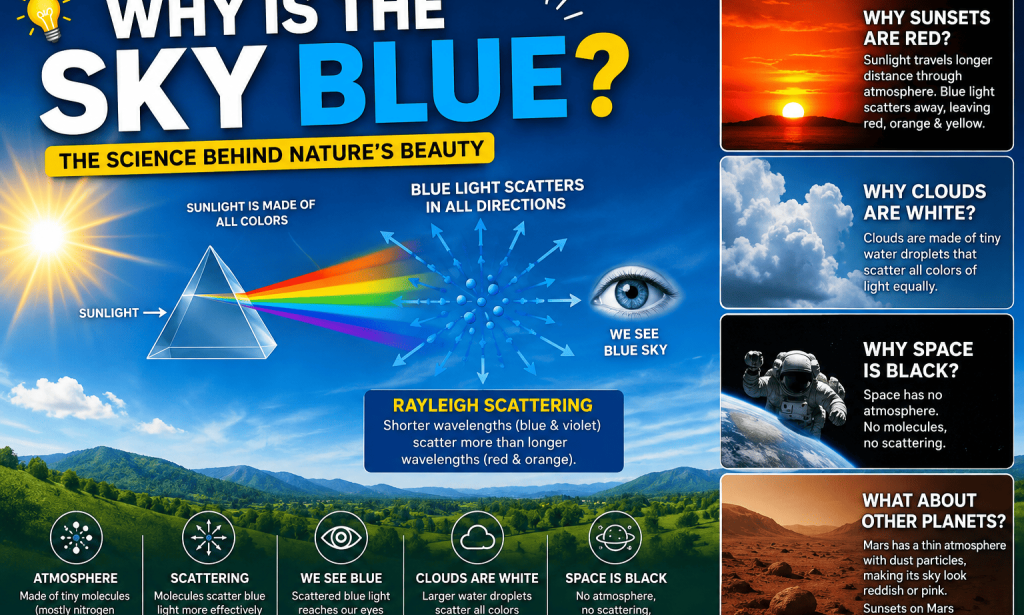
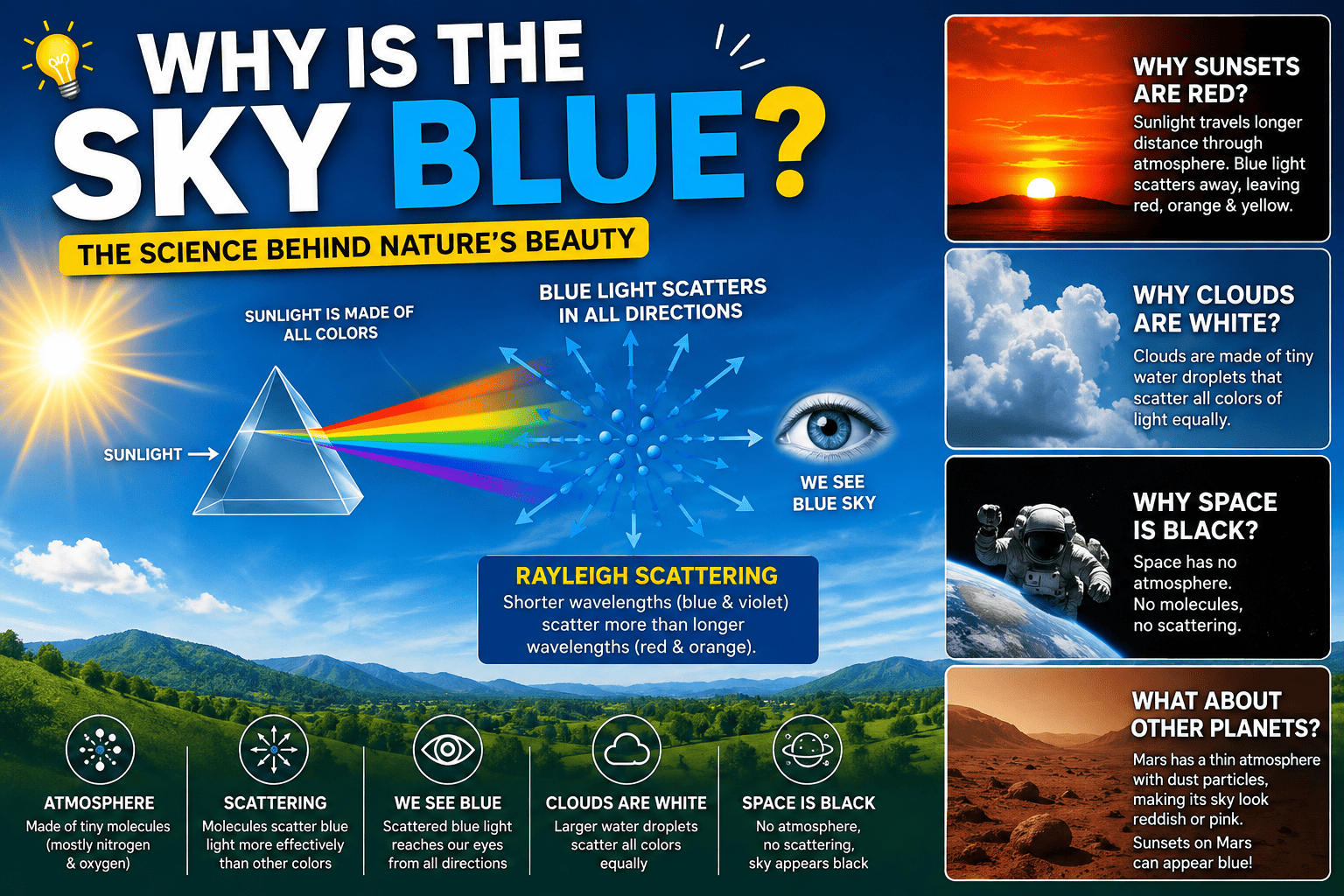
At first glance, sunlight looks white. But in reality, white light is made up of all the colors of the rainbow. If you've ever seen a rainbow after it rains or watched light pass through a glass prism, you've seen sunlight separate into different colors.
These colors include:
- Red
- Orange
- Yellow
- Green
- Blue
- Indigo
- Violet
Each color has a different wavelength. Red light has the longest wavelength, while blue and violet have much shorter wavelengths.
This difference is the key to solving our mystery.
Earth's Atmosphere
Now let's think about what happens when sunlight reaches Earth.
Our planet is surrounded by an atmosphere made mostly of nitrogen and oxygen. Although these gases are invisible, they are made of billions upon billions of tiny molecules.
When sunlight enters the atmosphere, it doesn't simply travel straight to the ground. Instead, it collides with these tiny air molecules.
This is where the magic begins.
Rayleigh Scattering
The scientific explanation is called Rayleigh Scattering, named after British physicist Lord Rayleigh.
Rayleigh scattering happens because tiny molecules in the atmosphere scatter shorter wavelengths of light much more effectively than longer wavelengths.
Since blue and violet light have shorter wavelengths, they scatter in every direction far more than red or yellow light.
Wherever you look during the daytime, scattered blue light is reaching your eyes from every direction.
That is why the sky appears blue.
Why Isn't the Sky Violet?
Here's something surprising.
Violet light actually scatters even more than blue light.
So why don't we see a violet sky?
There are two main reasons.
First, the Sun emits slightly less violet light than blue light.
Second, and more importantly, human eyes are much more sensitive to blue light than violet light.
Our eyes contain special cells called cones that help us detect color. These cells respond much better to blue than violet.
In addition, some violet light is absorbed by the ozone layer high in Earth's atmosphere.
As a result, the scattered light reaching our eyes appears mostly blue.
Why Are Sunsets Red and Orange?
Now let's answer another amazing question.
Why do sunsets look so colorful?
During midday, sunlight travels through a relatively short distance of Earth's atmosphere before reaching your eyes.
But during sunrise and sunset, the Sun is much lower on the horizon.
This means sunlight has to travel through a much thicker layer of atmosphere.
Along this longer path, nearly all the blue light gets scattered away before reaching your eyes.
The only colors left traveling directly toward you are the longer wavelengths—red, orange, and yellow.
That's why sunsets can produce breathtaking shades of orange, red, pink, and even purple.
Every sunset is slightly different because dust, smoke, pollution, clouds, and moisture all affect how light scatters.
Why Do Clouds Look White?
If the atmosphere scatters blue light, why aren't clouds blue too?
Clouds are made of tiny water droplets and ice crystals.
These particles are much larger than air molecules.
Instead of scattering mostly blue light, they scatter nearly all colors equally.
When all the colors mix together, our eyes perceive them as white.
On cloudy days, sunlight is scattered in many directions, making the sky appear lighter or gray.
What About Space?
If you've seen photos taken by astronauts, you've probably noticed that space looks completely black.
Why?
Because space has almost no atmosphere.
Without air molecules, there is nothing to scatter sunlight.
Light travels directly without spreading across the sky.
That is why astronauts see a black sky even while the Sun shines brightly.
What Does the Sky Look Like on Other Planets?
Earth isn't the only planet with a sky.
On Mars, for example, the atmosphere is much thinner and filled with tiny dust particles.
Because of these particles, the Martian sky usually appears dusty pink or reddish during the day.
Interestingly, sunsets on Mars can appear bluish around the Sun—the opposite of what we experience on Earth.
This happens because Martian dust scatters light differently from Earth's atmosphere.
Scientists use these differences to learn more about planetary atmospheres across our solar system.
Why This Discovery Matters
You might wonder why understanding the color of the sky is important.
The answer is simple.
The same scientific principles help scientists study Earth's climate, monitor air pollution, design better telescopes, improve satellite technology, and even explore distant planets.
A simple question like "Why is the sky blue?" opens the door to understanding physics, astronomy, atmospheric science, and the nature of light itself.
Science often begins with curiosity.
Every great discovery starts with someone asking a simple question.
Fun Facts
Here are a few interesting facts you can share with your friends:
- The sky can appear darker blue at higher altitudes because the air is thinner.
- After heavy rain, the sky often looks brighter because rain removes dust and pollution from the atmosphere.
- On the Moon, the sky appears black even during daytime because there is almost no atmosphere.
- Pilots flying at high altitudes often notice the sky becoming a deeper shade of blue.
- Earth's atmosphere acts like a giant natural filter for sunlight.
Final Thoughts
The next time you walk outside on a bright sunny day, take a moment to look up.
That beautiful blue sky isn't just a pretty view.
It's a perfect demonstration of physics happening above your head every second.
Sunlight, tiny molecules, and the incredible process of Rayleigh scattering work together to paint the sky blue.
What seems ordinary is actually one of nature's greatest scientific masterpieces.
Science reminds us that even the simplest questions can reveal extraordinary answers.

You must be logged in to post a comment.