

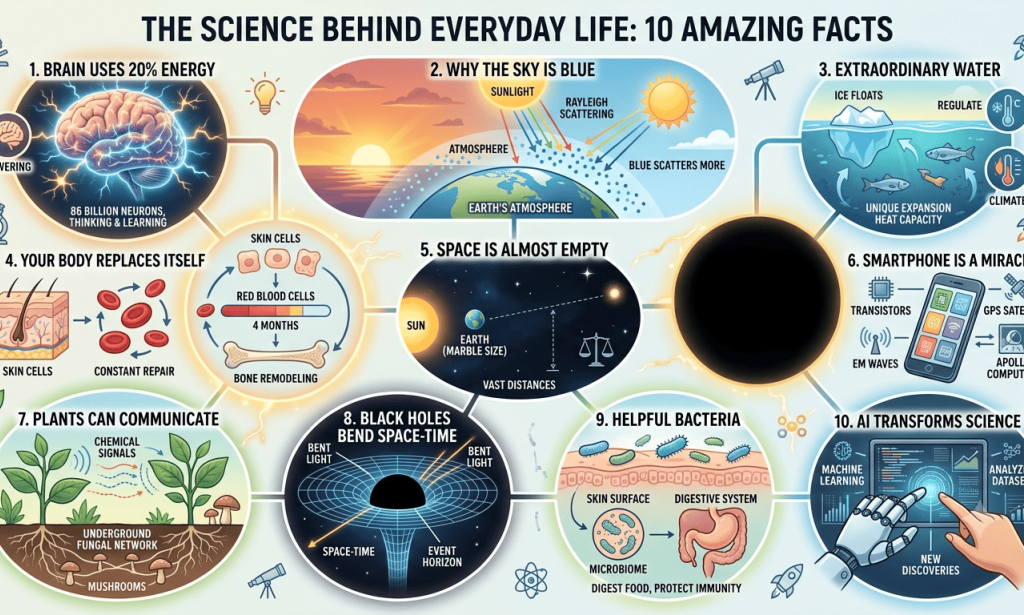

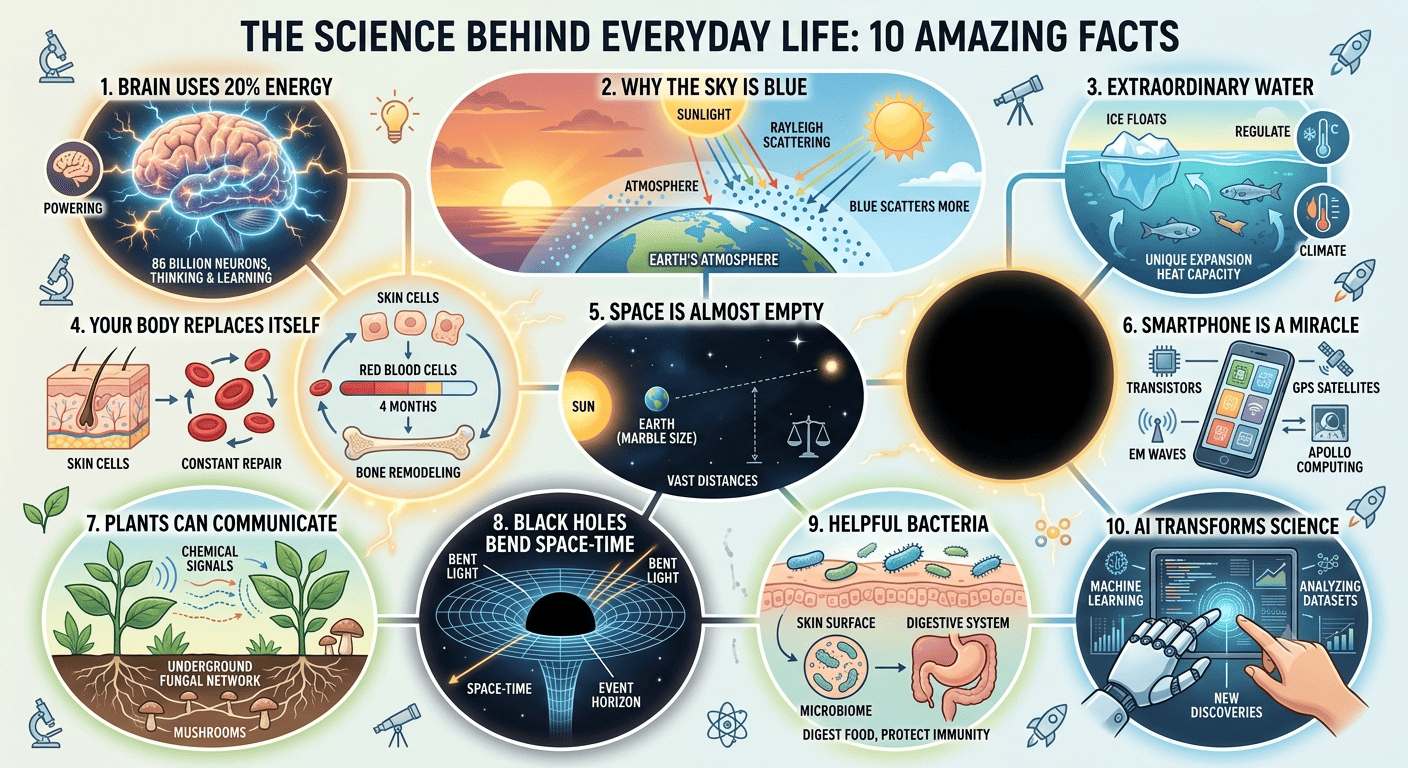
The Science Behind Everyday Life: 10 Amazing Facts That Will Change How You See the World
Science isn't limited to laboratories, space agencies, or university classrooms. It's happening every second around you. Every breath you take, every step you walk, every meal you eat, and every message you send through your phone depends on scientific principles. Understanding science helps us appreciate the incredible complexity and beauty of the world.
In this article, we'll explore ten fascinating scientific facts that are easy to understand yet incredibly powerful. These topics are perfect for educational blogs, YouTube science channels, and anyone interested in learning something new.
1. Your Brain Uses More Energy Than You Think
The human brain makes up only about 2% of your body weight, yet it consumes nearly 20% of the body's total energy. Even while you're sleeping, billions of neurons continue communicating with one another.
Your brain contains around 86 billion neurons, each connected to thousands of other neurons. These connections create an incredibly complex network responsible for thinking, learning, emotions, and memories.
Scientists continue studying the brain because many mysteries remain unsolved. Understanding how the brain works could lead to better treatments for diseases like Alzheimer's, Parkinson's, and depression.
2. Why Is the Sky Blue?
One of the most common questions in science has a beautiful answer.
Sunlight contains all the colors of the rainbow. When sunlight enters Earth's atmosphere, tiny air molecules scatter blue light much more effectively than red light. This process is known as Rayleigh Scattering.
During sunrise and sunset, sunlight travels through more of the atmosphere. Most of the blue light gets scattered away, allowing red, orange, and yellow colors to dominate the sky.
This simple scientific principle creates some of the world's most beautiful natural scenes.
3. Water Is More Extraordinary Than It Looks
Water covers about 71% of Earth's surface, but its unique properties make life possible.
Unlike most substances, water expands when it freezes. Ice becomes less dense than liquid water, allowing it to float. If ice sank, lakes and oceans would freeze from the bottom upward, making aquatic life almost impossible.
Water also has an unusually high heat capacity, meaning it can absorb a large amount of heat before changing temperature. This helps regulate Earth's climate and keeps living organisms stable.
4. Your Body Is Constantly Replacing Itself
Many people believe their bodies remain the same throughout life, but that's far from true.
Your skin replaces itself every few weeks. Your red blood cells last around four months before being replaced. Even many of your bones undergo continuous remodeling throughout your life.
Although not every cell is replaced, your body is constantly repairing and renewing itself, making you biologically different from the person you were years ago.
5. Space Is Almost Completely Empty
Movies often show spacecraft flying through crowded asteroid fields, but reality is very different.
Space is unimaginably vast. Even within our solar system, the distances between planets are enormous.
If Earth were the size of a marble, the nearest star beyond our Sun would still be thousands of kilometers away on the same scale.
This incredible emptiness highlights just how unique and precious our planet truly is.
6. Your Smartphone Is a Scientific Miracle
Modern smartphones combine multiple scientific disciplines into one small device.
Inside every phone are billions of microscopic transistors that process information at incredible speeds.
GPS relies on satellites orbiting Earth. Cameras use advanced optics and image sensors. Wireless communication depends on electromagnetic waves traveling at the speed of light.
A device that fits in your pocket contains more computing power than the computers used during the Apollo Moon missions.
7. Plants Can Communicate
Although plants don't speak like humans, they communicate in fascinating ways.
When insects attack certain plants, they release chemical signals into the air. Nearby plants detect these chemicals and begin producing defensive compounds before they're attacked.
Some plants even communicate through underground fungal networks often called the "Wood Wide Web."
Scientists continue discovering new ways plants interact with one another and their environment.
8. Black Holes Bend Space and Time
Black holes are among the most mysterious objects in the universe.
They form when extremely massive stars collapse under their own gravity.
Their gravitational pull is so powerful that even light cannot escape once it crosses the event horizon.
According to Einstein's theory of relativity, black holes don't simply pull objects inward—they actually bend space and time themselves.
Astronomers continue studying black holes to better understand gravity and the origins of the universe.
9. Bacteria Are Everywhere—and Most Are Helpful
Many people associate bacteria with illness, but the majority are beneficial.
Your body contains trillions of bacteria living on your skin, inside your mouth, and throughout your digestive system.
These microorganisms help digest food, produce vitamins, strengthen the immune system, and protect against harmful microbes.
Scientists now recognize the human microbiome as one of the most important factors influencing health.
10. Artificial Intelligence Is Transforming Science
Artificial Intelligence (AI) is changing the way scientists conduct research.
AI can analyze enormous datasets much faster than humans, helping researchers discover new medicines, predict weather patterns, detect diseases, and even explore distant galaxies.
Machine learning algorithms assist in identifying cancer cells, designing new materials, improving renewable energy systems, and understanding climate change.
As AI technology continues advancing, it will likely become one of the most important scientific tools of the 21st century.
Why Science Matters
Science is more than a collection of facts—it is a way of thinking. It encourages curiosity, critical thinking, experimentation, and evidence-based decision-making.
Scientific discoveries have improved medicine, transportation, communication, agriculture, and nearly every aspect of modern life. From vaccines that save millions of lives to satellites that help predict natural disasters, science continues to shape a better future.
Learning science also helps us distinguish facts from misinformation, making us better informed citizens in an increasingly technological world.
The Future of Science
The next few decades promise exciting breakthroughs. Scientists are working on quantum computers capable of solving impossible calculations, fusion energy that could provide nearly limitless clean power, advanced robotics for healthcare and exploration, and missions to Mars and beyond.
Genetic engineering may eliminate inherited diseases, while renewable energy technologies could help combat climate change.
The future belongs to those who remain curious and willing to learn

You must be logged in to post a comment.